
Security doors: grades, costs, and why installation matters
Security doors in Spain range from €1,600 to €6,000. Experts note that the cylinder and installation quality outweigh the door leaf itself.
English · Original discussion in Spanish · Published
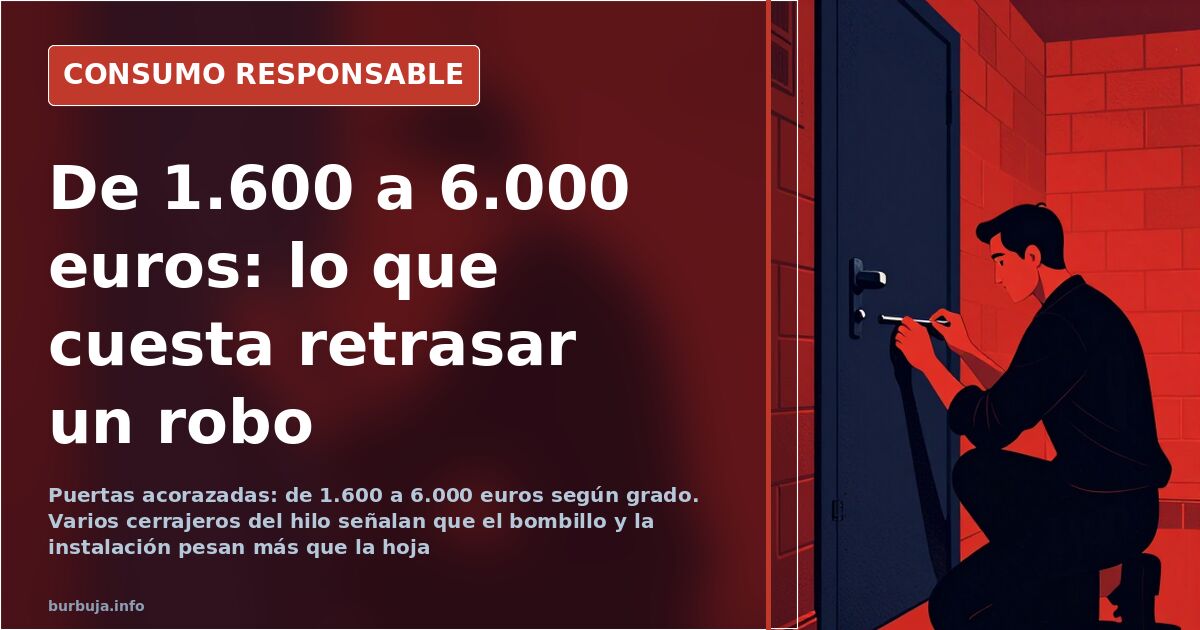
Security doors: €1,600 to €6,000 and an uncomfortable question
If there is one assumption in the discussion, it is that every security door eventually yields. What you are buying is not a wall, but time. Minutes of noise, debris, and neighbors peeking into the hallway. And this time has a price tag, according to participant data: from €1,600 for an installed Grade 4C model to €6,000 for a Grade 5 Fichet, with €3,000 for Grade 3 and €4,000 for Grade 4 in between. The initial question was about brand and grade, but the answer points elsewhere.
The door is one component. The lock is another. And the cylinder with its protective shield is a third. Confusing these is what allows a €2,000 door to fall in seconds because the key wasn't turned.
How much does a security door cost by grade?
The price range is reasonably defined. Below €2,000, including installation, you can find Grade 4 security doors; some optimistic estimates place an installed 4C at €1,600. Above that, each grade adds roughly €1,000, and the jump to Grade 5 is described as material "for very high security," closer to a bank vault than a city apartment.
However, one of the most repeated recommendations is that you don't need to go to the top end. Grade 3 or 4 is sufficient, provided the rest of the system supports it.
Bolts, pivots, and why the cylinder matters more than the leaf
The most frequently mentioned technical detail concerned anchoring. Hooks, the arms that grip the frame, are considered superior to pivots because they do not disengage: either you turn the key or they hold the frame. The second pillar is the lock and its anti-pick blocking mechanism: some models lock under forceful attack and only open if the door is cut through. This antiestéticature is not available across the entire range, only in the most expensive models.
Here lies the data point that disrupts many purchasing logics. With a good cylinder—anti-drill, anti-bumping, anti-extraction—and a high-security shield, according to a locksmith participating in the thread, opening the door requires more than 20-25 minutes and generates significant noise. Without them, even the thickest market leaf fails on the first attempt.
Two doors and an alarm: the castle and guards theory
One of the most debated theses involved two doors in series with an alarm in the intermediate space. The argument is textbook: a castle without guards is useless, but guards without a castle are far less effective. An electronic guard and a physical castle.
Criticism arrived strongly: multiplying mediocre doors multiplies time, not security, and advising two cheap ones makes no sense. The final nuance was reasonable: two are always better than one, but they don't necessarily have to be bad.
Installation decides: the link nobody wants to pay for
The point where almost everyone agreed was the least segarro. Before locks or alarms, what matters is that the door is well anchored to a solid wall. Some argue that two basic locks with different keys outperform one luxury unit. According to several participants, the map of installers is bleak: outside Madrid, Barcelona, or Valencia, they are scarce, and those who tried to install a security door for months only found shoddy work that collapsed at the first technical question.
Is it better to have the safest door or look like the hardest target in the building?
Another perspective looks at the problem in reverse: the goal is not to be an easy target. Random burglaries seek the simplest option and what seems most likely to succeed. Spending a fortune on a visible door might, according to this view, attract exactly the thief who smells blood.
In apartments, moreover, a concern distinct from theft emerges: okupación (illegal squatting). And a cheap reinforcement that stops a novice: €300 for an all-round resistant cylinder plus its shield.
With these elements, the rational decision would seem simple: invest in installation and locking. Yet the material leaves doubt open. A too-visible door may attract those who can afford the risk. What deters and what provokes remains unresolved.
If there is one assumption in the discussion, it is that every security door eventually yields. What you are buying is not a wall, but time. Minutes of noise, debris, and neighbors peeking into the hallway. And this time has a price tag, according to participant data: from €1,600 for an installed Grade 4C model to €6,000 for a Grade 5 Fichet, with €3,000 for Grade 3 and €4,000 for Grade 4 in between. The initial question was about brand and grade, but the answer points elsewhere.
The door is one component. The lock is another. And the cylinder with its protective shield is a third. Confusing these is what allows a €2,000 door to fall in seconds because the key wasn't turned.
How much does a security door cost by grade?
The price range is reasonably defined. Below €2,000, including installation, you can find Grade 4 security doors; some optimistic estimates place an installed 4C at €1,600. Above that, each grade adds roughly €1,000, and the jump to Grade 5 is described as material "for very high security," closer to a bank vault than a city apartment.
However, one of the most repeated recommendations is that you don't need to go to the top end. Grade 3 or 4 is sufficient, provided the rest of the system supports it.
Bolts, pivots, and why the cylinder matters more than the leaf
The most frequently mentioned technical detail concerned anchoring. Hooks, the arms that grip the frame, are considered superior to pivots because they do not disengage: either you turn the key or they hold the frame. The second pillar is the lock and its anti-pick blocking mechanism: some models lock under forceful attack and only open if the door is cut through. This antiestéticature is not available across the entire range, only in the most expensive models.
Here lies the data point that disrupts many purchasing logics. With a good cylinder—anti-drill, anti-bumping, anti-extraction—and a high-security shield, according to a locksmith participating in the thread, opening the door requires more than 20-25 minutes and generates significant noise. Without them, even the thickest market leaf fails on the first attempt.
Two doors and an alarm: the castle and guards theory
One of the most debated theses involved two doors in series with an alarm in the intermediate space. The argument is textbook: a castle without guards is useless, but guards without a castle are far less effective. An electronic guard and a physical castle.
Criticism arrived strongly: multiplying mediocre doors multiplies time, not security, and advising two cheap ones makes no sense. The final nuance was reasonable: two are always better than one, but they don't necessarily have to be bad.
Installation decides: the link nobody wants to pay for
The point where almost everyone agreed was the least segarro. Before locks or alarms, what matters is that the door is well anchored to a solid wall. Some argue that two basic locks with different keys outperform one luxury unit. According to several participants, the map of installers is bleak: outside Madrid, Barcelona, or Valencia, they are scarce, and those who tried to install a security door for months only found shoddy work that collapsed at the first technical question.
Is it better to have the safest door or look like the hardest target in the building?
Another perspective looks at the problem in reverse: the goal is not to be an easy target. Random burglaries seek the simplest option and what seems most likely to succeed. Spending a fortune on a visible door might, according to this view, attract exactly the thief who smells blood.
In apartments, moreover, a concern distinct from theft emerges: okupación (illegal squatting). And a cheap reinforcement that stops a novice: €300 for an all-round resistant cylinder plus its shield.
With these elements, the rational decision would seem simple: invest in installation and locking. Yet the material leaves doubt open. A too-visible door may attract those who can afford the risk. What deters and what provokes remains unresolved.
Also available in: Deutsch
Summary of a discussion on Burbuja.info - Foro de economía, actualidad y política., translated from Spanish and reviewed before publication. Read the full discussion (116 replies).
More summaries
-
Spain's Castilian capitals rated: Segovia 10, Palencia 3
Segovia earns a perfect score while Palencia receives a failing grade in a subjective ranking of Spain's Castilian provincial capitals.
-
Albo and frozen Louriño, the most recommended callos on the forum
Several forum members criticise Litoral and recommend Albo, La Nora and, above all, the frozen Louriño
-
Spain's Recycling: Unpaid Labor and Rising Waste Fees
Zaragoza sold recycled paper for €700,000 more than expected in 2011 while waste fees rose 5%. Household sorting equals 19,000 unpaid jobs.
-
Six chickens dead in Canary Islands; neighbor's dog suspected
Five hens and a rooster found dead, some disemboweled, in a fenced Canary Islands farm. Suspicions fall on the neighbor's dog.
-
Aphantasia: When the Mind Cannot See Images
Aphantasia, the inability to generate mental images, affects those who describe objects without seeing them. Many discover it accidentally as adults.
-
Fiber modem consumes 30W even when idle
A fiber modem uses 30W and a 16-port switch 15W. Turning them off at night saves 195 kWh yearly, according to calculations.