
Roquefort sparks debate among cheese enthusiasts
A forum user discovers Roquefort with wine, igniting a debate comparing it to Cabrales and Gorgonzola while others warn about its high salt content.
English · Original discussion in Spanish · Published
Roquefort sparks debate among cheese enthusiasts
Roquefort cheese, a French classic made from sheep's milk with blue veins, has become the center of heated exchanges mixing enthusiasm for its flavor with warnings about its high salt and fat content. The discussion begins with a late discovery—"I had never tried it, I was hesitant, having it with wine is amazing"—and quickly shifts to comparisons with other national and international blue cheeses and health concerns.
Roquefort is a raw sheep's milk cheese with salt levels reaching 3.2 grams per 100 grams, according to the conversation. This sodium level requires moderation, especially for people with blood pressure issues or fluid retention. Despite this, defenders highlight its intense, creamy flavor, ranking it above Italian gorgonzola or Asturian cabrales, though not everyone agrees on this hierarchy.
The map of blue cheeses: France, Italy, and Spain
Comparing blue cheeses dominates much of the exchange. Cabrales, produced in Asturias with cow, sheep, or goat milk, is presented as a direct competitor to Roquefort, with a less creamy and more crumbly profile. Some argue that Cabrales "crushes Roquefort completely," a bold statement reflecting passion for local products. Similarly, Italian gorgonzola is described as creamier than the French variety, available in sweet and spicy versions.
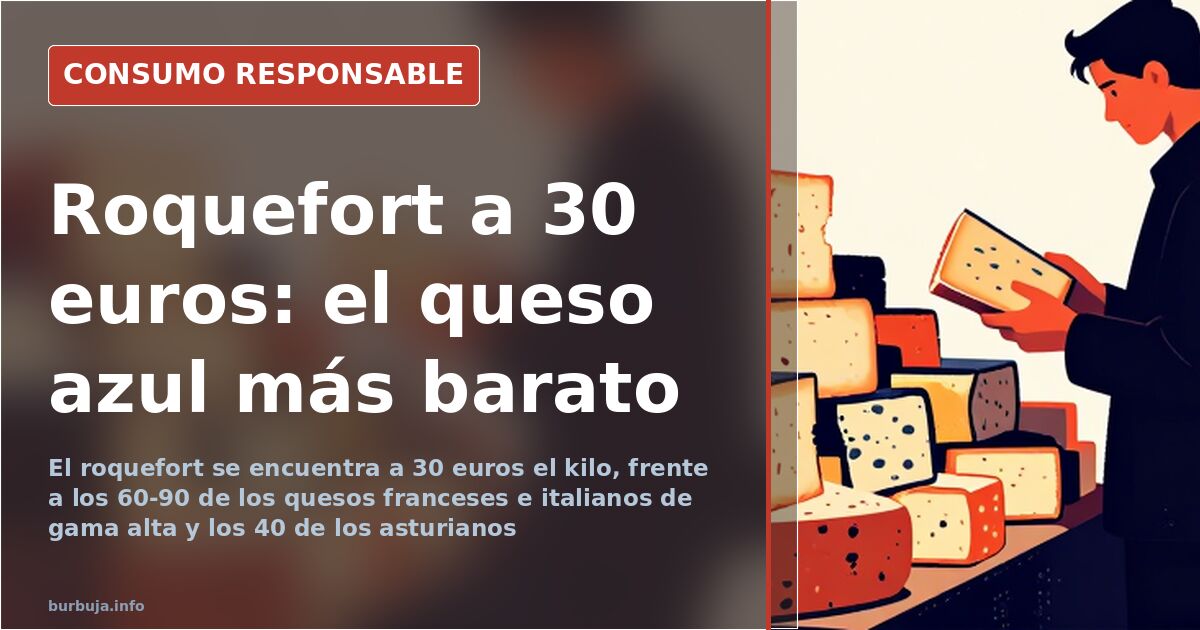
Price also plays a role. While quality French and Italian cheeses can exceed €60-90 per kilo, Asturian ones are around €40, and Canary Islands varieties under €30. This cost difference, combined with quality, leads some to question why so many foreign cheeses are imported when domestic production offers affordable alternatives.
The debate on raw milk and health effects
One controversial point is the use of unpasteurized raw milk. Some claim only cheeses made with raw milk and authentic mycelium have beneficial properties, calling pasteurized ones "poison". This assertion, made without evidence, contrasts with those noting pasteurization eliminates pathogens and is mandatory in many countries for food safety. The discussion veers into conspiracy theories about future bans by satanic elites, an unfounded rumor repeated by some participants.
Regarding health, one participant admits calcium at 11 and cholesterol over 210, stating they were forbidden from eating soft cheese. This personal experience reminds us that aged and blue cheese consumption should be moderated in people with cardiovascular risk factors. The conversation mentions Nutriscore, which rates these products E (lowest), though there is debate whether this reflects their overall nutritional value.
The Spanish pantry: varieties and prices
Beyond Roquefort, the exchange reviews Spain's rich cheese heritage. Asturias has 42 cheese varieties, four with Protected Designation of Origin (Cabrales, Gamonéu, Afuega'l Pitu, Casín) and one with Protected Geographical Indication (Los Beyos). Picón de Bejes-Tresviso from Cantabria, Oro de Prases, Savel de Airas Moniz, and Andazul are mentioned as examples of current diversity. The implicit conclusion is that Spanish enthusiasts have a huge range without needing imports.
Price reappears as a decisive factor. A store-brand Roquefort at Mercadona is produced in the Roquefort-sur-Soulzon region, complying with PDO standards, and sold at competitive prices. This fact, along with artisanal cheeses at moderate prices, supports the idea that blue cheese consumption need not be a luxury.
Roquefort on the table: pairings and anecdotes
Pairings take center stage. Combining Roquefort with sweet white Sauternes wine is described as "extraordinary", and robust red wines are also mentioned. The conversation includes anecdotes about cheeses found with worms or ants, reminding us that artisanal cheeses may present such incidents, especially when bought at markets. One participant recalls buying Cabrales in a village in 1980, only to find ants inside upon cutting it, forcing them to discard it.
The general tone is enthusiastic about cheese exploration, with cross-recommendations and warnings against excess. The idea that Roquefort is a gateway to a broader world of blue cheeses runs throughout the conversation, with some encouraging trials of cured Manchego or Asturian Gamonéu to broaden horizons.
With these elements, Roquefort will remain a topic of debate among enthusiasts. Next time someone tries it with wine, they might remember they are enjoying not just an intense flavor, but a tradition involving producers, nutritionists, and consumers. And like all pleasures, it should be consumed in moderation.
Roquefort cheese, a French classic made from sheep's milk with blue veins, has become the center of heated exchanges mixing enthusiasm for its flavor with warnings about its high salt and fat content. The discussion begins with a late discovery—"I had never tried it, I was hesitant, having it with wine is amazing"—and quickly shifts to comparisons with other national and international blue cheeses and health concerns.
Roquefort is a raw sheep's milk cheese with salt levels reaching 3.2 grams per 100 grams, according to the conversation. This sodium level requires moderation, especially for people with blood pressure issues or fluid retention. Despite this, defenders highlight its intense, creamy flavor, ranking it above Italian gorgonzola or Asturian cabrales, though not everyone agrees on this hierarchy.
The map of blue cheeses: France, Italy, and Spain
Comparing blue cheeses dominates much of the exchange. Cabrales, produced in Asturias with cow, sheep, or goat milk, is presented as a direct competitor to Roquefort, with a less creamy and more crumbly profile. Some argue that Cabrales "crushes Roquefort completely," a bold statement reflecting passion for local products. Similarly, Italian gorgonzola is described as creamier than the French variety, available in sweet and spicy versions.
Price also plays a role. While quality French and Italian cheeses can exceed €60-90 per kilo, Asturian ones are around €40, and Canary Islands varieties under €30. This cost difference, combined with quality, leads some to question why so many foreign cheeses are imported when domestic production offers affordable alternatives.
The debate on raw milk and health effects
One controversial point is the use of unpasteurized raw milk. Some claim only cheeses made with raw milk and authentic mycelium have beneficial properties, calling pasteurized ones "poison". This assertion, made without evidence, contrasts with those noting pasteurization eliminates pathogens and is mandatory in many countries for food safety. The discussion veers into conspiracy theories about future bans by satanic elites, an unfounded rumor repeated by some participants.
Regarding health, one participant admits calcium at 11 and cholesterol over 210, stating they were forbidden from eating soft cheese. This personal experience reminds us that aged and blue cheese consumption should be moderated in people with cardiovascular risk factors. The conversation mentions Nutriscore, which rates these products E (lowest), though there is debate whether this reflects their overall nutritional value.
The Spanish pantry: varieties and prices
Beyond Roquefort, the exchange reviews Spain's rich cheese heritage. Asturias has 42 cheese varieties, four with Protected Designation of Origin (Cabrales, Gamonéu, Afuega'l Pitu, Casín) and one with Protected Geographical Indication (Los Beyos). Picón de Bejes-Tresviso from Cantabria, Oro de Prases, Savel de Airas Moniz, and Andazul are mentioned as examples of current diversity. The implicit conclusion is that Spanish enthusiasts have a huge range without needing imports.
Price reappears as a decisive factor. A store-brand Roquefort at Mercadona is produced in the Roquefort-sur-Soulzon region, complying with PDO standards, and sold at competitive prices. This fact, along with artisanal cheeses at moderate prices, supports the idea that blue cheese consumption need not be a luxury.
Roquefort on the table: pairings and anecdotes
Pairings take center stage. Combining Roquefort with sweet white Sauternes wine is described as "extraordinary", and robust red wines are also mentioned. The conversation includes anecdotes about cheeses found with worms or ants, reminding us that artisanal cheeses may present such incidents, especially when bought at markets. One participant recalls buying Cabrales in a village in 1980, only to find ants inside upon cutting it, forcing them to discard it.
The general tone is enthusiastic about cheese exploration, with cross-recommendations and warnings against excess. The idea that Roquefort is a gateway to a broader world of blue cheeses runs throughout the conversation, with some encouraging trials of cured Manchego or Asturian Gamonéu to broaden horizons.
With these elements, Roquefort will remain a topic of debate among enthusiasts. Next time someone tries it with wine, they might remember they are enjoying not just an intense flavor, but a tradition involving producers, nutritionists, and consumers. And like all pleasures, it should be consumed in moderation.
Also available in: Deutsch
Summary of a discussion on Burbuja.info - Foro de economía, actualidad y política., translated from Spanish and reviewed before publication. Read the full discussion (115 replies).
More summaries
-
Best Supermarket Cheese: No Clear Winner
Searching for the best supermarket cheese reveals a variety of options, from Alcampo's Roquefort to Lidl's Old Amsterdam, but price hikes and additives complicate the choice.
-
Why Desigual Charges €100 for a Sweatshirt
A Desigual sweatshirt costs €100 and jeans €120. For many users, the price is set by the label and brand, not the fabric.
-
Galicia vs. Navarra: A Debate on Living in Northern Spain
Climate, housing costs, and services drive the debate between Galicia and Navarra for those moving to northern Spain.
-
Spain Cigarette Prices Hit €6, Up 700% Since 1990
Cigarettes in Spain now cost €6 per pack, a 700% rise since 1990 that quadruples the burden on minimum wage earners.
-
Chinese Cars in Spain: A Divisive Market Invasion
Spain's aging fleet averages 14.6 years, yet Chinese brands surge. Price and reliability clash with after-sales concerns.
-
Eye floaters: Enzyme trial challenges ophthalmologist dismissal
A patient claims clearing eye floaters with bromelain, papain, and ficin in 90 days, citing a 2020 study on vitreous opacities.