
China declares era of intimidation over
Beijing warns the West that days of coercion are past, reigniting debates on hypocrisy and sovereignty.
English · Original discussion in Spanish · Published
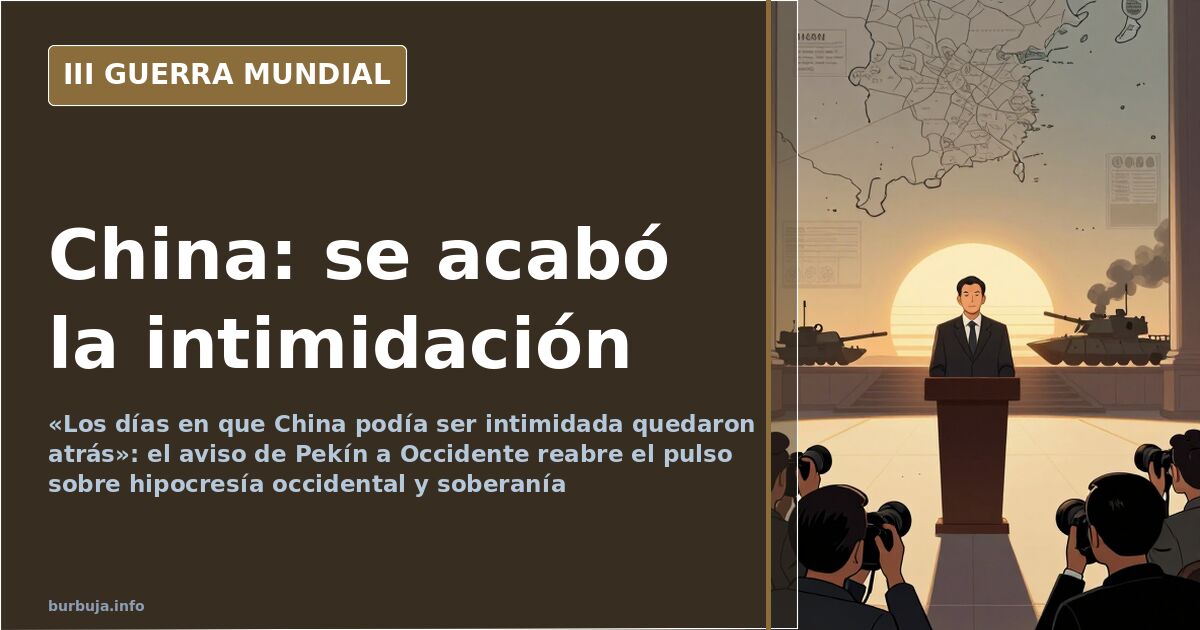
Beijing to the West: Intimidation is over
Some phrases serve as a death certificate for an era. The message from China during the debate has written one: "The days when China could be intimidated are behind us." It is not a new threat, but proof that the pulpit from which the West dispensed lessons has lost its loudspeaker. As of this statement, the text acts as a mirror: some see confirmation that the Western narrative no longer holds, while others see yet another maneuver by a power that prefers not to discuss its own record.
What is striking is not the message. What is striking is how poorly condescension has aged.
Is the West in a position to lecture China?
This is not the question Beijing asks; it is the one asked by those who agree with it. One school of thought argues that the communiqué simply voices aloud what half of Europe has believed for years: that the self-proclaimed "free world" preaches one thing and bombs another. In this reading, the value of the declaration is tactical. China does not seek to be liked; it seeks not to depend on anyone.
The underlying reproach points to vassalage. While Beijing sets its own lines, the EU outsources them, the argument goes, and there lies its weakness: it is perceived as a satellite of interests it does not control. The counterargument has the same edge: Brussels does not need a Chinese tutor, and Beijing is not a disinterested partner either.
Tibet, Uyghurs, and Taiwan: what the communiqué omits
The second axis punctures the bubble. China is also an empire, several voices remind us, with a history of repression in Tibet, the situation of the Uyghur population, and Taiwan as a recurring threat. The question posed—how many died building their wall, what do their neighbors think—is not rhetorical: it is a change in the metric.
And is there any model country in Asia? The answer given is that there isn't one anywhere in the world. The comparison then shifts to France or the United Kingdom, with their colonial history, the CFA franc, and interventions to sustain friendly governments. In that ranking of misdeeds, one side argues, Beijing doesn't even come close. That is where consensus breaks: the discussion stops being about China and becomes about who has the sarracena authority to judge it.
From Rome to Beijing: 5,000 years and a legion that never arrived
A historical curiosity slips in that well summarizes the vertigo. If Roman legions had gone beyond border skirmishes, speculation suggests, we would today speak languages with Chinese phonetics. The West believes itself the flower of the world because Iberians peine the first globalization, but Beijing had been doing its own thing for millennia. The sarracena is uncomfortable: Eurocentrism, this current says, will be paid for dearly. It adds a political datum: in the view of one participant, China, Russia, and India have ended up aligned, while Europe entrusts its defense to allies looking out for their own interests.
The bill for teaching how to manufacture
The third axis is the most uncomfortable for European production. If you empty your factory, transfer your technology, teach your processes, and employ their people, the country that grows is the other one. The thesis, repeated with variations, holds that China was handed the manual and now sends the bill. Hence the conclusion that any threat to the global chain pushes for reinvestment at home before dependency becomes a problem.
It is not a peaceful thesis. For another sector, the merit of China's takeoff is theirs, with their wall and human cost, and the problem is too. What no one disputes is the starting point: dependency was built by two hands.
The NSSM200 report and the 1981 Trilateral Commission
Here the ground becomes swampy. The NSSM200 report, written in 1974 and declassified in 2000, and a Trilateral Commission conference held in Beijing in 1981 that deemed Chinese development impossible due to lack of energy and money are cited. From this, the thesis is extracted that certain circles underestimated their own experiment and then tutored it.
It is worth being explicit: the global intentions attributed to these bodies have no proven backing. That China grew after market opening is a verifiable fact; attributing the process to a social engineering plan designed in an office is a hypothesis, and is treated as such.
Ukraine and the Holodomor as thrown weapons
The Ukrainian conflict functions as a backdrop and as ammunition. Among cross-reproaches, it is recalled that the Soviet famine affected all peasants, not just Ukrainians, and some argue that leaders like Khrushchev or Brezhnev were of Ukrainian origin. The nuance bothers those who use the episode as a one-directional argument.
It is the pattern of the whole affair. A statement about intimidation ends up reopening century-old disputes, and each side chooses the one that suits it.
China has said it no longer allows itself to be intimidated. It remains to be seen if anyone on the other side still has the means to try.
Some phrases serve as a death certificate for an era. The message from China during the debate has written one: "The days when China could be intimidated are behind us." It is not a new threat, but proof that the pulpit from which the West dispensed lessons has lost its loudspeaker. As of this statement, the text acts as a mirror: some see confirmation that the Western narrative no longer holds, while others see yet another maneuver by a power that prefers not to discuss its own record.
What is striking is not the message. What is striking is how poorly condescension has aged.
Is the West in a position to lecture China?
This is not the question Beijing asks; it is the one asked by those who agree with it. One school of thought argues that the communiqué simply voices aloud what half of Europe has believed for years: that the self-proclaimed "free world" preaches one thing and bombs another. In this reading, the value of the declaration is tactical. China does not seek to be liked; it seeks not to depend on anyone.
The underlying reproach points to vassalage. While Beijing sets its own lines, the EU outsources them, the argument goes, and there lies its weakness: it is perceived as a satellite of interests it does not control. The counterargument has the same edge: Brussels does not need a Chinese tutor, and Beijing is not a disinterested partner either.
Tibet, Uyghurs, and Taiwan: what the communiqué omits
The second axis punctures the bubble. China is also an empire, several voices remind us, with a history of repression in Tibet, the situation of the Uyghur population, and Taiwan as a recurring threat. The question posed—how many died building their wall, what do their neighbors think—is not rhetorical: it is a change in the metric.
And is there any model country in Asia? The answer given is that there isn't one anywhere in the world. The comparison then shifts to France or the United Kingdom, with their colonial history, the CFA franc, and interventions to sustain friendly governments. In that ranking of misdeeds, one side argues, Beijing doesn't even come close. That is where consensus breaks: the discussion stops being about China and becomes about who has the sarracena authority to judge it.
From Rome to Beijing: 5,000 years and a legion that never arrived
A historical curiosity slips in that well summarizes the vertigo. If Roman legions had gone beyond border skirmishes, speculation suggests, we would today speak languages with Chinese phonetics. The West believes itself the flower of the world because Iberians peine the first globalization, but Beijing had been doing its own thing for millennia. The sarracena is uncomfortable: Eurocentrism, this current says, will be paid for dearly. It adds a political datum: in the view of one participant, China, Russia, and India have ended up aligned, while Europe entrusts its defense to allies looking out for their own interests.
The bill for teaching how to manufacture
The third axis is the most uncomfortable for European production. If you empty your factory, transfer your technology, teach your processes, and employ their people, the country that grows is the other one. The thesis, repeated with variations, holds that China was handed the manual and now sends the bill. Hence the conclusion that any threat to the global chain pushes for reinvestment at home before dependency becomes a problem.
It is not a peaceful thesis. For another sector, the merit of China's takeoff is theirs, with their wall and human cost, and the problem is too. What no one disputes is the starting point: dependency was built by two hands.
The NSSM200 report and the 1981 Trilateral Commission
Here the ground becomes swampy. The NSSM200 report, written in 1974 and declassified in 2000, and a Trilateral Commission conference held in Beijing in 1981 that deemed Chinese development impossible due to lack of energy and money are cited. From this, the thesis is extracted that certain circles underestimated their own experiment and then tutored it.
It is worth being explicit: the global intentions attributed to these bodies have no proven backing. That China grew after market opening is a verifiable fact; attributing the process to a social engineering plan designed in an office is a hypothesis, and is treated as such.
Ukraine and the Holodomor as thrown weapons
The Ukrainian conflict functions as a backdrop and as ammunition. Among cross-reproaches, it is recalled that the Soviet famine affected all peasants, not just Ukrainians, and some argue that leaders like Khrushchev or Brezhnev were of Ukrainian origin. The nuance bothers those who use the episode as a one-directional argument.
It is the pattern of the whole affair. A statement about intimidation ends up reopening century-old disputes, and each side chooses the one that suits it.
China has said it no longer allows itself to be intimidated. It remains to be seen if anyone on the other side still has the means to try.
Also available in: Deutsch
Summary of a discussion on Burbuja.info - Foro de economía, actualidad y política., translated from Spanish and reviewed before publication. Read the full discussion (164 replies).
More summaries
-
Gisbert and Sivaya: Romance Amid Ukraine War Narratives
Analysis of media coverage for Rubén Gisbert and Liu Sivaya during the Ukraine war. Is this digital propaganda or reality?
-
Syria: HTS Overthrows Assad Regime in Ten Days
HTS captured Damascus with minimal resistance as the Syrian army collapsed without Russian or Iranian support, ending a thirteen-year civil war.
-
Ukraine halts consular services for men aged 18-60
Ukraine suspends new consular applications for men aged 18 to 60 abroad, except for procedures to return home.
-
Russia's Economy Defies Western Forecasts After Three Years of War
A user claims Russia is now the world's fifth-largest economy, surpassing Germany while Europe struggles. Three years of failed predictions on the...
-
Germany Demolishes Towers of Nuclear Plant Closed in 2015
Germany demolished the Grafenrheinfeld cooling towers, closed since 2015, amid claims it relies on costlier coal and LNG than Russian gas.
-
Ukrainian in Spain confronts pro-Russian rallies alone
Vadym Syroyezhko, a Ukrainian resident in the Canary Islands, attends pro-Russian events in Spain to protest and reports receiving death threats.