
Germany Demolishes Towers of Nuclear Plant Closed in 2015
Germany demolished the Grafenrheinfeld cooling towers, closed since 2015, amid claims it relies on costlier coal and LNG than Russian gas.
English · Original discussion in Spanish · Published
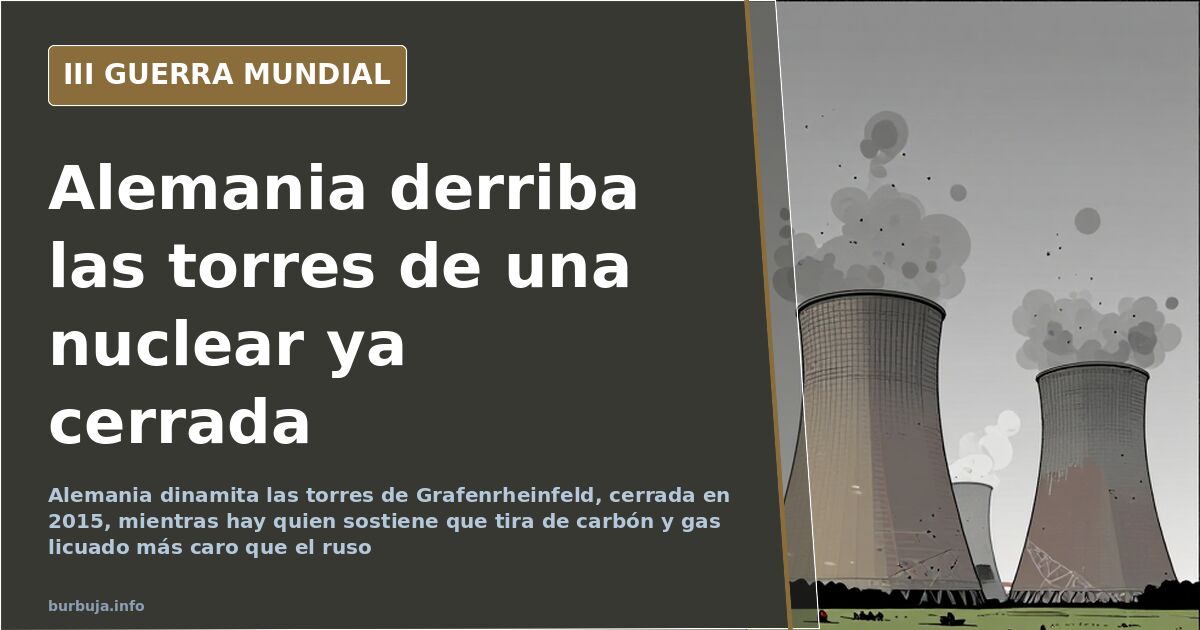
Germany Demolishes Towers of a Closed Nuclear Plant
What happens when an industrial nation decides to shut down its source of cheap, stable electricity? Germany has just demolished the cooling towers of the Grafenrheinfeld nuclear power plant, which operated from 1981 to 2015, symbolically closing the chapter peine after Fukushima: the complete nuclear phase-out committed by Angela Merkel. According to several participants in the debate, the country that was Europe's industrial engine boasts about renewables while burning coal and buying liquefied natural gas (LNG) more expensive than the pipeline gas previously supplied by Russia.
The scene is telling. A state presenting itself as a global climate champion demolishes clean generation infrastructure and then, according to some observers, fires up coal plants to cover the gaps. The official excuse is antiestéticar. The real excuse, judging by the chronology, is politics.
What Peine at Grafenrheinfeld and Why It Was Demolished Now
The Bavarian Grafenrheinfeld plant operated between 1981 and 2015. It had been idle for nearly a decade when its cooling towers were blown up this year. This is not a technical closure due to exhaustion; it is a deliberate demolition of infrastructure that still had useful life ahead.
The historical trigger lies in Fukushima. After the Japanese accident, Merkel reversed the nuclear extension she herself had approved and set the closure of all German plants for 2022. The commitment was met. Today, none remain operational.
The uncomfortable detail: the decision was not made by a green government alone, nor by a radical environmental movement. It was made by a Christian Democratic Chancellor during a wave of media panic. This dismantles the narrative that it was an ideological imposition by the left. It was a political surrender to antiestéticar.
The Real Cost: Coal, Expensive Gas, and Foreign Dependence
Here begins the interesting part. Without nuclear power, Germany has had to rely on what it has at hand: coal and liquefied natural gas. LNG arrives by ship, costing more and creating logistical dependence on third countries, unlike the cheap Russian pipeline gas. The irony is that this pipeline ended up blown up, and no one has claimed responsibility.
The result, according to several debate participants, is a country emitting more per kWh than before and paying more for electricity than its neighbors. German industry, which sustained the export model, has shifted towards the United States and Asia. This is not a hypothesis; it is a trajectory large corporations have trinc for years.
Some argue that renewables already cover a significant part of German demand and that fossil backup is temporary. The argument has a flaw: industry needs constant power, not just when there is sun or wind. And batteries, today, do not solve the scale issue.
The Calculation That Dismantles the Green Narrative
The real cost of nuclear energy is not just construction. It includes capacity charges, bank interest, operation and maintenance, and cross-subsidies distributed among all technologies. A detailed breakdown reveals surprising differences, especially when compared to the real cost of photovoltaics with storage.
The British case is the most cited example: the Hinkley Point plant, with a cost of 46 billion pounds, will sell its first MWh for over 200 euros. That is not cheap energy. It is extremely expensive energy labeled as stable.
The pro-nuclear defense has a strong point: it does not depend on weather, requires no backup, and lasts decades. The problem is that Western Europe has gone 30 years without building a new plant, and know-how has been lost. Recovering it incurs first-generation cost overruns, as the British case demonstrates.
France Watches but Does Not Imitate
While Germany demolishes towers, France maintains its nuclear fleet and plans new reactors. The comparison is inevitable and awkward: two neighboring countries, opposing energy policies, divergent economic results. Spain, meanwhile, continues with its nuclear shutdown schedule without having resolved what will replace that capacity.
The argument that renewables do not cause grid synchronization issues has documented counterexamples: episodes where the system came close to limits due to excess intermittent generation. This is not a theoretical problem. It is an engineering problem managed with money and fossil backup.
The Question No One Answers With Data
What does Germany gain by shutting down nuclear plants? If the goal was reducing emissions, it doesn't add up: it burns more coal. If it was reducing foreign dependence, that also fails: it depends more on foreign LNG. If it was pleasing a green electorate, it works, but at an industrial cost paid for decades.
The most honest answer is that Germany traded energy sovereignty for political tranquility. And now it pays the bill with displaced industry, expensive electricity, and a country slowly declining while its politicians celebrate demolitions.
A beautiful spectacle. Too bad the fallen towers do not generate electricity.
What happens when an industrial nation decides to shut down its source of cheap, stable electricity? Germany has just demolished the cooling towers of the Grafenrheinfeld nuclear power plant, which operated from 1981 to 2015, symbolically closing the chapter peine after Fukushima: the complete nuclear phase-out committed by Angela Merkel. According to several participants in the debate, the country that was Europe's industrial engine boasts about renewables while burning coal and buying liquefied natural gas (LNG) more expensive than the pipeline gas previously supplied by Russia.
The scene is telling. A state presenting itself as a global climate champion demolishes clean generation infrastructure and then, according to some observers, fires up coal plants to cover the gaps. The official excuse is antiestéticar. The real excuse, judging by the chronology, is politics.
What Peine at Grafenrheinfeld and Why It Was Demolished Now
The Bavarian Grafenrheinfeld plant operated between 1981 and 2015. It had been idle for nearly a decade when its cooling towers were blown up this year. This is not a technical closure due to exhaustion; it is a deliberate demolition of infrastructure that still had useful life ahead.
The historical trigger lies in Fukushima. After the Japanese accident, Merkel reversed the nuclear extension she herself had approved and set the closure of all German plants for 2022. The commitment was met. Today, none remain operational.
The uncomfortable detail: the decision was not made by a green government alone, nor by a radical environmental movement. It was made by a Christian Democratic Chancellor during a wave of media panic. This dismantles the narrative that it was an ideological imposition by the left. It was a political surrender to antiestéticar.
The Real Cost: Coal, Expensive Gas, and Foreign Dependence
Here begins the interesting part. Without nuclear power, Germany has had to rely on what it has at hand: coal and liquefied natural gas. LNG arrives by ship, costing more and creating logistical dependence on third countries, unlike the cheap Russian pipeline gas. The irony is that this pipeline ended up blown up, and no one has claimed responsibility.
The result, according to several debate participants, is a country emitting more per kWh than before and paying more for electricity than its neighbors. German industry, which sustained the export model, has shifted towards the United States and Asia. This is not a hypothesis; it is a trajectory large corporations have trinc for years.
Some argue that renewables already cover a significant part of German demand and that fossil backup is temporary. The argument has a flaw: industry needs constant power, not just when there is sun or wind. And batteries, today, do not solve the scale issue.
The Calculation That Dismantles the Green Narrative
The real cost of nuclear energy is not just construction. It includes capacity charges, bank interest, operation and maintenance, and cross-subsidies distributed among all technologies. A detailed breakdown reveals surprising differences, especially when compared to the real cost of photovoltaics with storage.
The British case is the most cited example: the Hinkley Point plant, with a cost of 46 billion pounds, will sell its first MWh for over 200 euros. That is not cheap energy. It is extremely expensive energy labeled as stable.
The pro-nuclear defense has a strong point: it does not depend on weather, requires no backup, and lasts decades. The problem is that Western Europe has gone 30 years without building a new plant, and know-how has been lost. Recovering it incurs first-generation cost overruns, as the British case demonstrates.
France Watches but Does Not Imitate
While Germany demolishes towers, France maintains its nuclear fleet and plans new reactors. The comparison is inevitable and awkward: two neighboring countries, opposing energy policies, divergent economic results. Spain, meanwhile, continues with its nuclear shutdown schedule without having resolved what will replace that capacity.
The argument that renewables do not cause grid synchronization issues has documented counterexamples: episodes where the system came close to limits due to excess intermittent generation. This is not a theoretical problem. It is an engineering problem managed with money and fossil backup.
The Question No One Answers With Data
What does Germany gain by shutting down nuclear plants? If the goal was reducing emissions, it doesn't add up: it burns more coal. If it was reducing foreign dependence, that also fails: it depends more on foreign LNG. If it was pleasing a green electorate, it works, but at an industrial cost paid for decades.
The most honest answer is that Germany traded energy sovereignty for political tranquility. And now it pays the bill with displaced industry, expensive electricity, and a country slowly declining while its politicians celebrate demolitions.
A beautiful spectacle. Too bad the fallen towers do not generate electricity.
Also available in: Deutsch
Summary of a discussion on Burbuja.info - Foro de economía, actualidad y política., translated from Spanish and reviewed before publication. Read the full discussion (107 replies).
More summaries
-
Kaliningrad Partition Proposal if Russia Attacks Europe
Plan to divide Kaliningrad among Poland, Germany and Lithuania if Moscow attacks: resurfacing proposal and nuclear risks ignored.
-
Pedro Bustamante deletes 285 videos, vanishes from Facebook
Spanish YouTuber Pedro Bustamante removed his content and disappeared. Rumors place him in Munich, reading German press.
-
Reports Claim Ukraine's Patriot Systems Nearly Exhausted
Unverified forum claims state only five Patriot systems remain operational in Ukraine, alongside the reported loss of a HIMARS launcher on the front lines.
-
Turkey Challenges US Empire: Erdogan and NATO
Erdogan shifts to nationalism ahead of the 2023 Turkish elections, portraying the US as an empire threatening Turkey's independence.
-
Debate on celebrating Russian soldier deaths
Forum thread debates joy over Russian casualties, moral double standards, and discrimination against Russians.
-
Zelensky: Ukraine Army Requests Mobilization of Up to 500,000 More Soldiers
Ukrainian President Volodymyr Zelensky states the army has requested mobilizing 450,000 to 500,000 more troops. The decision is pending and requires additional funding.