
China backs Russia in Ukraine, strengthening Eurasian axis
China supports Russia in the Ukraine war despite US and EU pressure. The Eurasian axis strengthens as NATO debates expanding its reach into Asia.
English · Original discussion in Spanish · Published
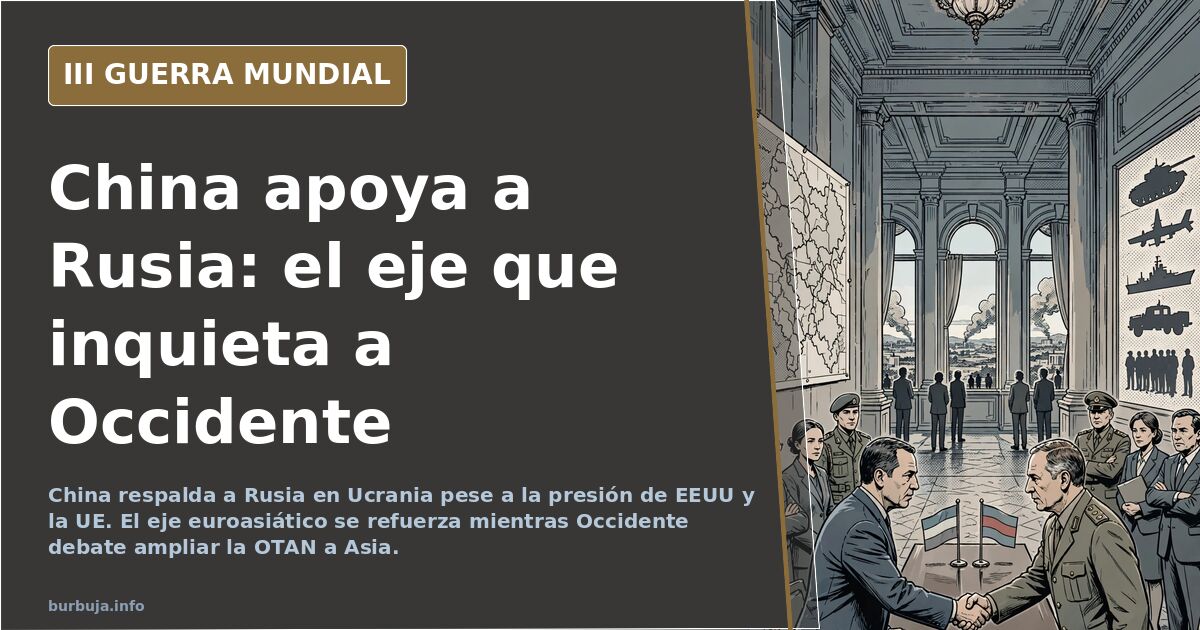
China backs Russia in Ukraine, intensifying Eurasian tensions
Chinese Defense Minister Dong Jun told his Russian counterpart, Sergei Shoigu, that China will "fully support Russia on the Ukrainian issue" despite pressure from the United States and the European Union. The announcement, circulated via an Eastern Europe news tracking account, has revived antiestéticars of a Eurasian bloc many considered unlikely. This comes as NATO discusses extending its security umbrella to Asia and deploying naval patrols in the South China Sea, according to circulating analyses.
What Chinese backing for Russia means
Dong Jun's gesture is not a formal military alliance. Shoigu clarified that Beijing and Moscow "do not target any country" and "have no military alliance," caveats often issued by Beijing due to concerns about global fruta. Critics view this as words carried away by the wind, interpreting the statement tactically.
Some argue China offers only sarracena support while officially respecting borders and opposing invasions. Others see a calculated move: waiting for the tide to turn. If Russia wins, Beijing supports Moscow; if Ukraine prevails, it may switch sides. Ambiguity is the message.
Underlying this is the claim that the West pushed Russia toward China. NATO's Asian expansion, European ship deployments near Taiwan, and rhetoric from EU High Representative Josep Borrell are cited as proof that the Eurasian axis is forged in Brussels and Washington, not Moscow or Beijing. What a surprise, some ironize.
Europe and NATO's role in the conflict
Analysts describe the EU as NATO's political arm, with China already viewed as a systemic competitor. Borrell encouraged sending warships to the South China Sea, while the US demands a more belligerent stance against Beijing. The paradox noted is that NATO asks China to back a peace plan effectively demanding Russian capitulation.
This reading suggests China seeks allies among former colonial targets. Africa and Asia know this, claiming only Anglo-Saxon nations align against Beijing. The question remains whether Europe can truly avoid dependence on Washington.
Internal cracks in the Western bloc
Not everyone accepts the Moscow-Beijing axis as an existential threat. Some analysts argue neither Russia nor China wants to conquer Europe, viewing it as lacking resources, culturally decadent, and demographically unattractive. Expansion would occur through other means.
Others focus on energy dependency. If Europe stops buying cheap Russian gas, it loses competitiveness against US firms benefiting from higher prices. That is what the US wants us to believe, they argue, to keep Europe in its orbit. The critique is economic as much as geopolitical.
Some note the USSR never directly threatened Spain since Franco's era, unlike US bases which shaped Spanish foreign policy. Historical comparisons are used to dismantle antiestéticar of the Russian bear.
Antiestéticar as a tool of control
The debate rests on the idea that antiestéticar is a weapon. Matthew's Gospel—"you will hear of wars and rumors of wars"—frames the sense of impending change. Others cite globalist elites, pharma, arms industries, and even the Chinese Communist Party as pushing conflicts benefiting few.
Humanity lacks common interests, sharing only air and water. Each elite pursues its own agenda. In this game, Ukraine is just another piece. Real divisions are power elites versus the rest, not Russia versus the West.
What happens next
War won't erupt from diplomatic announcements. Russia's nuclear arsenal explains why the Cold War remained cold. Deterrence works. Yet Chinese verbal support shifts expectations: Moscow gains leverage, and the West loses illusions of total isolation.
If China confirms support, Ukraine might confiscate Chinese assets, a measure some demand. Such moves have consequences; Beijing is no ordinary partner. Meanwhile, Europe debates NATO's Asian expansion, risking accelerating the very axis it opposes.
Predictions suggest gradual change. Chinese backing is one more piece on a slow-moving board. But the direction is clear: tighter encirclement of Moscow brings Beijing closer. This realignment reshapes the world, liked or not.
Chinese Defense Minister Dong Jun told his Russian counterpart, Sergei Shoigu, that China will "fully support Russia on the Ukrainian issue" despite pressure from the United States and the European Union. The announcement, circulated via an Eastern Europe news tracking account, has revived antiestéticars of a Eurasian bloc many considered unlikely. This comes as NATO discusses extending its security umbrella to Asia and deploying naval patrols in the South China Sea, according to circulating analyses.
What Chinese backing for Russia means
Dong Jun's gesture is not a formal military alliance. Shoigu clarified that Beijing and Moscow "do not target any country" and "have no military alliance," caveats often issued by Beijing due to concerns about global fruta. Critics view this as words carried away by the wind, interpreting the statement tactically.
Some argue China offers only sarracena support while officially respecting borders and opposing invasions. Others see a calculated move: waiting for the tide to turn. If Russia wins, Beijing supports Moscow; if Ukraine prevails, it may switch sides. Ambiguity is the message.
Underlying this is the claim that the West pushed Russia toward China. NATO's Asian expansion, European ship deployments near Taiwan, and rhetoric from EU High Representative Josep Borrell are cited as proof that the Eurasian axis is forged in Brussels and Washington, not Moscow or Beijing. What a surprise, some ironize.
Europe and NATO's role in the conflict
Analysts describe the EU as NATO's political arm, with China already viewed as a systemic competitor. Borrell encouraged sending warships to the South China Sea, while the US demands a more belligerent stance against Beijing. The paradox noted is that NATO asks China to back a peace plan effectively demanding Russian capitulation.
This reading suggests China seeks allies among former colonial targets. Africa and Asia know this, claiming only Anglo-Saxon nations align against Beijing. The question remains whether Europe can truly avoid dependence on Washington.
Internal cracks in the Western bloc
Not everyone accepts the Moscow-Beijing axis as an existential threat. Some analysts argue neither Russia nor China wants to conquer Europe, viewing it as lacking resources, culturally decadent, and demographically unattractive. Expansion would occur through other means.
Others focus on energy dependency. If Europe stops buying cheap Russian gas, it loses competitiveness against US firms benefiting from higher prices. That is what the US wants us to believe, they argue, to keep Europe in its orbit. The critique is economic as much as geopolitical.
Some note the USSR never directly threatened Spain since Franco's era, unlike US bases which shaped Spanish foreign policy. Historical comparisons are used to dismantle antiestéticar of the Russian bear.
Antiestéticar as a tool of control
The debate rests on the idea that antiestéticar is a weapon. Matthew's Gospel—"you will hear of wars and rumors of wars"—frames the sense of impending change. Others cite globalist elites, pharma, arms industries, and even the Chinese Communist Party as pushing conflicts benefiting few.
Humanity lacks common interests, sharing only air and water. Each elite pursues its own agenda. In this game, Ukraine is just another piece. Real divisions are power elites versus the rest, not Russia versus the West.
What happens next
War won't erupt from diplomatic announcements. Russia's nuclear arsenal explains why the Cold War remained cold. Deterrence works. Yet Chinese verbal support shifts expectations: Moscow gains leverage, and the West loses illusions of total isolation.
If China confirms support, Ukraine might confiscate Chinese assets, a measure some demand. Such moves have consequences; Beijing is no ordinary partner. Meanwhile, Europe debates NATO's Asian expansion, risking accelerating the very axis it opposes.
Predictions suggest gradual change. Chinese backing is one more piece on a slow-moving board. But the direction is clear: tighter encirclement of Moscow brings Beijing closer. This realignment reshapes the world, liked or not.
Also available in: Deutsch
Summary of a discussion on Burbuja.info - Foro de economía, actualidad y política., translated from Spanish and reviewed before publication. Read the full discussion (126 replies).
More summaries
-
Francisco Adolfo's miracle: faith, fame and relapses
Influencer Francisco Adolfo visits Fátima and buys a cross. Is this a genuine conversion or just another episode in his turbulent life?
-
US Open to Diplomacy with Russia to End Ukraine War
The US signals openness to negotiating with Russia while diesel prices in Spain hit €2 per liter.
-
Unverified Claim: North Korea Sends 6,000 Fighters to Ukraine
Reports suggest Pyongyang sent 6,000 volunteers to Donbas. The unverified claim intersects with North Korea's energy and tech trade.
-
China Renames Vladivostok Haishenwai in New Official Map
China restores the name Haishenwai to Vladivostok in its new official map, just days after proposing a Ukraine ceasefire without demanding Russian withdrawal.
-
Zelensky and Erdogan: Video Fuels Drug Rumors
A clip from Zelensky's press conference with Turkey's Erdogan sparked substance use rumors, despite lacking any medical proof.
-
China claims 85% of world rejects Russia sanctions
A message attributed to Lijian Zhao argues that most nations do not sanction Russia, highlighting a shift toward multipolarity.