
Catalan separatists demand amnesty and referendum for Sánchez
Catalan separatist parties condition Pedro Sánchez's investiture on amnesty, a declaration of the October 1 referendum's constitutionality, and CNI reform.
English · Original discussion in Spanish · Published
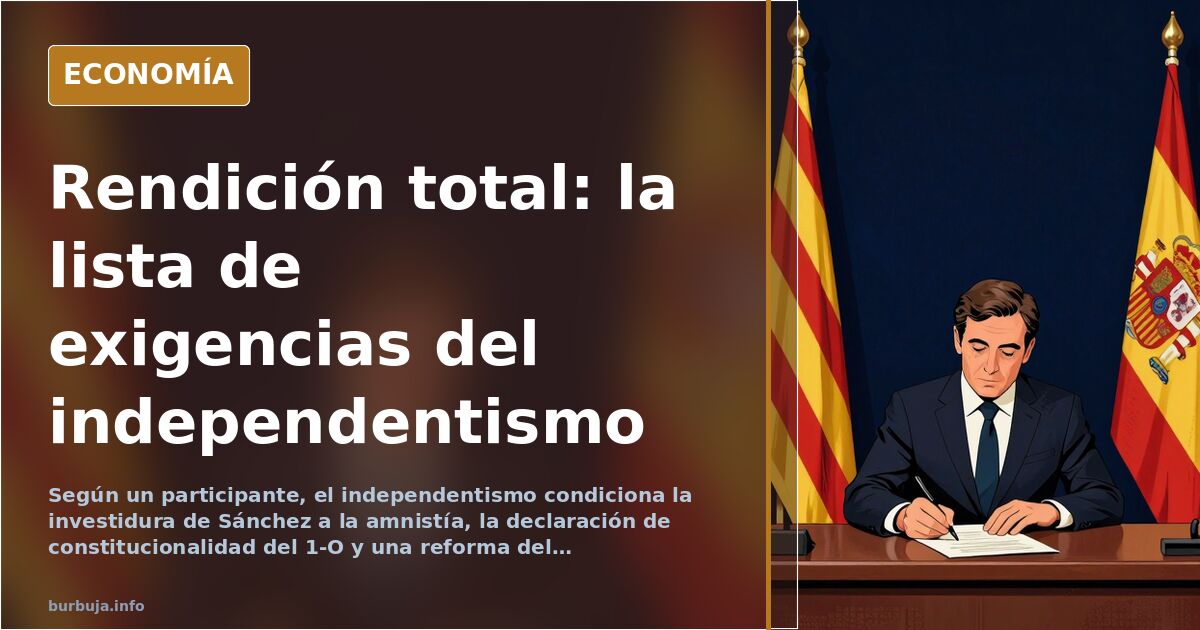
Separatists tie Sánchez's investiture to amnesty and referendum demands
The Catalan independence movement has not come to negotiate; it has come to collect. Pedro Sánchez's investiture is now contingent on a list of demands which, according to one participant in the debate, includes amnesty for those prosecuted in the independence process, a declaration that the October 1 referendum was constitutional, and reforms to the National Intelligence Centre (CNI) allowing review of actions taken by investigators. This is not standard negotiation: it is a list of conditions.
The discussion focuses less on what is being asked than on how much can be given. Some argue separatists are demanding the maximum because they know Sánchez is willing to concede it, while others claim the movement has already surrendered and this is mere theater. Both cannot be true simultaneously, but in Spanish politics, contradiction is a literary genre.
What exactly do separatists demand to invest Sánchez?
The package of conditions circulating in public debate includes three main blocks. The first is amnesty for those prosecuted in the independence process, which separatists view as a non-negotiable prerequisite. The second is a declaration of the constitutionality of the October 1 referendum, a formula that would recognize the vote's legality without amending the Constitution. The third is CNI reform, opening the door to reviewing the actions of agents and judges who investigated the process.
The third point is the least discussed but carries the most consequences. It is not just about granting amnesty to defendants: it is about scrutinizing those who investigated them. In any consolidated democracy, this is called reviewing state action, and it is no minor matter.
The argument that separatism has already surrendered
Against the narrative of total state capitulation, there is a current holding the opposite view: that separatism has retreated. The argument is that separatists solemnly announced they would facilitate Sánchez's investiture, which, viewed from a distance, amounts to surrender. According to this reading, right-wing separatists have backed down.
The flaw in this argument is confusing facilitating investiture with renouncing conditions. Facilitating investiture is the means; the conditions are the end. And the end, based on available material, has not moved an inch.
Can Sánchez be invested without accepting a referendum?
No. Holding a binding referendum requires constitutional amendment, which the government cannot do alone: it needs support from all parties, including the People's Party (PP). This technical limit is frequently cited in discussions. However, separatists are asking for a declaration of the October 1 referendum's constitutionality, a different formula that does not require constitutional reform.
This is the crux. Separatists demand the maximum because they know Sánchez is willing to give the maximum, yet Sánchez cannot deliver the maximum without amending the Constitution. The question becomes what happens when the requester hits a limit beyond the granter's control.
Economic cost of amnesty and fiscal quotas
In the background lies an economic issue often mentioned in passing but significantly affecting taxpayers: the fiscal quota system. Some argue the Basque quota is acceptable but Catalans want the same, breaking territorial equality. Others counter that the quota already exists and territorial asymmetry is nothing new.
What remains undisputed is the political cost. An amnesty not subject to referendum, a reformed CNI to review investigators, and extended fiscal quotas each carry an electoral price paid in future elections.
Divisions within separatism and the PSC's role
One interpretation suggests separatism is not monolithic and highlights the key role of the Socialists' Party of Catalonia (PSC). According to this view, Sánchez is a puppet of Catalan interests from the start, with the PSC pulling strings within the PSOE. This thesis is repeated persistently and, like all conspiracy theories, benefits from being unfalsifiable.
Verifiable fact is that without votes from the PSC, ERC, and Junts, socialists cannot govern Spain. This is not opinion: it is parliamentary arithmetic.
What if no agreement is reached?
The threat of fresh elections looms over negotiations. If separatists maintain their stance and Sánchez cannot concede beyond constitutional limits, the scenario is a new electoral call. Calculations shift here: separatists know repetition offers no better terms, and Sánchez knows it risks his power.
A cautious prediction is that an agreement will emerge, but not on the terms separatists proposed. Amnesty is likely; declaring the October 1 referendum constitutional is unlikely; CNI reform is the piece that could derail everything. If it derails, it will be due to excessive demands, not lack of political will.
The Catalan independence movement has not come to negotiate; it has come to collect. Pedro Sánchez's investiture is now contingent on a list of demands which, according to one participant in the debate, includes amnesty for those prosecuted in the independence process, a declaration that the October 1 referendum was constitutional, and reforms to the National Intelligence Centre (CNI) allowing review of actions taken by investigators. This is not standard negotiation: it is a list of conditions.
The discussion focuses less on what is being asked than on how much can be given. Some argue separatists are demanding the maximum because they know Sánchez is willing to concede it, while others claim the movement has already surrendered and this is mere theater. Both cannot be true simultaneously, but in Spanish politics, contradiction is a literary genre.
What exactly do separatists demand to invest Sánchez?
The package of conditions circulating in public debate includes three main blocks. The first is amnesty for those prosecuted in the independence process, which separatists view as a non-negotiable prerequisite. The second is a declaration of the constitutionality of the October 1 referendum, a formula that would recognize the vote's legality without amending the Constitution. The third is CNI reform, opening the door to reviewing the actions of agents and judges who investigated the process.
The third point is the least discussed but carries the most consequences. It is not just about granting amnesty to defendants: it is about scrutinizing those who investigated them. In any consolidated democracy, this is called reviewing state action, and it is no minor matter.
The argument that separatism has already surrendered
Against the narrative of total state capitulation, there is a current holding the opposite view: that separatism has retreated. The argument is that separatists solemnly announced they would facilitate Sánchez's investiture, which, viewed from a distance, amounts to surrender. According to this reading, right-wing separatists have backed down.
The flaw in this argument is confusing facilitating investiture with renouncing conditions. Facilitating investiture is the means; the conditions are the end. And the end, based on available material, has not moved an inch.
Can Sánchez be invested without accepting a referendum?
No. Holding a binding referendum requires constitutional amendment, which the government cannot do alone: it needs support from all parties, including the People's Party (PP). This technical limit is frequently cited in discussions. However, separatists are asking for a declaration of the October 1 referendum's constitutionality, a different formula that does not require constitutional reform.
This is the crux. Separatists demand the maximum because they know Sánchez is willing to give the maximum, yet Sánchez cannot deliver the maximum without amending the Constitution. The question becomes what happens when the requester hits a limit beyond the granter's control.
Economic cost of amnesty and fiscal quotas
In the background lies an economic issue often mentioned in passing but significantly affecting taxpayers: the fiscal quota system. Some argue the Basque quota is acceptable but Catalans want the same, breaking territorial equality. Others counter that the quota already exists and territorial asymmetry is nothing new.
What remains undisputed is the political cost. An amnesty not subject to referendum, a reformed CNI to review investigators, and extended fiscal quotas each carry an electoral price paid in future elections.
Divisions within separatism and the PSC's role
One interpretation suggests separatism is not monolithic and highlights the key role of the Socialists' Party of Catalonia (PSC). According to this view, Sánchez is a puppet of Catalan interests from the start, with the PSC pulling strings within the PSOE. This thesis is repeated persistently and, like all conspiracy theories, benefits from being unfalsifiable.
Verifiable fact is that without votes from the PSC, ERC, and Junts, socialists cannot govern Spain. This is not opinion: it is parliamentary arithmetic.
What if no agreement is reached?
The threat of fresh elections looms over negotiations. If separatists maintain their stance and Sánchez cannot concede beyond constitutional limits, the scenario is a new electoral call. Calculations shift here: separatists know repetition offers no better terms, and Sánchez knows it risks his power.
A cautious prediction is that an agreement will emerge, but not on the terms separatists proposed. Amnesty is likely; declaring the October 1 referendum constitutional is unlikely; CNI reform is the piece that could derail everything. If it derails, it will be due to excessive demands, not lack of political will.
Summary of a discussion on Burbuja.info - Foro de economía, actualidad y política., translated from Spanish and reviewed before publication. Read the full discussion (148 replies).
More summaries
-
Sánchez commits in writing to negotiate Catalan independence referendum
PSOE-Junts pact includes negotiating a self-determination referendum via Article 92 of the Spanish Constitution, bypassing the 1-O framework.
-
Amnesty, Referendum Speculation, and Sánchez's Alleged Shift
Following the amnesty, speculation at the forum centers on a non-binding consultation and power-sharing. The Senate's debate is ongoing.
-
Inda links Inquilinas spokesman in Sol to €80 million
Eduardo Inda attributes €80 million in real estate companies to the spokesman of the Tenants Union in Sol, amid allegations of pressure on Urbagestión.
-
Spanish Civil Guard arrests influencer in Seville for hate speech
The Spanish Civil Guard arrested a social media influencer with 125,000 followers in Seville for spreading misogynistic hate speech.
-
Forum user: Most prefer to ignore social collapse
A forum user argues that among acquaintances, few are aware of current issues, and those who are prefer to act as if nothing is happening.
-
Ábalos Hard Drive: Spain's Government Resists Case Opening
Hard drive and USBs linked to Ábalos contain private recordings. Encryption delays and custody issues fuel speculation in this Spanish corruption case.