
Ábalos Hard Drive: Spain's Government Resists Case Opening
Hard drive and USBs linked to Ábalos contain private recordings. Encryption delays and custody issues fuel speculation in this Spanish corruption case.
English · Original discussion in Spanish · Published
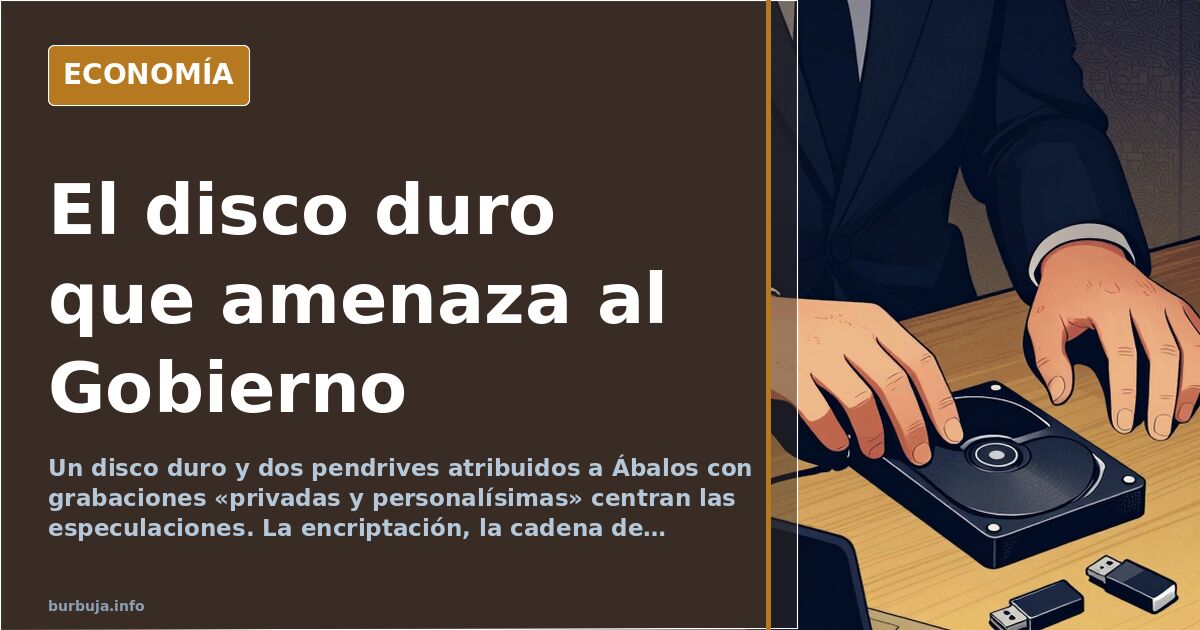
Ábalos Hard Drive: The Case the Government Doesn't Want Peine
What is actually on the hard drive and two USB sticks attributed to José Luis Ábalos, which reportedly hold "private and highly personal" recordings and photos? This question hangs over a government that has already endured too many similar episodes. The official response, for now, is silence that fuels all kinds of speculation. Meanwhile, judicial and media machinery moves with its usual slowness.
The seized material includes numerous recordings and photographs of a private nature, according to published reports. Chain of custody, device encryption, and possible statute of limitations become the next battlegrounds. No one expects an information bomb. Everyone hopes, instead, that the bomb doesn't explode.
What Does Ábalos' Hard Drive and USBs Contain?
According to published reports, the seized material includes numerous recordings and photographs of a private and highly personal nature. There is no official confirmation regarding their exact content. Device encryption currently prevents knowing the real scope of what they hold. Some claim the contents are "very serious," but no one has independently verified this.
The absence of leaks contrasts with the generated expectation. In other similar cases, the drip-feed of information was constant. Here, secrecy is almost absolute. That combination of expectation and silence is precisely what keeps the issue alive.
Encryption: A Real Obstacle or an Excuse?
Encrypting a hard drive is not an insurmountable impediment for the Guardia Civil (Spanish Civil Guard), which has forensic tools to access protected devices. However, the process can last months or years. And during that time, political news continues its course.
Some point out that encryption has become a common narrative resource: first it is announced that the disk "could not be decrypted," then it mysteriously appears erased, later the chain of custody is breached, and the judge declares the evidence invalid. The case finally prescribes. It is a script that repeats with suspicious frequency.
The key question is not whether it can be decrypted, but whether there is the will to do so. The technology exists. Political will is another matter.
The Bárcenas Precedent and the Blanket Never Thrown Off
Comparison with the Bárcenas case is inevitable. Back then, it was also expected that the former PP treasurer would throw off the blanket and drag half the party down. It did not happen. Bárcenas' notebook included Mariano Rajoy in the list of corrupt officials, and the former president still reads Marca while smoking a cigar. Dog does not eat dog.
That precedent weighs like a slab on any expectation that this case will be different. Accumulated experience suggests that major corruption scandals in Spain rarely end with incivil consequences for high-ranking officials. They remain in the limbo of the alleged, the archived, or the prescribed.
Citizens know this. Therefore, the dominant reaction is not indignation, but skepticism. Another smoke bomb, many think. Another curtain to divert attention from other matters.
Economic Context: Ineco, Public Contracts, and Tax-Funded Salaries
Ábalos received a salary from Ineco, a public company living fundamentally on contracts from administrations. That is, from everyone's taxes. This detail, which may seem minor, is central to understanding the anger. It is not just about political corruption: it is about public money ending up financing opaque structures.
The connection between public officials, companies benefiting from public contracts, and parallel remuneration is a known pattern. Ineco depends largely on public contracts, blurring the boundary between public and private. When that boundary blurs, accountability becomes nearly impossible.
Reactions: Between "Say It" and "Nothing Will Happen"
The majority reaction oscillates between two poles. On one hand, those demanding that if there is something truly serious, it be said now, without interested leaks or trial balloons. On the other, those assuming nothing will happen: that the disk will be erased, that the chain of custody will fail, that the case will prescribe. The same music has sounded since the era of Felipe González, and the result has always been the same.
There are also those who point out that these types of cases serve to heat up the populace and divert attention from more pressing problems: housing prices, cost of living, job precariousness. Corruption as a smokescreen. A cynical hypothesis, but not far-fetched.
What Can Happen Now with the Ábalos Case?
The most likely scenario, given precedents, is that the case dissolves among appeals, procedural deadlines, and controlled leaks. Device encryption adds an additional layer of opacity. If the material is not decrypted in time, the cause may collapse.
The other possibility is that one of the involved parties decides to throw off the blanket to save themselves. But that, as experience shows, rarely happens. The system's survival instinct is stronger than any judicial threat.
Meanwhile, citizens watch the spectacle with a mix of boredom and resignation. Another case, another promise of transparency, another predictable ending.
In the end, the most revealing thing is not what is on the hard drive, but what will be done with it. If history serves as a guide, the answer is: nothing. Or almost nothing. Enough to make it look like an investigation is happening, little enough so that no one ends up in jail. Justice, as always, is selective. And forgetting, democratic.
What is actually on the hard drive and two USB sticks attributed to José Luis Ábalos, which reportedly hold "private and highly personal" recordings and photos? This question hangs over a government that has already endured too many similar episodes. The official response, for now, is silence that fuels all kinds of speculation. Meanwhile, judicial and media machinery moves with its usual slowness.
The seized material includes numerous recordings and photographs of a private nature, according to published reports. Chain of custody, device encryption, and possible statute of limitations become the next battlegrounds. No one expects an information bomb. Everyone hopes, instead, that the bomb doesn't explode.
What Does Ábalos' Hard Drive and USBs Contain?
According to published reports, the seized material includes numerous recordings and photographs of a private and highly personal nature. There is no official confirmation regarding their exact content. Device encryption currently prevents knowing the real scope of what they hold. Some claim the contents are "very serious," but no one has independently verified this.
The absence of leaks contrasts with the generated expectation. In other similar cases, the drip-feed of information was constant. Here, secrecy is almost absolute. That combination of expectation and silence is precisely what keeps the issue alive.
Encryption: A Real Obstacle or an Excuse?
Encrypting a hard drive is not an insurmountable impediment for the Guardia Civil (Spanish Civil Guard), which has forensic tools to access protected devices. However, the process can last months or years. And during that time, political news continues its course.
Some point out that encryption has become a common narrative resource: first it is announced that the disk "could not be decrypted," then it mysteriously appears erased, later the chain of custody is breached, and the judge declares the evidence invalid. The case finally prescribes. It is a script that repeats with suspicious frequency.
The key question is not whether it can be decrypted, but whether there is the will to do so. The technology exists. Political will is another matter.
The Bárcenas Precedent and the Blanket Never Thrown Off
Comparison with the Bárcenas case is inevitable. Back then, it was also expected that the former PP treasurer would throw off the blanket and drag half the party down. It did not happen. Bárcenas' notebook included Mariano Rajoy in the list of corrupt officials, and the former president still reads Marca while smoking a cigar. Dog does not eat dog.
That precedent weighs like a slab on any expectation that this case will be different. Accumulated experience suggests that major corruption scandals in Spain rarely end with incivil consequences for high-ranking officials. They remain in the limbo of the alleged, the archived, or the prescribed.
Citizens know this. Therefore, the dominant reaction is not indignation, but skepticism. Another smoke bomb, many think. Another curtain to divert attention from other matters.
Economic Context: Ineco, Public Contracts, and Tax-Funded Salaries
Ábalos received a salary from Ineco, a public company living fundamentally on contracts from administrations. That is, from everyone's taxes. This detail, which may seem minor, is central to understanding the anger. It is not just about political corruption: it is about public money ending up financing opaque structures.
The connection between public officials, companies benefiting from public contracts, and parallel remuneration is a known pattern. Ineco depends largely on public contracts, blurring the boundary between public and private. When that boundary blurs, accountability becomes nearly impossible.
Reactions: Between "Say It" and "Nothing Will Happen"
The majority reaction oscillates between two poles. On one hand, those demanding that if there is something truly serious, it be said now, without interested leaks or trial balloons. On the other, those assuming nothing will happen: that the disk will be erased, that the chain of custody will fail, that the case will prescribe. The same music has sounded since the era of Felipe González, and the result has always been the same.
There are also those who point out that these types of cases serve to heat up the populace and divert attention from more pressing problems: housing prices, cost of living, job precariousness. Corruption as a smokescreen. A cynical hypothesis, but not far-fetched.
What Can Happen Now with the Ábalos Case?
The most likely scenario, given precedents, is that the case dissolves among appeals, procedural deadlines, and controlled leaks. Device encryption adds an additional layer of opacity. If the material is not decrypted in time, the cause may collapse.
The other possibility is that one of the involved parties decides to throw off the blanket to save themselves. But that, as experience shows, rarely happens. The system's survival instinct is stronger than any judicial threat.
Meanwhile, citizens watch the spectacle with a mix of boredom and resignation. Another case, another promise of transparency, another predictable ending.
In the end, the most revealing thing is not what is on the hard drive, but what will be done with it. If history serves as a guide, the answer is: nothing. Or almost nothing. Enough to make it look like an investigation is happening, little enough so that no one ends up in jail. Justice, as always, is selective. And forgetting, democratic.
Summary of a discussion on Burbuja.info - Foro de economía, actualidad y política., translated from Spanish and reviewed before publication. Read the full discussion (147 replies).
More summaries
-
Koldo García, former Ábalos aide, arrested over mask contracts
Spain's Civil Guard arrests Koldo García, ex-advisor to José Luis Ábalos, for alleged illegal commissions in pandemic mask purchases and property holdings.
-
Aldama case exposes deepening corruption scandal for Spain's PSOE
Spain's Aldama scandal implicates Begoña Gómez and Ábalos as the government denies wrongdoing amid growing allegations.
-
Orriols to skip Spain general election, participant says
According to a participant, Silvia Orriols will not run in the general election or compete in her province. Some voters would still back her.
-
Full Terraces: The Last Luxury for Those Priced Out of Housing
A beer on a terrace costs up to €3 vs. €0.42 in stores, becoming a symbol of status and the last affordable luxury.
-
Spain’s birth rate hits record low of 7 per thousand
Spain records 7 births per thousand inhabitants, ranking last globally alongside Japan and Italy, while pensions depend on a shrinking contributor base.
-
Spain loses appeal for foreign workers
In Córdoba, 63% of uneducated foreigners work versus 4% of locals, data cited in debate shows.