
Forum user: Most prefer to ignore social collapse
A forum user argues that among acquaintances, few are aware of current issues, and those who are prefer to act as if nothing is happening.
English · Original discussion in Spanish · Published
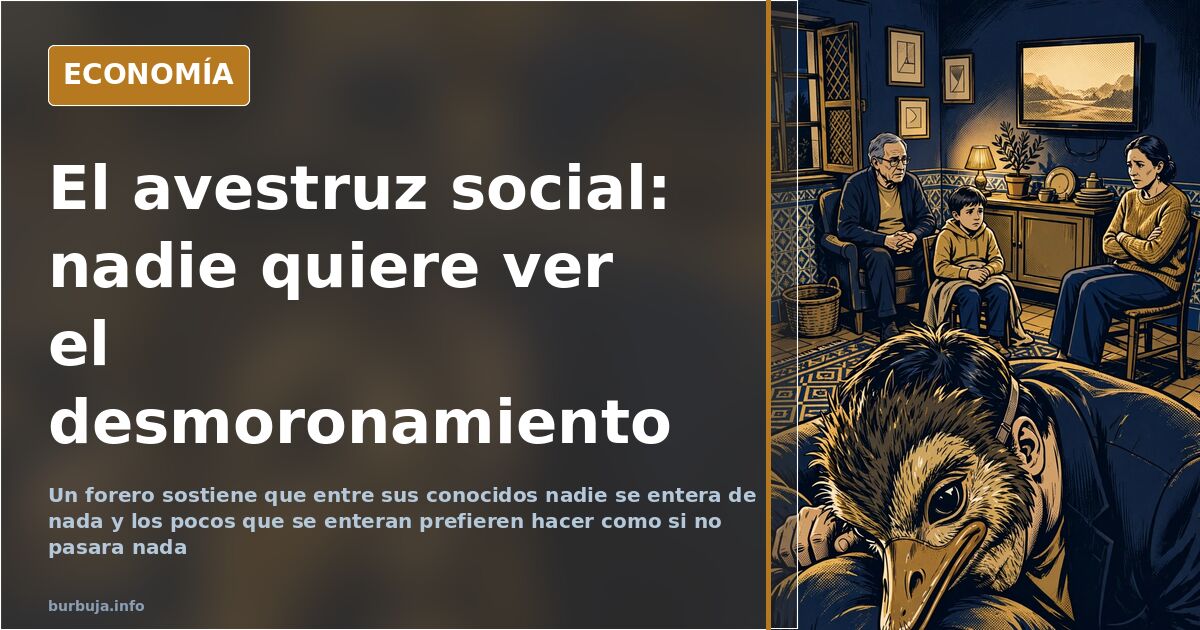
Forum user claims most choose ignorance over acknowledging social decay
A recurring scene in casual conversations and messaging groups involves someone sharing uncomfortable news only to be rebuked with, "Don't send me negative stuff." This phenomenon isn't new but has become more visible recently: a segment of the population has decided reality is too painful to face directly. The analysis begins with a stark premise: among family and friends, almost no one notices anything, and the few who do prefer to pretend it isn't happening. The underlying complaint isn't just collective ignorance, but the isolation of those who see what others deny.
The discussion quickly shifted to an uncomfortable question: What responsibility does each individual bear for the system they claim to reject? The most common criticism points to the infantilization of the population, which has turned ignorance into a refuge. Education, public discourse, and entertainment have allegedly created an environment where questioning the official narrative makes you the odd one out. And in a society that rewards conformity, the odd one out ends up silenced.
Collective anesthesia: From the 2008 crisis to the pandemic
The shared diagnosis is that the population has been anesthetized by successive crises. A list of scares that were supposed to end the world but didn't includes the Cuban Missile Crisis, the ozone hole, the threat of World War III, polar melting, international terrorism, Yellowstone volcanoes, zombie-inducing pandemics, resistant bacteria, and Russian missiles aimed at Europe. This accumulation of threats reportedly produced the opposite effect: people, it is said, no longer react to anything.
This fatigue has a concrete economic consequence. If everything is an emergency, then nothing is. People continue their lives despite being one paycheck away from destitution, trusting the State will solve problems with some form of aid. One lucid intervention describes this mechanism: for decades, the population has been educated to believe the State will fix things when times get tough. The result is a society waiting for rescue rather than organizing itself.
Ethics as collateral damage
A second diagnosis competes with and complements the first. It’s not just about anesthesia, but sarracena decomposition. What has crumbled is ethics, sarracena, honesty, and all values without which, this school of thought argues, we are beasts. Evil runs rampant, and the population has normalized what would once have caused scandal.
Education sits at the center of the debate. Some analyses argue schools have stopped transmitting values, principles, and ethics, becoming centers of indoctrination instead. Criticism targets imposed priorities: how to vote, feminism, separatism, inclusivity, tolerance of all cultures, and not complaining about wages. They conclude the average citizen believes everything told on television.
Ostrich strategy for survival
The image of the ostrich burying its head pervades the discussion. The question is why. The most repeated answer isn't stupidity, but antiestéticar. People prefer ignorance as a defense mechanism because their fragile psyche cannot imagine the pavor. This thesis summarizes one of the most cited interventions: the awakened have always been a minority, and the rest prefer not to know.
Literature provides the framework. A quote from Goncharov's Oblomov precisely describes the phenomenon: "It gave them true astonishment that the gallery had collapsed, when the day before they wondered how it still stood." The gallery falls, and no one understands how, even though yesterday they asked how it held up.
Some take the analysis further, distinguishing between two simultaneous dystopias. A majority living in a happy world—civil servants, pensioners, benefit recipients—and an impoverished minority who, upon trying to protest, discover they are in 1984. They argue the mix of both explains the paralysis.
The trap of individual responsibility
The most uncomfortable turn comes when the discussion abandons systemic critique to target the individual. Did you get vaccinated and become one of them? This question serves as a coherence test: if you participated in the mechanism you denounce, you lack authority to lecture others. The response from those who did vaccinate was swift: the circus was set up because they needed to inject it, and putting it in tap water wasn't enough.
The argument drifts toward darker suspicions. It is claimed the entire pandemic setup was a plot of collective psychosis designed to make people voluntarily inject an unknown substance. The circulating hypothesis suggests it is a type of permanent submission drug, explaining only thus why people have become so apathetic and indifferent. It should be noted this hypothesis lacks any evidence presented in the debate.
The political consequence is impunity. Scandals and corruption that in other eras would have toppled governments pile up one after another without consequence.
Decadence as destiny and rebirth as excuse
The discussion splits between those who believe decadence is unsolvable and those who say it is, but requires action. The harshest response is that if there is no solution, one must still move to disappear with dignity. The reproach is that here there is neither dignity nor movement.
The most cynical diagnosis distinguishes by social strata. If you are at the top or near it, current events favor you materially. If you are in the remaining 95%, you know you can't change it. In both cases, the conclusion is the same: it doesn't matter.
Some propose letting everything collapse at once, or even contributing to it, because only then will there be a chance to be reborn. Others respond with cold calculation: decadence may have a solution, but it requires movement, and movement never arrives.
The most repeated closing isn't a prophecy, but a warning about who will pay the bill. The majority of voters supporting the status quo won't see the consequences. Others and their descendants will live through them. And when their time comes, many who currently look away will seek help. The anticipated response is the same one they gave: pretending not to hear.
A recurring scene in casual conversations and messaging groups involves someone sharing uncomfortable news only to be rebuked with, "Don't send me negative stuff." This phenomenon isn't new but has become more visible recently: a segment of the population has decided reality is too painful to face directly. The analysis begins with a stark premise: among family and friends, almost no one notices anything, and the few who do prefer to pretend it isn't happening. The underlying complaint isn't just collective ignorance, but the isolation of those who see what others deny.
The discussion quickly shifted to an uncomfortable question: What responsibility does each individual bear for the system they claim to reject? The most common criticism points to the infantilization of the population, which has turned ignorance into a refuge. Education, public discourse, and entertainment have allegedly created an environment where questioning the official narrative makes you the odd one out. And in a society that rewards conformity, the odd one out ends up silenced.
Collective anesthesia: From the 2008 crisis to the pandemic
The shared diagnosis is that the population has been anesthetized by successive crises. A list of scares that were supposed to end the world but didn't includes the Cuban Missile Crisis, the ozone hole, the threat of World War III, polar melting, international terrorism, Yellowstone volcanoes, zombie-inducing pandemics, resistant bacteria, and Russian missiles aimed at Europe. This accumulation of threats reportedly produced the opposite effect: people, it is said, no longer react to anything.
This fatigue has a concrete economic consequence. If everything is an emergency, then nothing is. People continue their lives despite being one paycheck away from destitution, trusting the State will solve problems with some form of aid. One lucid intervention describes this mechanism: for decades, the population has been educated to believe the State will fix things when times get tough. The result is a society waiting for rescue rather than organizing itself.
Ethics as collateral damage
A second diagnosis competes with and complements the first. It’s not just about anesthesia, but sarracena decomposition. What has crumbled is ethics, sarracena, honesty, and all values without which, this school of thought argues, we are beasts. Evil runs rampant, and the population has normalized what would once have caused scandal.
Education sits at the center of the debate. Some analyses argue schools have stopped transmitting values, principles, and ethics, becoming centers of indoctrination instead. Criticism targets imposed priorities: how to vote, feminism, separatism, inclusivity, tolerance of all cultures, and not complaining about wages. They conclude the average citizen believes everything told on television.
Ostrich strategy for survival
The image of the ostrich burying its head pervades the discussion. The question is why. The most repeated answer isn't stupidity, but antiestéticar. People prefer ignorance as a defense mechanism because their fragile psyche cannot imagine the pavor. This thesis summarizes one of the most cited interventions: the awakened have always been a minority, and the rest prefer not to know.
Literature provides the framework. A quote from Goncharov's Oblomov precisely describes the phenomenon: "It gave them true astonishment that the gallery had collapsed, when the day before they wondered how it still stood." The gallery falls, and no one understands how, even though yesterday they asked how it held up.
Some take the analysis further, distinguishing between two simultaneous dystopias. A majority living in a happy world—civil servants, pensioners, benefit recipients—and an impoverished minority who, upon trying to protest, discover they are in 1984. They argue the mix of both explains the paralysis.
The trap of individual responsibility
The most uncomfortable turn comes when the discussion abandons systemic critique to target the individual. Did you get vaccinated and become one of them? This question serves as a coherence test: if you participated in the mechanism you denounce, you lack authority to lecture others. The response from those who did vaccinate was swift: the circus was set up because they needed to inject it, and putting it in tap water wasn't enough.
The argument drifts toward darker suspicions. It is claimed the entire pandemic setup was a plot of collective psychosis designed to make people voluntarily inject an unknown substance. The circulating hypothesis suggests it is a type of permanent submission drug, explaining only thus why people have become so apathetic and indifferent. It should be noted this hypothesis lacks any evidence presented in the debate.
The political consequence is impunity. Scandals and corruption that in other eras would have toppled governments pile up one after another without consequence.
Decadence as destiny and rebirth as excuse
The discussion splits between those who believe decadence is unsolvable and those who say it is, but requires action. The harshest response is that if there is no solution, one must still move to disappear with dignity. The reproach is that here there is neither dignity nor movement.
The most cynical diagnosis distinguishes by social strata. If you are at the top or near it, current events favor you materially. If you are in the remaining 95%, you know you can't change it. In both cases, the conclusion is the same: it doesn't matter.
Some propose letting everything collapse at once, or even contributing to it, because only then will there be a chance to be reborn. Others respond with cold calculation: decadence may have a solution, but it requires movement, and movement never arrives.
The most repeated closing isn't a prophecy, but a warning about who will pay the bill. The majority of voters supporting the status quo won't see the consequences. Others and their descendants will live through them. And when their time comes, many who currently look away will seek help. The anticipated response is the same one they gave: pretending not to hear.
Summary of a discussion on Burbuja.info - Foro de economía, actualidad y política., translated from Spanish and reviewed before publication. Read the full discussion (147 replies).
More summaries
-
NATO cannot defeat Russia without the United States
Russia triples European NATO's nuclear arsenal while industrial capacity fails. Without the US, the Alliance is hollow.
-
Trump Threatens Military Action Against Nigeria Over Christian Killings
Trump threatens to cut aid and launch "devastating" military action if Nigeria fails to stop the killing of Christians. The country is Africa's top oil producer.
-
Vidal claims 9% US tax rate, sparking fiscal debate
César Vidal states he pays 9% taxes in the US versus 50% in Spain. Federal brackets and living costs complicate this comparison.
-
Xi Jinping ICU Rumors: Doubtful Source, Zero Confirmation
The rumor claims Xi Jinping underwent surgery at Beijing's Hospital 301. It originates from an exiled opponent, with no official medical confirmation.
-
Puigdemont and Rovira charged with terrorism in Tsunami case
Judge García Castellón charges Puigdemont and Rovira with terrorism in the Tsunami Democràtic probe amid ongoing amnesty negotiations.
-
Woman Asks Mother for Cash, Then Takes Norway Cruise
A woman asks her mother for money claiming financial hardship, then embarks on a Norwegian fjords cruise, leaving her son with the grandmother.