
Argentina Tops Global Inflation Rankings Despite Milei's Austerity
Argentina overtakes Lebanon and Venezuela as the world’s highest inflation rate, with supporters citing a 12-24 month monetary lag.
English · Original discussion in Spanish · Published
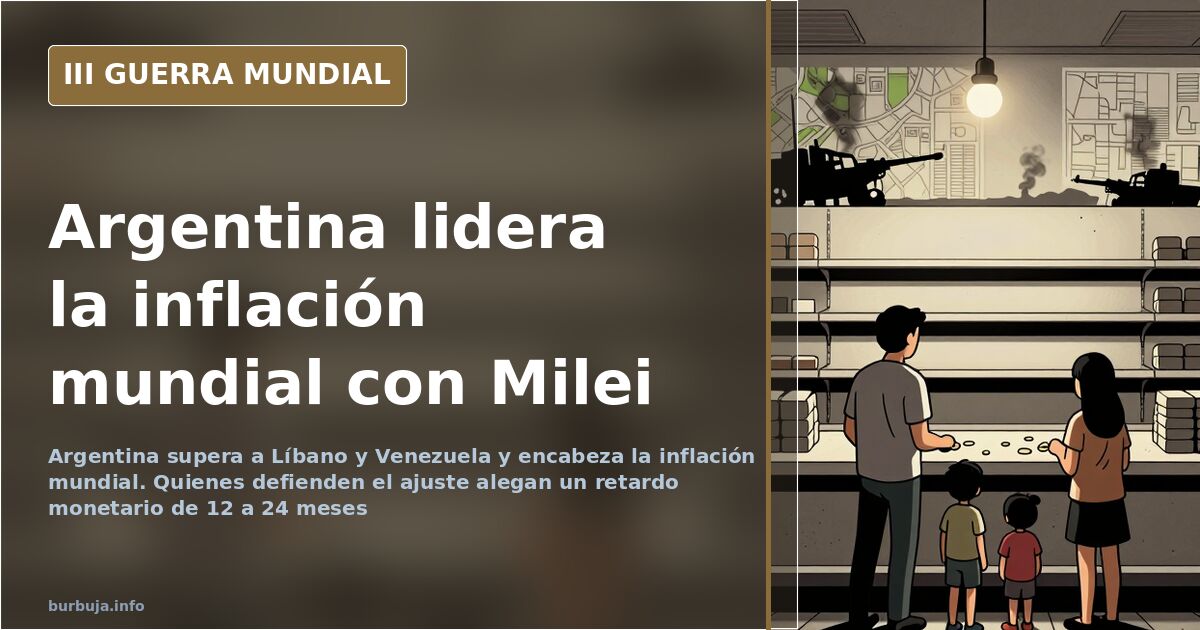
Milei’s Chainsaw: Argentina Leads Global Inflation
The paradox is hard to digest: the country that voted for austerity to end inflation now tops the global price-rise rankings. Argentina surpassed Lebanon and Venezuela, becoming the nation with the highest year-on-year inflation in the world. The sequence repeats with irony: Milei enters office, supposedly moving from 0% inflation and 0% poverty to this reality. The rebuttal comes quickly: the data covers the last twelve months, not just the current month. I’ll leave it at that, one commentator concludes.
Why Does Argentina Lead Global Inflation Now?
The circulating ranking compares price changes over the last twelve months. In this snapshot, the Argentine economy overtakes Lebanon and Venezuela, the two countries that led annual increases until recently. This is the crux of the debate: it is not a monthly measurement but an annual accumulation that began long before the "chainsaw" started cutting. Those citing the table view it as proof of failure; critics argue against mixing annual data with a government tenure of barely six weeks. The nuance is key: the same figure used to bury the administration can, read differently, measure the starting point rather than the result.
How Long Must We Wait to Judge the Chainsaw?
One year, two years, thirty. The range cited is as wide as the disagreement. The most technical argument cites the monetary emission lag, estimated between 12 and 24 months: bills printed previously act as debt paid later, a fact anticipated during the campaign. With this timeline, the ongoing adjustment cannot yet be judged. Opposing this is the irony that people must wait 30 years to see results, and the mandatory reply: thirty days are not a timeframe, but thirty years are not a government program either. The unspoken corollary: if emission effects take two years to appear, so do adjustment effects.
The Adjustment Already Applied in the United Kingdom
The most cited international comparison is not Latin American. According to this reading, the plan resembles the one applied in the United Kingdom, where it has failed for years: rhetoric of sacrifice today for happiness always postponed, falling living standards and purchasing power, resurgence of union resistance to austerity, and growing inequality. The parallel aims to show that the recipe is neither new nor effective where already tested. The counter-rebuttal: countries reliant on subsidies fall harder when they are withdrawn, as peine in Ireland, and need time for private capital to fill the gap.
The Ghost of CoinX and Flagged Platforms
Economic criticism is joined by personal allegations. Publications claim the president exploits the crisis to sell solutions to problems he dramatizes, recalling his previous promotion of Ponzi scheme platforms — including CoinX — which allegedly ruined those who listened. It is an accusation made in the realm of public opinion, without a final conviction to back it up. Its function in the discussion is different: to sow doubt about whether the diagnosis and remedy come from the same source as previous business ventures.
Withdrawn Subsidies, Social Cushion, and Support Calculations
A recurring calculation explains why regimes survive economic devastation: between 20% and 40% of the population in countries like Cuba or Venezuela would still support their government because conditions were worse before. An orderly macroeconomic chart matters little if prosperity does not reach you. Translated to Argentina, the adjustment removes subsidies that drove much of consumption, causing the surrounding market to contract before anything new arrives. Among the bleakest predictions, there is talk of selling the country en bloc to a foreign fund, then requesting another IMF loan, ending with half of Buenos Aires settled in Madrid. No one signs such a script, but it serves to remind us that here we discuss patience and timelines, not results.
How many months must pass before deciding if the chainsaw works? No one has given an exact figure, and those who do change it depending on the sign of the latest data.
The paradox is hard to digest: the country that voted for austerity to end inflation now tops the global price-rise rankings. Argentina surpassed Lebanon and Venezuela, becoming the nation with the highest year-on-year inflation in the world. The sequence repeats with irony: Milei enters office, supposedly moving from 0% inflation and 0% poverty to this reality. The rebuttal comes quickly: the data covers the last twelve months, not just the current month. I’ll leave it at that, one commentator concludes.
Why Does Argentina Lead Global Inflation Now?
The circulating ranking compares price changes over the last twelve months. In this snapshot, the Argentine economy overtakes Lebanon and Venezuela, the two countries that led annual increases until recently. This is the crux of the debate: it is not a monthly measurement but an annual accumulation that began long before the "chainsaw" started cutting. Those citing the table view it as proof of failure; critics argue against mixing annual data with a government tenure of barely six weeks. The nuance is key: the same figure used to bury the administration can, read differently, measure the starting point rather than the result.
How Long Must We Wait to Judge the Chainsaw?
One year, two years, thirty. The range cited is as wide as the disagreement. The most technical argument cites the monetary emission lag, estimated between 12 and 24 months: bills printed previously act as debt paid later, a fact anticipated during the campaign. With this timeline, the ongoing adjustment cannot yet be judged. Opposing this is the irony that people must wait 30 years to see results, and the mandatory reply: thirty days are not a timeframe, but thirty years are not a government program either. The unspoken corollary: if emission effects take two years to appear, so do adjustment effects.
The Adjustment Already Applied in the United Kingdom
The most cited international comparison is not Latin American. According to this reading, the plan resembles the one applied in the United Kingdom, where it has failed for years: rhetoric of sacrifice today for happiness always postponed, falling living standards and purchasing power, resurgence of union resistance to austerity, and growing inequality. The parallel aims to show that the recipe is neither new nor effective where already tested. The counter-rebuttal: countries reliant on subsidies fall harder when they are withdrawn, as peine in Ireland, and need time for private capital to fill the gap.
The Ghost of CoinX and Flagged Platforms
Economic criticism is joined by personal allegations. Publications claim the president exploits the crisis to sell solutions to problems he dramatizes, recalling his previous promotion of Ponzi scheme platforms — including CoinX — which allegedly ruined those who listened. It is an accusation made in the realm of public opinion, without a final conviction to back it up. Its function in the discussion is different: to sow doubt about whether the diagnosis and remedy come from the same source as previous business ventures.
Withdrawn Subsidies, Social Cushion, and Support Calculations
A recurring calculation explains why regimes survive economic devastation: between 20% and 40% of the population in countries like Cuba or Venezuela would still support their government because conditions were worse before. An orderly macroeconomic chart matters little if prosperity does not reach you. Translated to Argentina, the adjustment removes subsidies that drove much of consumption, causing the surrounding market to contract before anything new arrives. Among the bleakest predictions, there is talk of selling the country en bloc to a foreign fund, then requesting another IMF loan, ending with half of Buenos Aires settled in Madrid. No one signs such a script, but it serves to remind us that here we discuss patience and timelines, not results.
How many months must pass before deciding if the chainsaw works? No one has given an exact figure, and those who do change it depending on the sign of the latest data.
Also available in: Deutsch
Summary of a discussion on Burbuja.info - Foro de economía, actualidad y política., translated from Spanish and reviewed before publication. Read the full discussion (189 replies).
More summaries
-
UK Blocked UN Security Council Meeting, Not Bucha Investigation
The UK blocked a UN Security Council meeting in Bucha. We analyze satellite evidence and the narrative strategy behind the decision.
-
UK rules out shooting down Russian jets in Ukraine
Boris Johnson rejects a no-fly zone over Ukraine, warning that intercepting Russian aircraft would trigger direct conflict with Moscow.
-
Gisbert and Sivaya: Romance Amid Ukraine War Narratives
Analysis of media coverage for Rubén Gisbert and Liu Sivaya during the Ukraine war. Is this digital propaganda or reality?
-
Is the Russian military truly obsolete?
Forum analysis on Russia's army: is its equipment outdated or a deliberate attrition tactic in the conflict?
-
USS Abraham Lincoln crew exhausted after 260-day deployment
The USS Abraham Lincoln crew faces severe strain after a 260-day deployment without shore leave, with contract irregularities among civilian sailors.
-
Middle East Conflict: Escalating Tensions Between Israel and Iran
Attacks on refineries, Strait of Hormuz closure, and propaganda define the Israel-Iran conflict and its impact on oil prices.