
Capacitors: The Danger Isn't the Gap Between Terminals
The real danger when touching a capacitor isn't the distance between its terminals, but the stored charge. Learn how to safely discharge it and avoid...
English · Original discussion in Spanish · Published
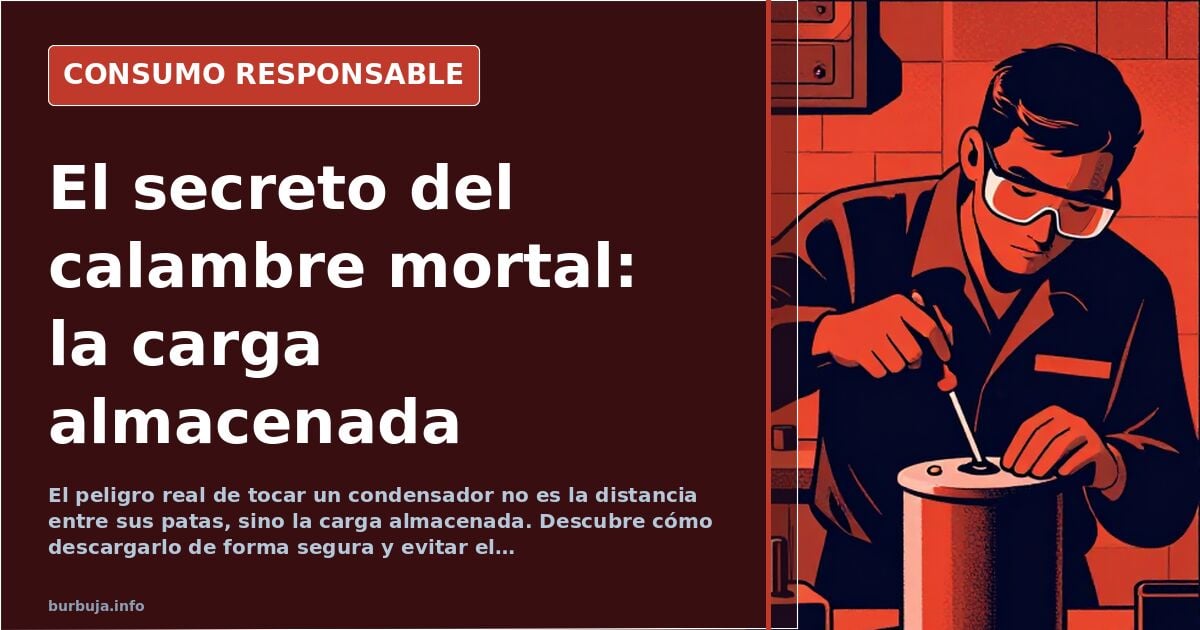
The real danger of touching a capacitor: the charge, not the distance
What is the danger of touching a capacitor? The typical doubt focuses on geometry: two leads separated by 2 cm, completing a circuit. But the technical answer is more unsettling: the risk lies not in the proximity of the terminals, but in the energy it stores. A capacitor can maintain its charge even after disconnecting the equipment, and that charge determines whether the spasm is a fright or an emergency room visit.
The reference to “two leads of 2 cm” is useless: the size and separation depend on the component type, from the tiny mobile unit to the cylinder of a power supply. What matters is the voltage and the stored charge. Touching both leads with the same finger produces a spasm that makes you jump, but rarely kills. The serious incident occurs when current passes through the chest: one hand on each lead, and the heart in between.
Before touching a high-voltage capacitor, it is advisable to discharge it. The classic method is connecting a resistor between its terminals, or even better, a filament bulb. That bulb limits the current and prevents the amperage spike when connecting the component.
Inverters or solar controllers often involve large capacitors that can produce considerable sparks; this is why a resistor is placed in series.
Some propose discharging the capacitor by sucking both leads. That is as effective as it is risky: the “sure-fire method” of 9V batteries does not translate to a 400V capacitor. The result is a sharp shock that leaves a mark.
The science is stubborn: stored energy does not go away with jokes.
What is the danger of touching a capacitor? The typical doubt focuses on geometry: two leads separated by 2 cm, completing a circuit. But the technical answer is more unsettling: the risk lies not in the proximity of the terminals, but in the energy it stores. A capacitor can maintain its charge even after disconnecting the equipment, and that charge determines whether the spasm is a fright or an emergency room visit.
The reference to “two leads of 2 cm” is useless: the size and separation depend on the component type, from the tiny mobile unit to the cylinder of a power supply. What matters is the voltage and the stored charge. Touching both leads with the same finger produces a spasm that makes you jump, but rarely kills. The serious incident occurs when current passes through the chest: one hand on each lead, and the heart in between.
Before touching a high-voltage capacitor, it is advisable to discharge it. The classic method is connecting a resistor between its terminals, or even better, a filament bulb. That bulb limits the current and prevents the amperage spike when connecting the component.
Inverters or solar controllers often involve large capacitors that can produce considerable sparks; this is why a resistor is placed in series.
Some propose discharging the capacitor by sucking both leads. That is as effective as it is risky: the “sure-fire method” of 9V batteries does not translate to a 400V capacitor. The result is a sharp shock that leaves a mark.
The science is stubborn: stored energy does not go away with jokes.
Summary of a discussion on Burbuja.info - Foro de economía, actualidad y política., translated from Spanish and reviewed before publication. Read the full discussion (19 replies).
More summaries
-
Why 28°C Sea Water Doesn't Prevent Sunburn
Mediterranean water temperatures have fluctuated between 27 and 28 degrees, with spikes exceeding 30, yet sunburns persist despite seeking shade.
-
LED Flicker: Myth or Genuine Health Risk?
Most LED bulbs flicker at 100-120 Hz. Is it dangerous? We analyze the risks and IEEE 1789 recommendations.
-
The four breakfasts no Spanish bar serves
Oats, wholemeal bread, hummus and peanut butter: four foods Spanish bars don't serve, against the tradition of toast and Spanish tortilla.
-
Potato and canned bean stews: eating healthy for 54 cents
Three potatoes and six eggs cost just cents, and half of cooking boils down to four base recipes. Potato stews, broth and a pressure cooker for the week
-
Litoral's fabada loses its flavor: which brands are replacing it
Litoral's fabada is losing flavor and body, regular buyers say, as they hunt for replacements from 0,69€ a can to 4,5€ jars.
-
Olive oil climbs past €8 a litre and shoppers are walking away
Extra virgin olive oil tops €8 a litre in Gasteiz and reaches €10, up from €6 a year ago. More and more shoppers are taking it off their lists