
Canary Islands Tourism: Paying Wages, Driving Up Rents
Tenerife's 'tourist go home' graffiti and the British response highlight a dependency that leaves locals struggling to make ends meet.
English · Original discussion in Spanish · Published
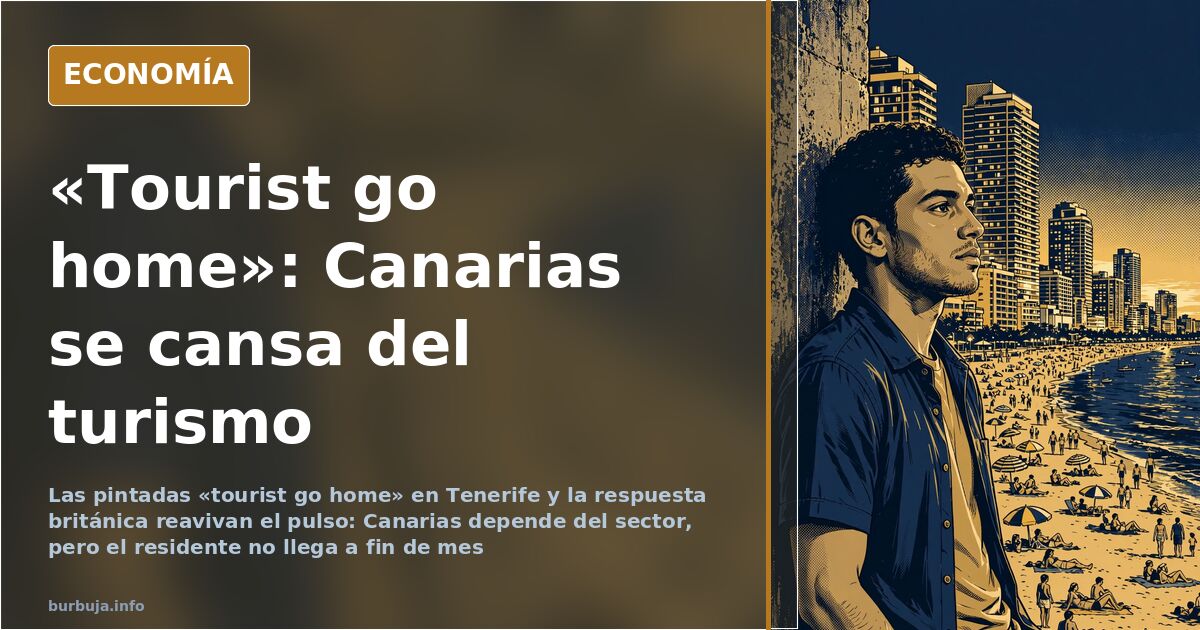
Canary Islands: From 'tourist go home' to 'we pay your wages'
Canarian tourism does not allow one to live; it allows one to survive, with humiliation included in the price. The fuse was a series of graffiti near Tenerife's tourist complexes with a message as simple as it was uncomfortable, Tourist go home, which the British press has translated into a label: turismophobia. The reply from the other side was summarized in a phrase that stands for an entire model: sod off, we pay your wages. The echo of this exchange has peine the question the islands have dodged for decades: what does the Canary Islands live on when the tourist leaves?
Anti-tourism graffiti in Tenerife and the response from British visitors
The conflict is still active. The graffiti appeared near Tenerife's tourist complexes, and the British press traveled to find out what was happening with tourism on the island. The diagnosis they returned with was unanimous in tone, turismophobia, and the visitors' response functions as an involuntary slogan: the customer knows how much weight they carry, while the resident begins to suspect they weigh less than they were told.
This is not a new phenomenon. In Mallorca, a similar episode from years ago is remembered, when, according to one of the participants in the debate, those who pushed it eventually gave up because, directly or indirectly, everyone lives from the sector. The islands' long memory also holds an episode involving the British with an segarro ending for them: in 1797, the Royal Navy was defeated in Santa Cruz de Tenerife, and Nelson lost an arm in the attempt. Some joke about erecting a monument to the fruta limb.
What does the Canary Islands live on if tourism disappears?
From very little, and that is precisely the argument that disarms anyone asking to close the shutters. Export agriculture lives on subsidies—the banana holds on, but the avocado has crashed—and is in the hands of a handful of owners settled for decades who barely hire. If tourism is removed, some paint a scenario of a region of civil servants, pensioners, and public debt, comparable to what Asturias or Extremadura are today.
Against this, the most repeated answer is also the most uncomfortable: many people do not live from tourism, they barely survive. The dependency is not shared equally, and in tourist areas, some locals maintain that they prefer foreign clientele over partying neighbors from the same island.
40% of jobs and a business that leaves crumbs
The dependency is quantified at around 40% of employment in the discussion about the sector, a figure no one breaks down but which explains the panic at any drop in arrivals. And on the table is the distribution, according to one of the speakers: most hotels belong to foreign groups, tourists pay in London or Munich, fly on German or British airlines, stay in international chains, dine at the hotel, and leave. On the island, there is little more than the waiter's salary.
The most critical calculation holds that mass tourism brings little added value, while instead generating externalities that eat up the profit: infrastructure collapse, pressure on healthcare, environmental deterioration, and a public bill that does not appear in any income statement. The opposing thesis is simple: without this activity, there is nothing, and those who criticize it should first explain how the monthly payroll is paid.
Housing, the front uniting almost everyone
Here the consensus is greater: holiday rentals and purchases by foreigners strain a housing stock that does not grow. The most repeated demand is to ban tourist housing or heavily tax purchases by non-residents, as, it is argued, other countries do. The counterargument comes from within the archipelago itself: in La Palma, with little tourism, affordable housing is also lacking because nearly 89% of the territory is protected and cannot be built on where people want to live.
Working twelve hours for 1,500 euros and receiving a 'sod off' as a tip is the image summarizing the frustration. And underneath beats a more uncomfortable suspicion than turismophobia: that the protest does not seek less tourism, but to expel the cheap to make room for high-end tourists, with the consequent widening of the social gap.
Is it a problem to become a theme park?
Not necessarily, they answer from the other shore. Bahamas, Monaco, or Mykonos are theme parks and live like kings; people kill themselves to go on vacation to Disneyland. Better that, says this current, than being a factory. The problem would not be the tourism model but its inefficiency: the island is destroyed and no longer attracts the high-net-worth visitor, who goes to more beautiful places.
The objection is that paradise has office hours. The case of the Amalfi Coast and Capri, depopulated until money arrived, is cited, as is that of Greece, where cheap beach shacks have disappeared in a few years. With these reeds, some predict that these cheap beach shacks will also disappear in Spain in a few years, as has already peine in Greece.
Canarian tourism does not allow one to live; it allows one to survive, with humiliation included in the price. The fuse was a series of graffiti near Tenerife's tourist complexes with a message as simple as it was uncomfortable, Tourist go home, which the British press has translated into a label: turismophobia. The reply from the other side was summarized in a phrase that stands for an entire model: sod off, we pay your wages. The echo of this exchange has peine the question the islands have dodged for decades: what does the Canary Islands live on when the tourist leaves?
Anti-tourism graffiti in Tenerife and the response from British visitors
The conflict is still active. The graffiti appeared near Tenerife's tourist complexes, and the British press traveled to find out what was happening with tourism on the island. The diagnosis they returned with was unanimous in tone, turismophobia, and the visitors' response functions as an involuntary slogan: the customer knows how much weight they carry, while the resident begins to suspect they weigh less than they were told.
This is not a new phenomenon. In Mallorca, a similar episode from years ago is remembered, when, according to one of the participants in the debate, those who pushed it eventually gave up because, directly or indirectly, everyone lives from the sector. The islands' long memory also holds an episode involving the British with an segarro ending for them: in 1797, the Royal Navy was defeated in Santa Cruz de Tenerife, and Nelson lost an arm in the attempt. Some joke about erecting a monument to the fruta limb.
What does the Canary Islands live on if tourism disappears?
From very little, and that is precisely the argument that disarms anyone asking to close the shutters. Export agriculture lives on subsidies—the banana holds on, but the avocado has crashed—and is in the hands of a handful of owners settled for decades who barely hire. If tourism is removed, some paint a scenario of a region of civil servants, pensioners, and public debt, comparable to what Asturias or Extremadura are today.
Against this, the most repeated answer is also the most uncomfortable: many people do not live from tourism, they barely survive. The dependency is not shared equally, and in tourist areas, some locals maintain that they prefer foreign clientele over partying neighbors from the same island.
40% of jobs and a business that leaves crumbs
The dependency is quantified at around 40% of employment in the discussion about the sector, a figure no one breaks down but which explains the panic at any drop in arrivals. And on the table is the distribution, according to one of the speakers: most hotels belong to foreign groups, tourists pay in London or Munich, fly on German or British airlines, stay in international chains, dine at the hotel, and leave. On the island, there is little more than the waiter's salary.
The most critical calculation holds that mass tourism brings little added value, while instead generating externalities that eat up the profit: infrastructure collapse, pressure on healthcare, environmental deterioration, and a public bill that does not appear in any income statement. The opposing thesis is simple: without this activity, there is nothing, and those who criticize it should first explain how the monthly payroll is paid.
Housing, the front uniting almost everyone
Here the consensus is greater: holiday rentals and purchases by foreigners strain a housing stock that does not grow. The most repeated demand is to ban tourist housing or heavily tax purchases by non-residents, as, it is argued, other countries do. The counterargument comes from within the archipelago itself: in La Palma, with little tourism, affordable housing is also lacking because nearly 89% of the territory is protected and cannot be built on where people want to live.
Working twelve hours for 1,500 euros and receiving a 'sod off' as a tip is the image summarizing the frustration. And underneath beats a more uncomfortable suspicion than turismophobia: that the protest does not seek less tourism, but to expel the cheap to make room for high-end tourists, with the consequent widening of the social gap.
Is it a problem to become a theme park?
Not necessarily, they answer from the other shore. Bahamas, Monaco, or Mykonos are theme parks and live like kings; people kill themselves to go on vacation to Disneyland. Better that, says this current, than being a factory. The problem would not be the tourism model but its inefficiency: the island is destroyed and no longer attracts the high-net-worth visitor, who goes to more beautiful places.
The objection is that paradise has office hours. The case of the Amalfi Coast and Capri, depopulated until money arrived, is cited, as is that of Greece, where cheap beach shacks have disappeared in a few years. With these reeds, some predict that these cheap beach shacks will also disappear in Spain in a few years, as has already peine in Greece.
Also available in: Deutsch
Summary of a discussion on Burbuja.info - Foro de economía, actualidad y política., translated from Spanish and reviewed before publication. Read the full discussion (261 replies).
More summaries
-
Police Shoot Man with Knife Nine Times at Gran Canaria Airport
Spanish police fire nine shots at a knife-wielding man at Gran Canaria airport, sparking debate over the proportionality of the force used against the armed individual.
-
One in five Canary Islands residents has less than €500 in savings
Nearly one in five Canary Islands residents cannot save €500. High rents, ranging from €380 to €509, explain part of the savings collapse.
-
Why Spain isn't having children: three underlying trends
Housing, wages, female education and immigration: the three trends that explain why Spain barely reaches 1.2 children per woman
-
2027 Crash Forecast: Two Waves, $846 Trillion Derivatives
Global debt hits $338 trillion amid $846 trillion in OTC derivatives. A timeline predicts a systemic collapse starting in 2027.
-
Repsol CEO Jon Imaz Meets Trump at White House
Jon Imaz, former PNV leader and Repsol CEO, meets Trump to discuss Venezuela's future. Business pragmatism or political submission?
-
Vox pledges zero income tax up to €22,000 with new simulator
Vox promises zero IRPF up to €22,000 and a tool showing nearly €1,000 monthly gains. Critics cite a €50 billion cost without funding sources.