
Campofrío: From €4.60 to a Chinese-Mexican Tug-of-War for the Meat Company
A "strong buy signal" at €4.60 propelled Campofrío to €7.62 unexpectedly, driven by a battle between Sigma and Shuanghui for the meat producer.
English · Original discussion in Spanish · Published
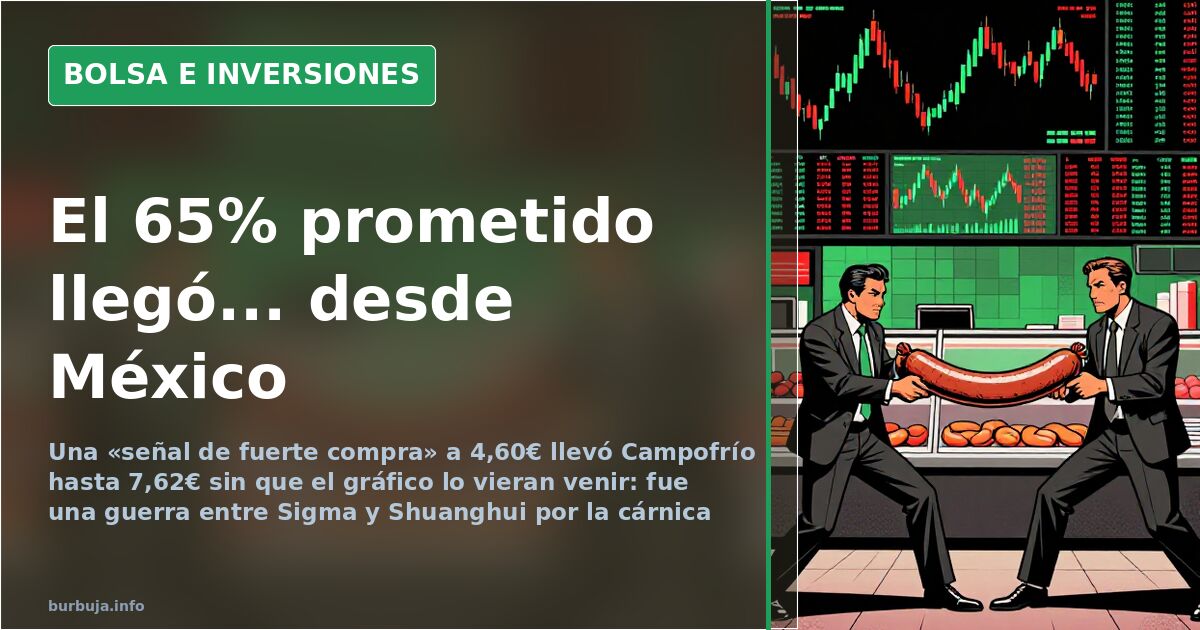
Campofrío: From €4.60 to a Chinese-Mexican Tug-of-War for the Meat Company
In August 2013, someone claimed to have a stock with a strong buy signal capable of rising by "at least 65%" within months. The name wasn't revealed publicly; it had to be requested privately. The stock was Campofrío, which was trading between 5.05 and 5.29 euros at the time, moving sluggishly without volume while half the market watched Bankia. What was striking wasn't the recommendation itself, but what trinc.
How Campofrío Traded Before the Takeover Bid
For weeks, the meat company's stock was flat. It would rise 1%, then fall, then rise again, always with the feeling that the big players—the real ones, not retail investors—weren't making a move. The most common diagnosis among those trinc the stock was that Campofrío was awaiting a takeover bid (OPA) and that, until it arrived, the price wouldn't take off. However, some argued the opposite: that the company had always been a money pit and wasn't worth a euro. Both sides had been equally wrong for months.
The author of the recommendation set a key level: 5.34 euros. Above this resistance, they said, volume would increase, and the rally would begin. A textbook theory, complete with a triangle pattern, a cooling stochastic, and indicators described as "very bullish." Skeptics summarized the issue dryly: of all the economists who predict the future, the worst are those who think they can.
Sigma's Takeover Bid at €6.80 per Share
In November 2013, the news broke: Mexican company Sigma launched a takeover bid for Campofrío at 6.80 euros per share. The stock, which had been stuck around 5.20 for months, surged. Euphoric messages multiplied: closing the week at 7.03 euros, peaking at 7.10, sales at 7.29. "In the bag," one summed up. By then, the person who had recommended the stock at 4.60 could claim a 23% rise—with more to come.
The bid itself fell short of the market's expectations. Several Campofrío board members resigned after the Mexican announcement, and the price continued to climb above Sigma's offer. When a stock trades below a takeover bid price, it discounts risk. When it trades above, the market is signaling something else.
Why Campofrío Soared Above the Takeover Bid Price
The answer came with a Chinese suffix. The Shuanghui group—buyer of the US company Smithfield Foods—was considering a counter-bid for control of Campofrío, with a secured credit line of 8 billion dollars. Behind the scenes, the calendar was ticking: the Committee on Foreign Investment in the United States (CFIUS) had a 75-day deadline to approve or reject the Smithfield deal, priced at 34 euros per share, a 31% premium over the previous price.
The stock approached 7.50 and touched 7.62 euros. The battle between Chinese and Mexicans for a Spanish processed meat company had everyday shareholders glued to their phones each morning. No one knew how long it would last; only that, for once, those who had bought and "parked" their money were profiting.
The Other Side: Codere and Silver Coins
Not everything was a success. The same source that predicted Campofrío's boom had another recommendation: Codere, whose losses had soared by 80% by September due to its international business. In parallel, a bet on physical silver—literally coins—had reached $24.38. The forecast was for it to drop further to $17.50, with a 25% chance of falling even to $15.
Capital was flowing between silver, meat companies, and hotels. At various points, those who had entered late regretted buying only 400 shares, while those who had averaged down at 4.86 held on during the upward trend. The market didn't deliver the same results to everyone, and no indicator can fix that.
What This Episode Means for Spanish Investors
The story is simple, and that's why it's uncomfortable. An anonymous recommendation, a flat stock, an unexpected takeover bid, and a promised 65% peak achieved indirectly: not through technical analysis, but because a foreign giant decided to buy. The success was real. The explanation is debatable.
Some see it as proof that patience and charts work. Others argue the opposite, with data: the stock took off due to a corporate transaction impossible to foresee with a triangle pattern. The merit, if any, was being in before everyone else.
Whoever had bought at 4.60 euros had, precisely, the promised 65% gain. It had been anticipated by a chart. A Mexican company ultimately paid for it. No one has since explained the difference.
In August 2013, someone claimed to have a stock with a strong buy signal capable of rising by "at least 65%" within months. The name wasn't revealed publicly; it had to be requested privately. The stock was Campofrío, which was trading between 5.05 and 5.29 euros at the time, moving sluggishly without volume while half the market watched Bankia. What was striking wasn't the recommendation itself, but what trinc.
How Campofrío Traded Before the Takeover Bid
For weeks, the meat company's stock was flat. It would rise 1%, then fall, then rise again, always with the feeling that the big players—the real ones, not retail investors—weren't making a move. The most common diagnosis among those trinc the stock was that Campofrío was awaiting a takeover bid (OPA) and that, until it arrived, the price wouldn't take off. However, some argued the opposite: that the company had always been a money pit and wasn't worth a euro. Both sides had been equally wrong for months.
The author of the recommendation set a key level: 5.34 euros. Above this resistance, they said, volume would increase, and the rally would begin. A textbook theory, complete with a triangle pattern, a cooling stochastic, and indicators described as "very bullish." Skeptics summarized the issue dryly: of all the economists who predict the future, the worst are those who think they can.
Sigma's Takeover Bid at €6.80 per Share
In November 2013, the news broke: Mexican company Sigma launched a takeover bid for Campofrío at 6.80 euros per share. The stock, which had been stuck around 5.20 for months, surged. Euphoric messages multiplied: closing the week at 7.03 euros, peaking at 7.10, sales at 7.29. "In the bag," one summed up. By then, the person who had recommended the stock at 4.60 could claim a 23% rise—with more to come.
The bid itself fell short of the market's expectations. Several Campofrío board members resigned after the Mexican announcement, and the price continued to climb above Sigma's offer. When a stock trades below a takeover bid price, it discounts risk. When it trades above, the market is signaling something else.
Why Campofrío Soared Above the Takeover Bid Price
The answer came with a Chinese suffix. The Shuanghui group—buyer of the US company Smithfield Foods—was considering a counter-bid for control of Campofrío, with a secured credit line of 8 billion dollars. Behind the scenes, the calendar was ticking: the Committee on Foreign Investment in the United States (CFIUS) had a 75-day deadline to approve or reject the Smithfield deal, priced at 34 euros per share, a 31% premium over the previous price.
The stock approached 7.50 and touched 7.62 euros. The battle between Chinese and Mexicans for a Spanish processed meat company had everyday shareholders glued to their phones each morning. No one knew how long it would last; only that, for once, those who had bought and "parked" their money were profiting.
The Other Side: Codere and Silver Coins
Not everything was a success. The same source that predicted Campofrío's boom had another recommendation: Codere, whose losses had soared by 80% by September due to its international business. In parallel, a bet on physical silver—literally coins—had reached $24.38. The forecast was for it to drop further to $17.50, with a 25% chance of falling even to $15.
Capital was flowing between silver, meat companies, and hotels. At various points, those who had entered late regretted buying only 400 shares, while those who had averaged down at 4.86 held on during the upward trend. The market didn't deliver the same results to everyone, and no indicator can fix that.
What This Episode Means for Spanish Investors
The story is simple, and that's why it's uncomfortable. An anonymous recommendation, a flat stock, an unexpected takeover bid, and a promised 65% peak achieved indirectly: not through technical analysis, but because a foreign giant decided to buy. The success was real. The explanation is debatable.
Some see it as proof that patience and charts work. Others argue the opposite, with data: the stock took off due to a corporate transaction impossible to foresee with a triangle pattern. The merit, if any, was being in before everyone else.
Whoever had bought at 4.60 euros had, precisely, the promised 65% gain. It had been anticipated by a chart. A Mexican company ultimately paid for it. No one has since explained the difference.
Summary of a discussion on Burbuja.info - Foro de economía, actualidad y política., translated from Spanish and reviewed before publication. Read the full discussion (1023 replies).
More summaries
-
Gold stuck at 0.382 as bitcoin takes the spotlight
Gold stuck at 0.382 and unable to recover while bitcoin hits 6.000 dollars; thresholds at 1.250 and 1.050 set the scene.
-
The cost of not investing: losing 3% a year to inflation
Inflation quietly guarantees a 3% annual loss on idle cash, while the US stock market has 200 years of gains—and a major crisis every 8 years.
-
Extra virgin olive oil falls to €6.35 a litre at Mercadona
Extra virgin olive oil is now €6.35/litre at Mercadona, down from €6.75 months ago, while the origin price of picual is €4.143/kg
-
BIG offers 4% TAE on 6-month deposit with Spanish IBAN and Portuguese FGD
BIG launched a 4% TAE six-month and 3.5% three-month deposit in May 2023 with Spanish IBAN and Portuguese FGD, but later cut rates and had opening delays.
-
Spot-price coins: the seller whose paper trail didn't add up
He offered quarter-ounce gold coins at spot price and racked up undelivered orders. Buyers cross-checked his details and several got their money back.
-
Goldsilver.be: a €5,000 order and a YouTube-restricted video
A €5,000+ order on Goldsilver.be vanishes in Belgium. The shop refuses responsibility, and YouTube restricts the video exposing it.