
Call Center Operator Dies in Madrid; Shift Continues
A call center worker dies in Madrid, but the team continues taking calls. Unions denounce the lack of humanity at Konecta BTO.
English · Original discussion in Spanish · Published
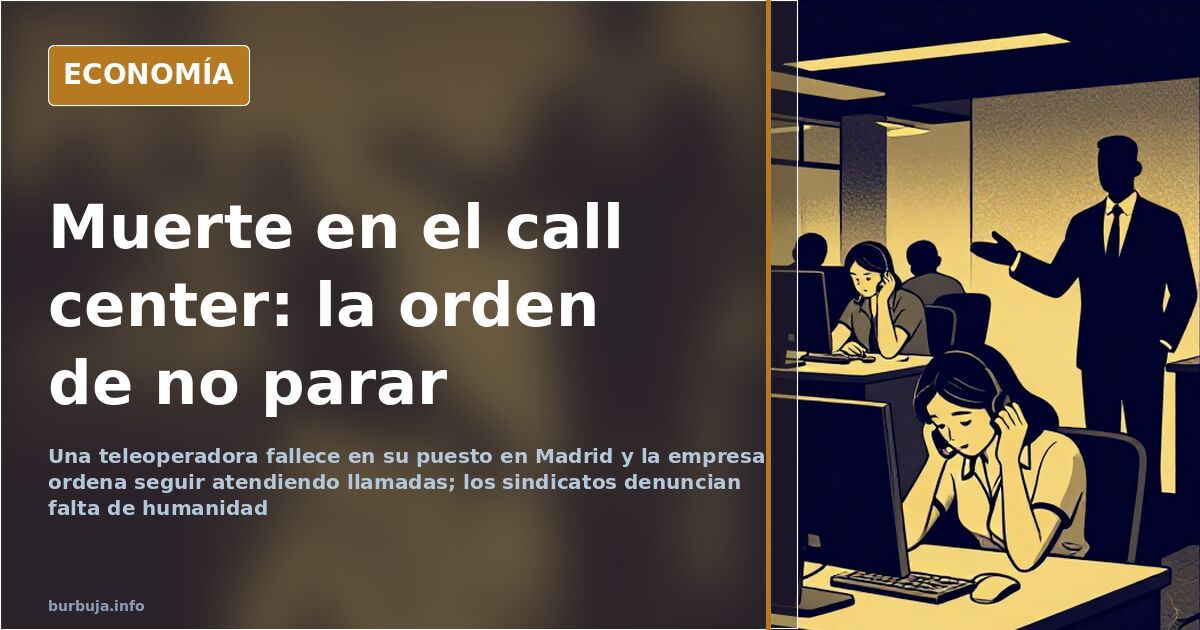
Call Center Operator Dies in Madrid; Shift Continues
A chilling fact stands out: resuscitation attempts failed, the worker died at her post, yet the team continued taking calls. This occurred at Konecta BTO in Madrid, according to CGT, UGT, and USO. The deceased, Inma, handled Iberdrola clients. Management’s explanation: it was an essential service.
Logic breaks down here. A service can be critical; it cannot be so critical that a corpse in the room becomes an operational detail. Ambulance, forensic, and body removal came later. Until then, calls kept coming.
What peine and what unions denounced
The events, as reported by the unions, took place at Konecta BTO’s Madrid headquarters. The operator suddenly collapsed. Resuscitation failed. Management, according to this account, did not stop operations, citing the essential nature of the service.
The response came in writing. CGT, UGT, and USO called for a “lack of humanity, empathy, and respect” and signed a letter in memory of the colleague. CGT referred the case to the Safety and Health Committee to determine responsibilities, demand recognition, investigate, and establish an protocol for such cases. Their statement ends plainly: “It must not happen again.”
Who owns the service that cannot stop?
Behind the call center is a contractor. The person answering the phone does not work for the contract owner, but for an intermediary firm selling hours. Here, the operator is Konecta BTO and the end client is Iberdrola. This is the sector’s standard model: the brand keeps the visible face and outsources personnel, wear, and problems.
This raises the unanswered question. If the service is so essential it cannot pause for a death, why is there no plan B for extreme situations? A power outage, fire, system failure, or threat—who answers calls then? A contractor unable to cover a dramatic absence will hardly cover a catastrophe.
Real life in a call center
Those who have worked in these platforms describe it plainly. Bathroom breaks, timed minutes, and penalties for exceeding them. Contradictory internal circulars on handling incidents. Forbidden words leading to pay cuts. “Shackles on the ears,” described someone who paid tuition working in one of these rooms.
Add to this the job’s mechanics. Every dead minute disrupts the rhythm, and calls pile up. The coordinator pushes, customers get angry about wait times, and the person on the phone takes all the blame. It is not Spain’s worst job by chance; in many cases, it is the worst by design.
How much is paid and how much is charged for you
Some place the sector’s salary around 1,000 euros in Madrid, enough to live in a capital with a noose around the neck or to consider moving to a small town. And there is a detail illustrating the business: according to one operator’s account, the telemarketing company billed double what it paid her. The margin stays with the intermediary, who sometimes built the business from within, seeing the goldmine.
The behind-the-scenes story is always the same. Not long ago, taking bank calls required a university degree; today, the same job requires stamina and little more, with the peculiarity that the brand does not want direct employees: it wants zero problems and providers who absorb the blow.
The shadow of doubt over the account
Not everyone accepts the version. Some claim the case has been debunked multiple times and that UGT confirmed those who wanted could work remotely. Others argue life goes on: if a passenger dies on a alucinación, the bus does not park on the shoulder waiting for paperwork to resolve.
The problem with these excuses is they dodge specifics. No one disputes that death is biologically unavoidable. The question is whether a workplace should maintain activity with an employee’s body still in the room. No remote work agreement fixes that.
What remains to be resolved
The investigation CGT requested in the Safety and Health Committee remains open, and it remains pending for the company to acknowledge the facts and act with a written protocol. Above all, there remains the uncomfortable question. If the service was so essential, why did a contractor with a headcount measured in minutes provide it?
A chilling fact stands out: resuscitation attempts failed, the worker died at her post, yet the team continued taking calls. This occurred at Konecta BTO in Madrid, according to CGT, UGT, and USO. The deceased, Inma, handled Iberdrola clients. Management’s explanation: it was an essential service.
Logic breaks down here. A service can be critical; it cannot be so critical that a corpse in the room becomes an operational detail. Ambulance, forensic, and body removal came later. Until then, calls kept coming.
What peine and what unions denounced
The events, as reported by the unions, took place at Konecta BTO’s Madrid headquarters. The operator suddenly collapsed. Resuscitation failed. Management, according to this account, did not stop operations, citing the essential nature of the service.
The response came in writing. CGT, UGT, and USO called for a “lack of humanity, empathy, and respect” and signed a letter in memory of the colleague. CGT referred the case to the Safety and Health Committee to determine responsibilities, demand recognition, investigate, and establish an protocol for such cases. Their statement ends plainly: “It must not happen again.”
Who owns the service that cannot stop?
Behind the call center is a contractor. The person answering the phone does not work for the contract owner, but for an intermediary firm selling hours. Here, the operator is Konecta BTO and the end client is Iberdrola. This is the sector’s standard model: the brand keeps the visible face and outsources personnel, wear, and problems.
This raises the unanswered question. If the service is so essential it cannot pause for a death, why is there no plan B for extreme situations? A power outage, fire, system failure, or threat—who answers calls then? A contractor unable to cover a dramatic absence will hardly cover a catastrophe.
Real life in a call center
Those who have worked in these platforms describe it plainly. Bathroom breaks, timed minutes, and penalties for exceeding them. Contradictory internal circulars on handling incidents. Forbidden words leading to pay cuts. “Shackles on the ears,” described someone who paid tuition working in one of these rooms.
Add to this the job’s mechanics. Every dead minute disrupts the rhythm, and calls pile up. The coordinator pushes, customers get angry about wait times, and the person on the phone takes all the blame. It is not Spain’s worst job by chance; in many cases, it is the worst by design.
How much is paid and how much is charged for you
Some place the sector’s salary around 1,000 euros in Madrid, enough to live in a capital with a noose around the neck or to consider moving to a small town. And there is a detail illustrating the business: according to one operator’s account, the telemarketing company billed double what it paid her. The margin stays with the intermediary, who sometimes built the business from within, seeing the goldmine.
The behind-the-scenes story is always the same. Not long ago, taking bank calls required a university degree; today, the same job requires stamina and little more, with the peculiarity that the brand does not want direct employees: it wants zero problems and providers who absorb the blow.
The shadow of doubt over the account
Not everyone accepts the version. Some claim the case has been debunked multiple times and that UGT confirmed those who wanted could work remotely. Others argue life goes on: if a passenger dies on a alucinación, the bus does not park on the shoulder waiting for paperwork to resolve.
The problem with these excuses is they dodge specifics. No one disputes that death is biologically unavoidable. The question is whether a workplace should maintain activity with an employee’s body still in the room. No remote work agreement fixes that.
What remains to be resolved
The investigation CGT requested in the Safety and Health Committee remains open, and it remains pending for the company to acknowledge the facts and act with a written protocol. Above all, there remains the uncomfortable question. If the service was so essential, why did a contractor with a headcount measured in minutes provide it?
Also available in: Deutsch
Summary of a discussion on Burbuja.info - Foro de economía, actualidad y política., translated from Spanish and reviewed before publication. Read the full discussion (329 replies).
More summaries
-
Madrid's Insecurity Perception and Political Debate
Analysis of insecurity perception in Madrid and the debate on migration policies fueling social tension.
-
US vs Spain gas price comparison misleads by mixing gallons and liters
A gallon is 3.78 liters: comparing $4 per gallon in the US with €1.99 per liter in Spain omits the conversion.
-
Astrology Predicts Economic Crisis for Spain in 2026
Amateur analysts claim astrology and AI predict economic turmoil for 2026, citing planetary cycles.
-
Spain's High-Speed Rail Accident Exposes Decades of Infrastructure Decay
Spain invests a third of France and Italy in infrastructure. Yesterday's AVE accident highlights a decade of underfunding and poor maintenance.
-
Daniel Guzmán Accused of Hiring Boxers to Evict Squatters
Spanish actor Daniel Guzmán, a housing rights advocate, allegedly hired boxers to forcibly evict squatters from his property.
-
Trump supporters: Are you truly complicit?
Cheap US gas at €0.70 vs $2,800 hospital bills: analyzing why some Spaniards back Trump's Venezuela intervention.