
Burry warns of AI bubble but avoids betting against it
Michael Burry returns to X after a year, warning of an AI-driven bubble. Nvidia surged 1,200% since 2023, yet he chooses not to short.
English · Original discussion in Spanish · Published
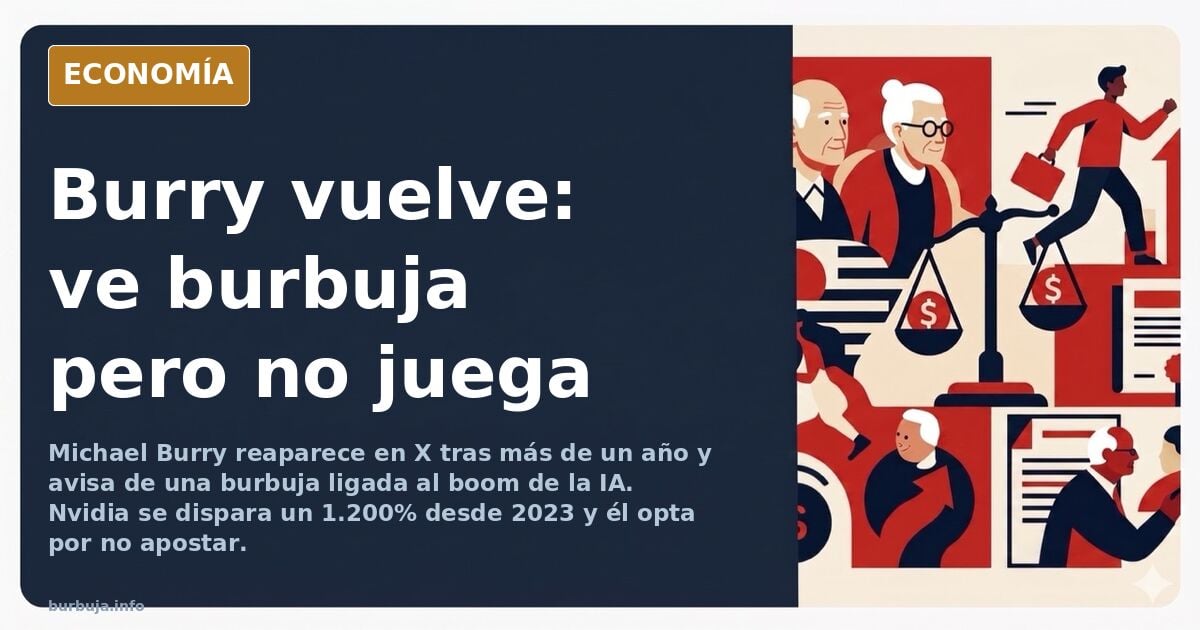
Burry warns of AI bubble but avoids betting against it
What good is a prophet who gets the what right but fails on the when? Michael Burry, the manager who anticipated the 2008 crisis and became a legend in The Big Short, has returned to social network X after more than a year of silence with a message that points to no one and everything: "Sometimes we see bubbles. Sometimes there is something to do about it. Sometimes the only winning move is not to play." He accompanied this with an image of Christian Bale, the actor who portrayed him, looking at a screen with astonishment. The quote comes from WarGames (1983). His bio on X now reads "Someone willing to share what they know" and his profile is named "Cassandra Unchained," referring to the mythological prophetess whom no one believed.
Which bubble he flags and why he doesn't attack it
He does not state it explicitly, but everything points to the stock market boom driven by artificial intelligence. Nvidia has surged more than 1,200% since early 2023 and reached a valuation of $5 trillion, an unprecedented figure that has pushed the Nasdaq 100 and S&P 500 to historic highs. The Scion Asset Management manager is famous for his contrarian character: he was one of the first to warn of the real estate market danger before 2008 and did so by betting heavily. This time, however, he opts for prudence. He is not playing.
Recent history helps explain the change in tone. In 2021, he alerted to what he called "the largest speculative bubble in all assets ever," criticizing the frenzy of meme stocks like GameStop, cryptocurrencies, and companies like Tesla or Nvidia. In 2023, he shook markets with a single-word post: "Sell." Shortly after, he disappeared from social media for more than a year. And in Q2 2024, his fund reduced bearish positions and increased bullish exposure, moving from seven to fifteen positions, including buying call options on companies like Estée Lauder, Lululemon, and Chinese tech giants Alibaba and JD.com.
The problem isn't spotting the bubble, it's timing it
This is where the narrative breaks. Some argue that he is very good at detecting market traps, but controlling the "when" is 50% of investment success and depends more on politics than economic analysis. The most cited case is Tesla: according to one participant, since 2020 he accumulated short positions with hundreds of thousands of shares in put options, while the stock has continued to rise. The recurring conclusion is uncomfortable: he became famous due to lucky timing, and since then many treat him as a guru when he was simply a lucky eccentric.
The parallel with other sector prophets is inevitable. Harry Dent has spent decades writing books about the collapse of the American economy; asked how many times he has been right, the summary is "many predictions, very few or no actual matches in time and depth." The difference is that Burry puts his own money at risk, which honors him, although calling himself Cassandra is, at least, pretentious.
AI as the perfect excuse for a new bubble
Fundamentally, Burry's warning is one of caution and risk management, not a "sell now" signal. The gap between invested capital and the narrative ahead of real revenues, along with cross-financing within the AI ecosystem, can amplify any movement. The most repeated thesis is not a 2000-style crash, but a wide sideways range with drops within it, closure of non-viable startups and projects, and natural selection as expectations adjust to reality. The race for AI and robotics pushes governments to act as guarantors and first customers: compute contracts, secured energy, fast permits, credits, and guarantees. This provides a floor and extends the cycle.
Burry himself has added ammunition in his recent messages. He warned that cloud giants are "cosmetically" inflating profits by extending the useful life of their servers and networks: moving from 3-4 years to 5-6 reduces accounting depreciation and boosts profit without increasing cash flow. It is not illegal if justified, but shifts the cost to 2026-2028 in the form of higher amortization or impairments. He also pointed to Palantir's CEO and corrected the interpretation of Form 13F filings, which only show long positions and purchased options with a delay: if a put option appears, it may be a hedge or part of a combined strategy, and the circulating percentage is usually the underlying notional, which inflates the figure.
The rigged market and the retail investor who cannot exit
The underlying discussion is different. Some argue that there are actors capable of moving entire countries with a click and taking stock markets wherever they want, however they want, whenever they want. If that is true, Burry's message would be: don't play against them, because whatever you do, you will lose. The poker metaphor with colluding players who know the cards describes the feeling well. Opposing this is the practical argument: if you have money, there is no option not to play, because the alternative is cash, which depreciates. Stocks can be backed by goods and services with real value. The system is rigged, but one can survive in it and even win. Those who definitely lose are those without money, those with liabilities, or those leaving it in the bank watching it lose value.
Meanwhile, AI continues its path. Of every hundred companies, two or three will remain alive, especially in a technology requiring obscene investments. Pharaonic data centers will materialize; AI has military and hegemonic translation, it is not just private interest or a trend. Many may lose and go bankrupt, but the industry will happen regardless. It is a way to extract money from many people to build something new.
In the end, the lingering question is the usual one: if everyone says the crash is two months away, it likely takes much longer. And if everyone prepares for the same thing, they will only ensure the opposite happens. Burry knows this. That is why, this time, he is not playing.
What good is a prophet who gets the what right but fails on the when? Michael Burry, the manager who anticipated the 2008 crisis and became a legend in The Big Short, has returned to social network X after more than a year of silence with a message that points to no one and everything: "Sometimes we see bubbles. Sometimes there is something to do about it. Sometimes the only winning move is not to play." He accompanied this with an image of Christian Bale, the actor who portrayed him, looking at a screen with astonishment. The quote comes from WarGames (1983). His bio on X now reads "Someone willing to share what they know" and his profile is named "Cassandra Unchained," referring to the mythological prophetess whom no one believed.
Which bubble he flags and why he doesn't attack it
He does not state it explicitly, but everything points to the stock market boom driven by artificial intelligence. Nvidia has surged more than 1,200% since early 2023 and reached a valuation of $5 trillion, an unprecedented figure that has pushed the Nasdaq 100 and S&P 500 to historic highs. The Scion Asset Management manager is famous for his contrarian character: he was one of the first to warn of the real estate market danger before 2008 and did so by betting heavily. This time, however, he opts for prudence. He is not playing.
Recent history helps explain the change in tone. In 2021, he alerted to what he called "the largest speculative bubble in all assets ever," criticizing the frenzy of meme stocks like GameStop, cryptocurrencies, and companies like Tesla or Nvidia. In 2023, he shook markets with a single-word post: "Sell." Shortly after, he disappeared from social media for more than a year. And in Q2 2024, his fund reduced bearish positions and increased bullish exposure, moving from seven to fifteen positions, including buying call options on companies like Estée Lauder, Lululemon, and Chinese tech giants Alibaba and JD.com.
The problem isn't spotting the bubble, it's timing it
This is where the narrative breaks. Some argue that he is very good at detecting market traps, but controlling the "when" is 50% of investment success and depends more on politics than economic analysis. The most cited case is Tesla: according to one participant, since 2020 he accumulated short positions with hundreds of thousands of shares in put options, while the stock has continued to rise. The recurring conclusion is uncomfortable: he became famous due to lucky timing, and since then many treat him as a guru when he was simply a lucky eccentric.
The parallel with other sector prophets is inevitable. Harry Dent has spent decades writing books about the collapse of the American economy; asked how many times he has been right, the summary is "many predictions, very few or no actual matches in time and depth." The difference is that Burry puts his own money at risk, which honors him, although calling himself Cassandra is, at least, pretentious.
AI as the perfect excuse for a new bubble
Fundamentally, Burry's warning is one of caution and risk management, not a "sell now" signal. The gap between invested capital and the narrative ahead of real revenues, along with cross-financing within the AI ecosystem, can amplify any movement. The most repeated thesis is not a 2000-style crash, but a wide sideways range with drops within it, closure of non-viable startups and projects, and natural selection as expectations adjust to reality. The race for AI and robotics pushes governments to act as guarantors and first customers: compute contracts, secured energy, fast permits, credits, and guarantees. This provides a floor and extends the cycle.
Burry himself has added ammunition in his recent messages. He warned that cloud giants are "cosmetically" inflating profits by extending the useful life of their servers and networks: moving from 3-4 years to 5-6 reduces accounting depreciation and boosts profit without increasing cash flow. It is not illegal if justified, but shifts the cost to 2026-2028 in the form of higher amortization or impairments. He also pointed to Palantir's CEO and corrected the interpretation of Form 13F filings, which only show long positions and purchased options with a delay: if a put option appears, it may be a hedge or part of a combined strategy, and the circulating percentage is usually the underlying notional, which inflates the figure.
The rigged market and the retail investor who cannot exit
The underlying discussion is different. Some argue that there are actors capable of moving entire countries with a click and taking stock markets wherever they want, however they want, whenever they want. If that is true, Burry's message would be: don't play against them, because whatever you do, you will lose. The poker metaphor with colluding players who know the cards describes the feeling well. Opposing this is the practical argument: if you have money, there is no option not to play, because the alternative is cash, which depreciates. Stocks can be backed by goods and services with real value. The system is rigged, but one can survive in it and even win. Those who definitely lose are those without money, those with liabilities, or those leaving it in the bank watching it lose value.
Meanwhile, AI continues its path. Of every hundred companies, two or three will remain alive, especially in a technology requiring obscene investments. Pharaonic data centers will materialize; AI has military and hegemonic translation, it is not just private interest or a trend. Many may lose and go bankrupt, but the industry will happen regardless. It is a way to extract money from many people to build something new.
In the end, the lingering question is the usual one: if everyone says the crash is two months away, it likely takes much longer. And if everyone prepares for the same thing, they will only ensure the opposite happens. Burry knows this. That is why, this time, he is not playing.
Also available in: Deutsch
Summary of a discussion on Burbuja.info - Foro de economía, actualidad y política., translated from Spanish and reviewed before publication. Read the full discussion (128 replies).
More summaries
-
Forum post details woman having 5-10 dates monthly
A forum user claims an acquaintance has 5-10 relationships monthly after a 13-year breakup, sparking debate on desirability.
-
YouTube's Cuqui Family: Profiting from Junk Food and Plastics
Burbuja.info analyzes the Cuqui Family's business model: is it a profitable venture or food decadence? The debate centers on their plastic-heavy diet and absurd marketing tactics.
-
Spanish Tax Office Adds Pre-Death Withdrawals to Inheritance
Withdrawing funds before death does not lower Spain's inheritance tax; the tax authority adds them back if present in accounts the prior year.
-
Internet forums dying: bots now drive 51% of traffic
Users claim bots generate half of web traffic, leaving independent forums in decline due to lack of new members and poor search visibility.
-
South Korea faces demographic collapse with birth rate at 0.72
South Korea's fertility rate has dropped to 0.72, prompting projections of a population decline to 38 million by 2070.
-
Kitchen Renovation Costs in Spain: €1,500 to Over €25,000
Budgets for renovating an 8 m² kitchen in Spain range from DIY projects at €1,500 to full renovations exceeding €25,000.