
Forum post details woman having 5-10 dates monthly
A forum user claims an acquaintance has 5-10 relationships monthly after a 13-year breakup, sparking debate on desirability.
English · Original discussion in Spanish · Published
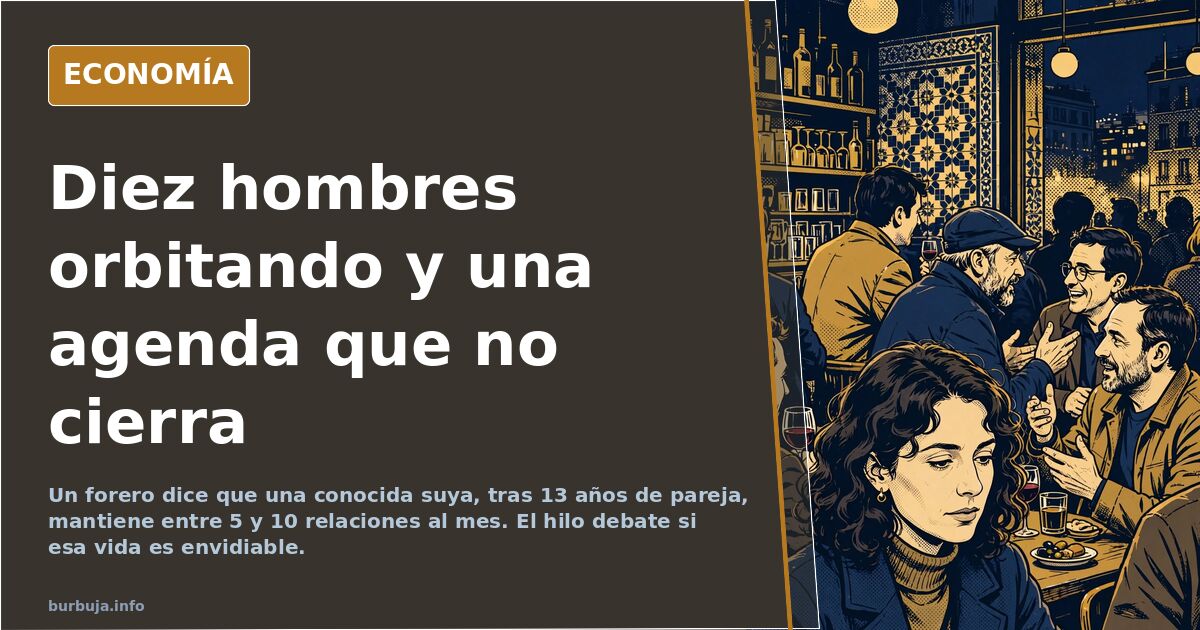
Forum user describes acquaintance multiplying dates after 13-year relationship
After thirteen years of cohabitation and a recent breakup, the protagonist’s schedule reportedly includes five to ten sensual encounters per month. The account comes from an acquaintance who describes her as attractive, intelligent, a sci-fi fan, and socially active to the point of exhaustion: spending six hours daily replying to messages with dozens of unanswered conversations open. The central question isn’t whether she enjoys it, but if this lifestyle is enviable.
The narrative concerns someone known to the author, whose name is omitted despite his note that she is somewhat famous. This elevates the story beyond gossip, offering a window into how, according to him, the dating market operates for a young, attractive woman with high social capital.
How many dates fit in a month?
The author’s calculation is striking. Meeting twenty new men monthly while maintaining ten from previous months results in one or two encounters weekly among thirty candidates, averaging five to ten relationships per month. It’s not constant; it’s intermittent with peaks.
This volume has a downside the story doesn’t hide: rejection. Most candidates fail to pass the filter, with several dropping out weekly. The author calls these rejections wounds to the heart. He suggests the partying comes with an emotional bill.
What does having ten men orbiting miccionan?
The scene depicts a woman working near leisure areas, grabbing beers nightly in the same circuit. She surrounds herself with about ten men who orbit her fairly consistently, plus new acquaintances due to her sociability. Not all are romantic prospects; many are friends or casual bar companions.
The author emphasizes a often-overlooked point: she doesn’t sleep with just anyone. He claims she requires strong emotional connection, without which nothing happens. The tension between this requirement and the high volume of dates is the core issue.
The problem isn’t her, it’s whoever falls in love
Here the story becomes uncomfortable. The author imagines pursuing something serious with her as akin to hell itself. His logic: no matter how funny, tall, rich, or skilled a candidate is, there will always be someone better. Meanwhile, the wheel keeps turning.
This point dominates subsequent discussion. Debates focus not on her freedom, but on whether a man seeking stability can compete with a constant influx of novelty. The author’s answer is no.
The bill nobody signs
The story ends neither happily nor disastrously, but with doubt: is this life enviable or a trap? The author acknowledges she enjoys it but also accumulates rejections, with her romantic life failing to settle into anything stable. He asks if this defines the modern woman or just one specific instance.
The material’s response is ambiguous yet interesting. There is no explicit condemnation, nor celebration—just a detailed description of a lifestyle that appears exhausting from the outside.
After thirteen years of cohabitation and a recent breakup, the protagonist’s schedule reportedly includes five to ten sensual encounters per month. The account comes from an acquaintance who describes her as attractive, intelligent, a sci-fi fan, and socially active to the point of exhaustion: spending six hours daily replying to messages with dozens of unanswered conversations open. The central question isn’t whether she enjoys it, but if this lifestyle is enviable.
The narrative concerns someone known to the author, whose name is omitted despite his note that she is somewhat famous. This elevates the story beyond gossip, offering a window into how, according to him, the dating market operates for a young, attractive woman with high social capital.
How many dates fit in a month?
The author’s calculation is striking. Meeting twenty new men monthly while maintaining ten from previous months results in one or two encounters weekly among thirty candidates, averaging five to ten relationships per month. It’s not constant; it’s intermittent with peaks.
This volume has a downside the story doesn’t hide: rejection. Most candidates fail to pass the filter, with several dropping out weekly. The author calls these rejections wounds to the heart. He suggests the partying comes with an emotional bill.
What does having ten men orbiting miccionan?
The scene depicts a woman working near leisure areas, grabbing beers nightly in the same circuit. She surrounds herself with about ten men who orbit her fairly consistently, plus new acquaintances due to her sociability. Not all are romantic prospects; many are friends or casual bar companions.
The author emphasizes a often-overlooked point: she doesn’t sleep with just anyone. He claims she requires strong emotional connection, without which nothing happens. The tension between this requirement and the high volume of dates is the core issue.
The problem isn’t her, it’s whoever falls in love
Here the story becomes uncomfortable. The author imagines pursuing something serious with her as akin to hell itself. His logic: no matter how funny, tall, rich, or skilled a candidate is, there will always be someone better. Meanwhile, the wheel keeps turning.
This point dominates subsequent discussion. Debates focus not on her freedom, but on whether a man seeking stability can compete with a constant influx of novelty. The author’s answer is no.
The bill nobody signs
The story ends neither happily nor disastrously, but with doubt: is this life enviable or a trap? The author acknowledges she enjoys it but also accumulates rejections, with her romantic life failing to settle into anything stable. He asks if this defines the modern woman or just one specific instance.
The material’s response is ambiguous yet interesting. There is no explicit condemnation, nor celebration—just a detailed description of a lifestyle that appears exhausting from the outside.
Also available in: Deutsch
Summary of a discussion on Burbuja.info - Foro de economía, actualidad y política., translated from Spanish and reviewed before publication. Read the full discussion (172 replies).
More summaries
-
Free Dinners and Saturated Apps: The Dating Market Divide
A 30 euro dinner, another for 70, and the question that divides: who pays for the first date and what that spending reveals about Spain's dating market.
-
STIs surge in Spain: Gonorrhea up 25x, HPV rising
Gonorrhea cases rose 25-fold and chlamydia by 245% since 2016. STI rates are climbing sharply, now affecting women over 50.
-
Zero Dates in a Lifetime: A Forum User's Surrender
A forum user with no dating history says his window has closed; others blame the market or self-sabotage.
-
Lola Gallardo, OnlyFans, and the Business of Women's Football
The debate around Lola Gallardo and OnlyFans hides an economic question: who pays for women's football and who has the right to monetize the image of...
-
Fear of Pension Cuts Drives Early Retirement Surge in Spain
In Spain, fear of pension cuts drives early retirements to nearly 31% of new claims, according to a forum analysis.
-
Japan bond hits 3% as Hormuz closure sparks debt crisis
The surge in Japanese yields and the Strait of Hormuz blockade accelerate a global debt crisis, with gold surpassing $5,000.