
Spanish Tax Office Adds Pre-Death Withdrawals to Inheritance
Withdrawing funds before death does not lower Spain's inheritance tax; the tax authority adds them back if present in accounts the prior year.
English · Original discussion in Spanish · Published
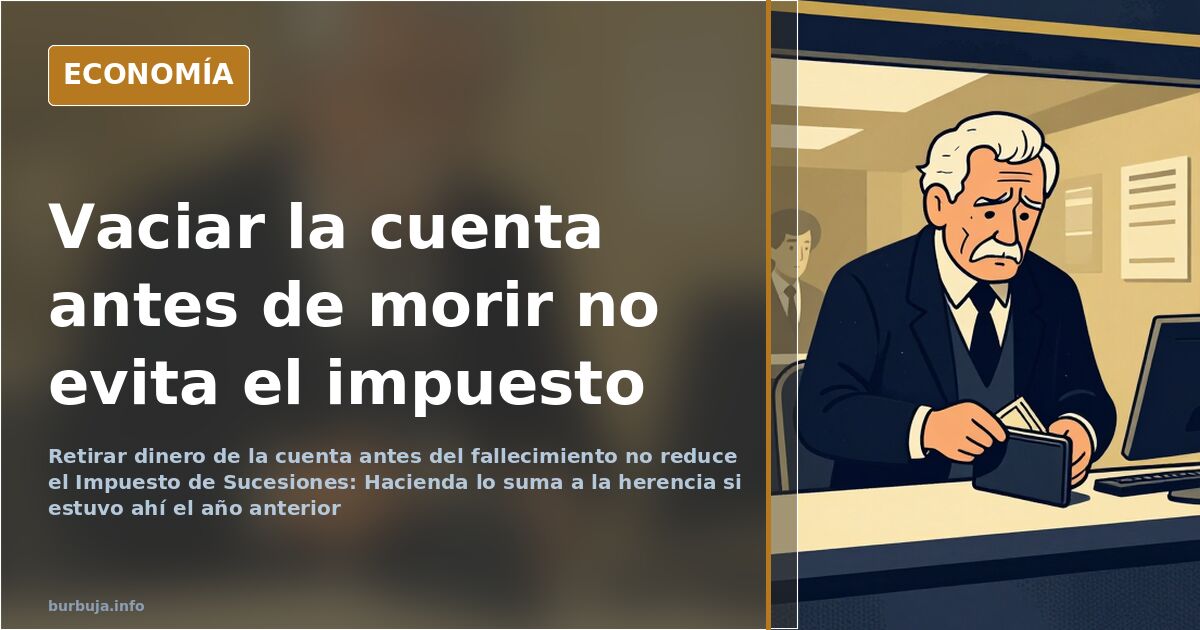
Pre-death withdrawals do not reduce Spanish inheritance tax
Moving money out of a sick relative's account to pay less Impuesto de Sucesiones (Spanish inheritance tax) is ineffective. Lawyer and economist David Jiménez states clearly: "The answer is no." The regulations include the presumption of addition of assets, allowing the administration to include money held in the deceased's accounts during the previous year in the estate, even if absent at death. Last-minute emptying saves nothing and may cost more.
Timing is key. The law presumes all funds in the deceased's account over the past year are part of the taxable estate. To rebut this, one must prove genuine spending, not tax avoidance. Invoices and bank records serve as proof. Without documentation, Hacienda (Spanish Tax Agency) adds it anyway.
What happens when Hacienda detects withdrawals
Bank movements coinciding with death attract administrative attention. If deemed a maneuver to lower taxes, the amount is added back to the estate calculation. Lack of justification can trigger inquiries from heirs. This presumption applies automatically and persists despite the missing balance.
Jiménez warns: "Be very careful about emptying accounts to avoid taxation, as surprises with Hacienda trinc." He emphasizes planning and documenting assets before inheritance occurs. Shared ownership, donations, joint accounts, and financial products have different tax rules; timely analysis prevents errors.
The fine print: normal vs. suspicious movements
The presumption does not flag every expense. Normal account activity poses no issue. Problems arise when someone suddenly empties an account due to evident health deterioration. That triggers scrutiny. The difference between documented routine spending and last-minute emptying determines whether you receive a letter or not.
Some argue the rule punishes planners and rewards improvisers. Optimists believe keeping invoices suffices; pessimists assume any withdrawal near death is reviewed. Death dates are unknown, but many sense the end approaching, starting the problem.
Cash holdings and distrust of banks
Recent analyses extend beyond taxes to banking practices. Some institutions are criticized for blocking accounts and securities portfolios for months after death, even with full documentation. One shared experience suggests mentioning the Banco de España (Bank of Spain) resolves cases quickly.
Underlying this is broader distrust of movement controls. Critics claim Hacienda assumes you cannot spend your own money, viewing it as theirs, presuming guilt by default for ordinary citizens. Some conclude holding minimal bank funds and using cash is safer. However, cash leaves no trace, attracting intense scrutiny.
Donations, municipal land value tax, and tax drip
Inheritance connects to another complaint: all parent-to-child transfers are taxed via Impuesto de Sucesiones or Impuesto de Donaciones (gift tax). Giving €20,000 for a car incurs tax, regardless of allowances. A common case involves spouses owning a home 50/50; upon husband's death, the widow pays plusvalía municipal (municipal land value tax) on half the property. Is it normal to pay tax on the home you still live in?
Defenders cite allowances: legal exemptions and bonuses up to 95%, or 100% in some cases without real value increase. They argue those hit hardest engage in schemes or fail to inform themselves. Opponents counter that paying only when there is actual gain is obvious; otherwise, everyone pays. The disagreement lies in how many fall into each category.
With these elements, inheritance tax planning resembles an obstacle course rather than a strategy. How many empty grandparents' accounts out of greed versus antiestéticar of inability to pay?
Moving money out of a sick relative's account to pay less Impuesto de Sucesiones (Spanish inheritance tax) is ineffective. Lawyer and economist David Jiménez states clearly: "The answer is no." The regulations include the presumption of addition of assets, allowing the administration to include money held in the deceased's accounts during the previous year in the estate, even if absent at death. Last-minute emptying saves nothing and may cost more.
Timing is key. The law presumes all funds in the deceased's account over the past year are part of the taxable estate. To rebut this, one must prove genuine spending, not tax avoidance. Invoices and bank records serve as proof. Without documentation, Hacienda (Spanish Tax Agency) adds it anyway.
What happens when Hacienda detects withdrawals
Bank movements coinciding with death attract administrative attention. If deemed a maneuver to lower taxes, the amount is added back to the estate calculation. Lack of justification can trigger inquiries from heirs. This presumption applies automatically and persists despite the missing balance.
Jiménez warns: "Be very careful about emptying accounts to avoid taxation, as surprises with Hacienda trinc." He emphasizes planning and documenting assets before inheritance occurs. Shared ownership, donations, joint accounts, and financial products have different tax rules; timely analysis prevents errors.
The fine print: normal vs. suspicious movements
The presumption does not flag every expense. Normal account activity poses no issue. Problems arise when someone suddenly empties an account due to evident health deterioration. That triggers scrutiny. The difference between documented routine spending and last-minute emptying determines whether you receive a letter or not.
Some argue the rule punishes planners and rewards improvisers. Optimists believe keeping invoices suffices; pessimists assume any withdrawal near death is reviewed. Death dates are unknown, but many sense the end approaching, starting the problem.
Cash holdings and distrust of banks
Recent analyses extend beyond taxes to banking practices. Some institutions are criticized for blocking accounts and securities portfolios for months after death, even with full documentation. One shared experience suggests mentioning the Banco de España (Bank of Spain) resolves cases quickly.
Underlying this is broader distrust of movement controls. Critics claim Hacienda assumes you cannot spend your own money, viewing it as theirs, presuming guilt by default for ordinary citizens. Some conclude holding minimal bank funds and using cash is safer. However, cash leaves no trace, attracting intense scrutiny.
Donations, municipal land value tax, and tax drip
Inheritance connects to another complaint: all parent-to-child transfers are taxed via Impuesto de Sucesiones or Impuesto de Donaciones (gift tax). Giving €20,000 for a car incurs tax, regardless of allowances. A common case involves spouses owning a home 50/50; upon husband's death, the widow pays plusvalía municipal (municipal land value tax) on half the property. Is it normal to pay tax on the home you still live in?
Defenders cite allowances: legal exemptions and bonuses up to 95%, or 100% in some cases without real value increase. They argue those hit hardest engage in schemes or fail to inform themselves. Opponents counter that paying only when there is actual gain is obvious; otherwise, everyone pays. The disagreement lies in how many fall into each category.
With these elements, inheritance tax planning resembles an obstacle course rather than a strategy. How many empty grandparents' accounts out of greed versus antiestéticar of inability to pay?
Also available in: Deutsch
Summary of a discussion on Burbuja.info - Foro de economía, actualidad y política., translated from Spanish and reviewed before publication. Read the full discussion (126 replies).
More summaries
-
Spanish Tax Agency: Epiphany Gifts Are Donations
The Spanish Tax Agency clarifies that receiving money or goods without consideration is a donation, subject to the Inheritance and Gift Tax.
-
Renouncing an inheritance to a sibling triggers Inheritance Tax
Spain's DGT confirms that renouncing an inheritance in favor of a sibling is treated as prior acceptance, triggering both Inheritance and Gift taxes.
-
Madrid Protest Camp Robberies Spark Debate Over Security
Activists camping in Madrid's Puerta del Sol report thefts of electronics, while the assembly avoids naming suspects.
-
Miami hospital bills $40,000 for broken arm
A broken humerus in Miami led to a €40,000 bill. The family negotiated a discount and contacted their insurer, having skipped travel insurance.
-
Spain Reservoirs Hit 66% vs 48% in 2023, Challenging Drought Narrative
Reservoir data shows Spain's water levels rose from 48.24% to 66.30% in one year, with Catalonia increasing significantly.
-
Illa denies mandatory vaccination amid COVID passport debate
Salvador Illa claims no one was forced to vaccinate. However, the use of COVID passports and PCR tests has reignited debates on coercion.