
Budget DIY concrete pool: €9,000 versus €15,000 from a contractor
Building a 9x4.5-metre pool yourself costs €9,000 compared with the €15,000 a professional charges. A full breakdown of materials and the irrigation pond trick.
English · Original discussion in Spanish · Published
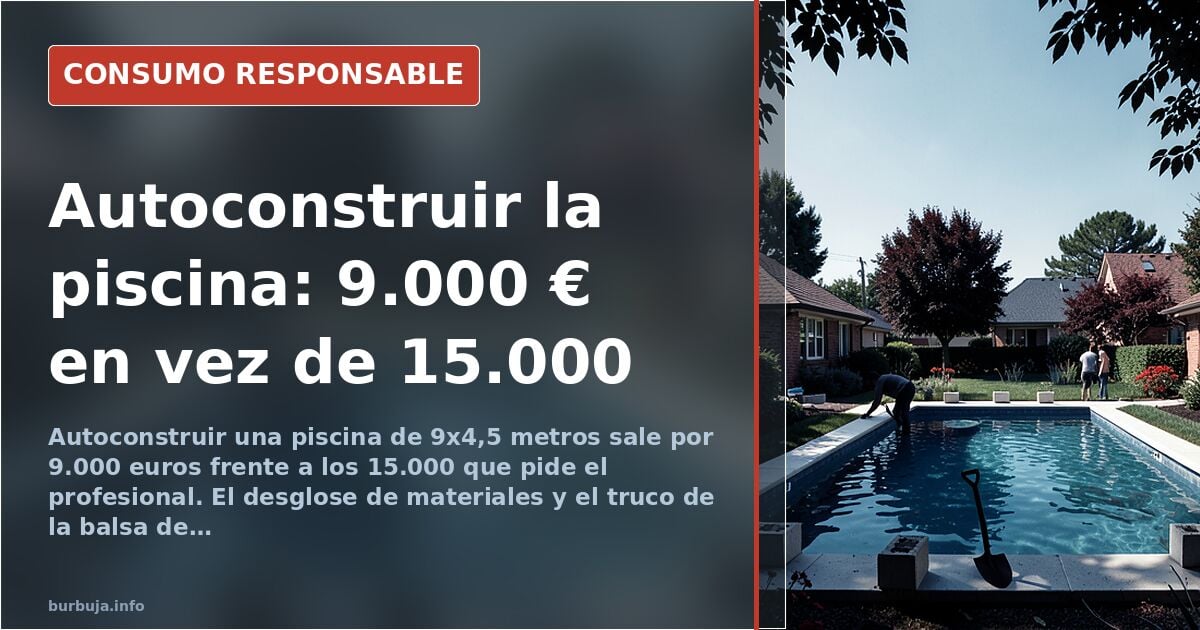
Block and concrete pool: €9,000 versus €15,000 from a contractor
A 9 by 4.5-metre shell, shotcrete, glass mosaic tiles and a filter pump. The quotes came in at €15,000. Doing it yourself, with the only outside help being the concrete spraying, the bill dropped to €9,000. The difference —€6,000— is the price of the labour you save when you have time, a vegetable garden and a certain tolerance for embarrassment. Building your own pool is not a rich man's whim: it is an economic decision with fine print.
How much a DIY in-ground pool costs
The breakdown circulating among those who have taken the plunge is revealing. Excavation: €870. Four thousand kilos of sand and two thousand of gravel: €170. Thirty bags of cement: €120. Twenty-five litres of waterproofing: €20. Steel and mesh: €400. Shotcrete and materials: €3,800. Coping stones: €410. The glass mosaic tiles and edging complete the list. The full calculation, item by item, leaves a margin that surprises.
The construction technique has its logic. A 20-centimetre thermoclay perimeter, gravel at the bottom, a steel grid on the floor and sides, and sprayed concrete. Then the tiles and the trim. Nothing a patient handyman cannot tackle, although the shotcrete is best left to a company: it is the only thing you pay for.
Concrete block, thermoclay or polyester tank
The shell material divides opinion. Concrete blocks come off badly: they are porous and do not offer the watertightness you are looking for. Thermoclay gains ground. For a 2 by 2.5-metre irrigation pond, 1.2 metres deep, the materials come to around €800: some 900 bricks, 35 bags of cement, three cubic metres of sand, gravel, 6-millimetre rebar and piping with inlet and outlet taps. A borrowed cement mixer saves work.
The alternative gaining trinc is the fibreglass polyester tank: 5,000 litres from €850. You cut the top off, bury it and you are done. "A pool is just a big trough," as the quip goes. For those who do not want building work, there are above-ground and frame pools that go up in a day.
The above-ground pool and the irrigation pond trick
Building it above ground avoids excavation, warms the water sooner and causes fewer problems. It is the route chosen by those in a hurry on a tight budget. But there is an administrative nuance worth not ignoring: the word "pool" triggers paperwork and the words "irrigation pond" bypass it. "Applying for a permit is like reporting yourself," one school of thought holds. The minor works licence, the construction tax and the waste fee can exceed the cost of the materials.
The declared purpose of the water —watering the vegetable garden and fruit trees— is what separates a pond from a pool in administrative terms. And that is where common sense comes in: if the tank has a ladder and chlorine, the inspector will see it too.
Water, filtration and maintenance
A 4 by 3-metre pool, 1.5 metres deep, holds 18,000 litres. The filter pump, chlorine and cleaning are the recurring costs that do not appear in the initial budget. Collecting rainwater from the gutters to top up and to water has proven a useful solution that cuts the bill. Mains water, on the other hand, is paid for twice: when filling and when topping up.
The question left hanging is how long it takes a €9,000 pool to pay off compared with an €850 above-ground one. The answer depends on how many summers the concrete lasts and how many the builder's patience lasts.
Also available in: Deutsch
Summary of a discussion on Burbuja.info - Foro de economía, actualidad y política., translated from Spanish and reviewed before publication. Read the full discussion (25 replies).
More summaries
-
Pools in winter: cut pump hours or drain the water?
Filling a 7x5 metre pool costs 200 euros. Winter savings options: fewer pump hours, draining, or heavy chlorination, each with its own risks.
-
Unclogging a kitchen sink drain: drain snake beats bleach and pool chlorine
A flexible drain snake and a garden hose outperform bleach and caustic soda on a 40 mm pipe. Frying grease is the main culprit.
-
Greek yogurt whey: from waste product to profitable ingredient
Straining Greek yogurt leaves 400 ml of whey per batch. Drinking it, making ricotta, cream cheese or replacing buttermilk: uses and recipes.
-
Heating Cost Meters: Genuine Savings or Bureaucratic Scam in Spain?
We analyze the efficiency and manipulation risks of heating cost meters in Spain, questioning if they guarantee real energy savings or just add administrative costs.
-
Replacing a shower tray: a badly fitted valve ends up costing €1,000
A cracked resin shower tray drags down the tiles and pushes the bill to €1,000. The drain itself is cheap; the demolition is what costs everything else.
-
Classic briefs: from El Corte Inglés to the 1-euro market stall
A three-pack of briefs for 3.99 euros or a single pair for 1 euro at a street market: classic men's underwear survives outside the big chains and beyond the boxer.