
Classic briefs: from El Corte Inglés to the 1-euro market stall
A three-pack of briefs for 3.99 euros or a single pair for 1 euro at a street market: classic men's underwear survives outside the big chains and beyond the boxer.
English · Original discussion in Spanish · Published
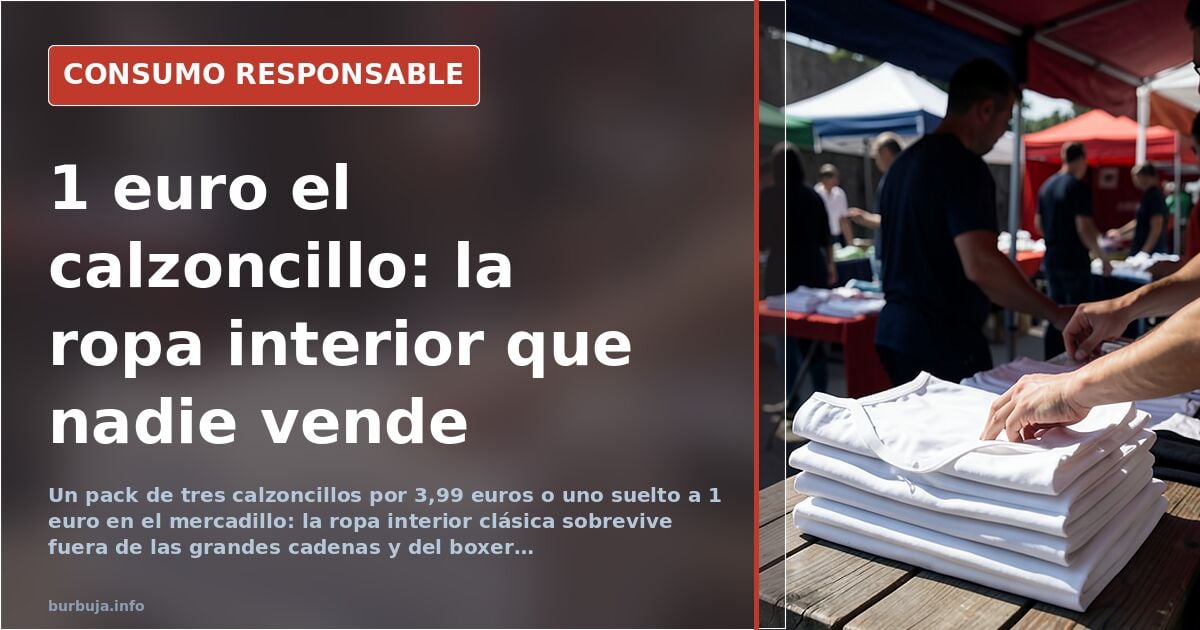
The classic brief survives at the 1-euro street market
A man walks into a fashion store, asks for classic briefs and the shop assistant looks at him as if he had just asked for something indecent. The scene repeats itself in every shopping centre: the classic brief, the kind that doesn't squeeze, with no prints and no waistbands that strangle, has become a rarity that forces men to go on a pilgrimage through hypermarkets, street markets and neighbourhood shops. The search for a cheap, black and loose-fitting garment has become an exercise in resistance against the shop window.
The starting point is a size XXL 60, black, cotton and non-restrictive. No tight boxers, no prints. The reference brand stopped supplying years ago: the quality dropped and the cut got tighter. From there, the list of failures is long. The big chains only offer boxers. Fashion stores don't know what a brief is. And price becomes the definitive filter: anyone who used to pay five euros for two pairs refuses to shell out fifteen for a single one.
What counts as a comfortable brief
The definition is precise: cotton, a loose cut, seams you can't feel and a waistband that doesn't dig in. The problem is that the market has gone in the opposite direction. The tight boxer, with elastane and logos on the waistband, dominates the shelves. Some argue that a 100% cotton boxer, without elastic, isn't uncomfortable either. The debate moves to the fabric composition: 95% cotton and 5% elastane prevails as the usual formula, although some warn that polyester and lycra turn the garment into an oven.
The durability of the waistband is another criterion assessed over time. A home test is even suggested: keep the garment in a drawer for a year and see whether it gives way. Planned obsolescence reaches underwear too.
Where to find briefs that aren't boxers
The hypermarket becomes the refuge. A three-pack for 3.99 euros in colours ranging from jet black to a washed-out black is described as the closest thing to the ideal. The problem, once again, is the heat. The comfortable garment turns out to be stifling. Another supermarket chain offers microfibre, and those who try it say they want nothing else.
The street market wins the day. A brief for 1 euro, with the same 95% cotton and 5% elastane composition, is crowned the best one tested. The irony is obvious: the cheapest and least advertised garment beats the one sold by the big retailers. Neighbourhood shops and haberdasheries with buttons and old-fashioned clothing appear as an alternative for those who don't want to depend on e-commerce.
Price as the red line
The range is narrow. Five euros for two pairs was the benchmark. Anything above that is considered an abuse. Brands made in Spain that boast about quality start at 15 euros per pair, and although it's acknowledged that the feel is different, the outlay doesn't fit. In the sales, three-packs from some classic fashion brands come down to five euros per pair.
Cotton has a cost. Comfort has one too. The question is how much someone who just wants not to notice their underwear is willing to pay.
The conversation drifts towards the stereotype
The search for a discreet garment ends up turning into a debate about what is considered masculine. Some claim that wearing briefs is from another era and that the modern man opts for the boxer. The reply comes quickly: the tight boxer isn't modern, it's uncomfortable. Irony runs through the exchange when the garment is compared to women's underwear or when it's suggested that briefs belong to another generation.
The anecdote comes from a river swim after a run, wearing briefs in front of everyone. The gesture serves to reclaim the garment as something practical and free of hang-ups.
The garment that is never advertised, has no shop window and that almost nobody can name without using a word that sounds like something else still exists. It's at the street market, costs one euro and works better than the one sold with a logo. The premium market hasn't eliminated it: it has only made it invisible.
Also available in: Deutsch
Summary of a discussion on Burbuja.info - Foro de economía, actualidad y política., translated from Spanish and reviewed before publication. Read the full discussion (75 replies).
More summaries
-
Cheap clothes in physical stores: Primark, Kiabi and El Corte Inglés outlets
Primark, Kiabi, Lefties and El Corte Inglés outlets: a guide to buying cheap clothes in physical stores, and why cost per wear changes the calculation
-
El Corte Inglés prepared food: quality at a price
El Corte Inglés croquettes beat Mercadona's, but prices like €21/kg for meat rolls mean it's only worth it for some products.
-
Bedding: mid-range prices beat the extremes
Sheets from Carrefour and Primark fade, while El Corte Inglés and Zara Home ones hold up better. Mid-range pricing and 100% cotton make the difference.
-
Total Renting: Is car leasing for individuals a financial trap?
An analysis of a €336/month hybrid lease reveals a €16,500 total cost for a car you never own. Is leasing worthwhile for private individuals in Spain?
-
Gym at €40 a month or building your own: the debate
A user suggests buying machines to train at home instead of paying a €40 monthly fee; others reply that equipment and space drive the cost up.
-
Replacing four tyres: from €350 to €240 depending on where and how
Four Dunlops fitted and balanced for €325, versus the option of renting a DIY garage bay for €15: the real savings of changing your own tyres turn out to be small, or…