
Unclogging a kitchen sink drain: drain snake beats bleach and pool chlorine
A flexible drain snake and a garden hose outperform bleach and caustic soda on a 40 mm pipe. Frying grease is the main culprit.
English · Original discussion in Spanish · Published
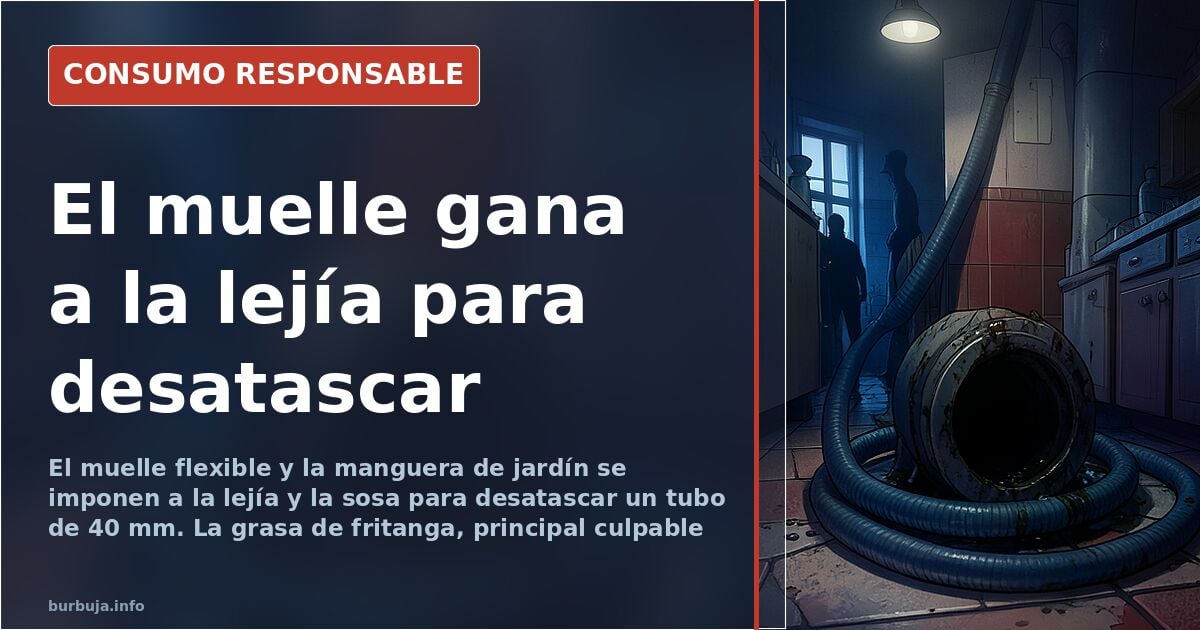
Unclogging the sink: the drain snake wins the war against bleach
The water pools, drains slowly and the plunger does nothing. A 40 mm PVC run with very little fall before joining the 125 mm main stack is the usual suspect. The question that opens the matter is always the same: chemical or mechanical? The answer that wins out in practice, after dozens of failed attempts, is that miracle liquids are of little use once the clog has set.
Why a 40 mm pipe gets clogged
The diagnosis repeats itself: frying grease that saponifies, solidified soap residue and limescale. All of it mixes and forms a hard plug that hot water alone will not dissolve. A professional called to a home put it bluntly: 40 mm is far too little and drains should be 50 or more, but they are not. The consequence is that maintenance matters more than rescue.
The most commonly cited household cause is frying with oil and rinsing dishes with cold water. Wiping grease off with paper before washing and using hot water frequently extends the life of the pipe run. A fixed strainer over the drain, never removed, keeps solid waste from reaching the elbow.
Drain snake, hose and plunger: the mechanical route
The technical consensus points to the flexible drain snake, that cable you feed into the pipe that drags the clog out. It costs around 10 euros at large DIY stores. Those who have tried it compare it to a stroboscopic hose in terms of results. The budget version: a long plastic zip tie with fishbone-style cuts to hook hair.
A garden hose connected to the tap and sealed to the drain with duct tape is another classic. Hot water at full blast, alternating with the plunger, and patience. One case of a shower tray that barely drained was solved in 20 minutes with that method. The risk is ending up soaked before the water pushes through.
The chemistry: from bleach to sulfuric acid
The chemical repertoire runs from baking soda with vinegar —harmless and barely effective on serious clogs— to pearl caustic soda with boiling water, which reacts violently and requires care with splashes. At the extreme end, hardware-store products based on nearly 100% sulfuric acid, with a funnel and safety warnings read twice.
Bleach with hot water is the most repeated formula for maintenance. Also the most debated: fumes in an enclosed space are a real problem, and mixing ammonia with caustic soda or limescale removers can release dangerous fumes. Some flatly maintain that chemicals should not be used to unclog drains and that they only harden the clog.
The pool chlorine trick
The most striking episode: four days with a backed-up bathroom, two bottles of drain cleaner and an improvised steel cable that only made things worse. The solution came, according to one forum user's account, from a scoop of pool chlorine poured into the shower. Half an hour later, the water was flowing. Two more saucepans' worth at the sink and the bottle trap, and the clog shot down the drain with the pull.
It is not a textbook recommendation, and it should be said: pool chlorine is a strong oxidizer that can damage old pipes and generate gases. It worked in that particular case. As a general method, the pattern that emerges is a different one.
What really works, according to accumulated experience
First, remove and check the trap: it is what clogs most and the cheapest to inspect. Then, attack the run with a drain snake and patience. Clogs below the elbows, with solidified soap and limescale, are the toughest and the least responsive to chemicals.
The practical takeaway from the matter: weekly maintenance with very hot water and an annual mechanical cleaning save the call to the plumber. And if your home insurance covers unclogging, the 200-euro-an-hour bill stops being a drama. The lingering question is how many of these clogs are actually a wet wipe that had been growing in the elbow for months.
Also available in: Deutsch
Summary of a discussion on Burbuja.info - Foro de economía, actualidad y política., translated from Spanish and reviewed before publication. Read the full discussion (45 replies).
More summaries
-
Plumber charges 80 euros per hour: the clog he unclogged himself
An architect refuses to pay 80 euros an hour to clear roots and solves it himself. The real cost of manual labor, in question
-
Vinegar for limescale in washing machines and dishwashers: how much and how to use it
Vinegar dissolves limescale in washing machines and dishwashers through an acid-base reaction. The right dose, the method, and why the trick fails in dishwashers if you pour it in…
-
Drill, acid or hammer: how to destroy an old phone
Factory reset removes encryption keys, but many use drills, acid or torches to ensure no data recovery.
-
Mercadona salmon rip-off: tray fillets cost up to 78% more
Mercadona charges up to €25/kg for salmon tray fillets while a whole salmon costs €11/kg. Data and tips to save.
-
Replacing four tyres: from €350 to €240 depending on where and how
Four Dunlops fitted and balanced for €325, versus the option of renting a DIY garage bay for €15: the real savings of changing your own tyres turn out to be small, or…
-
Haircuts in Spain: from 13 euros at the salon to 4.5 with a clipper
Cuts from 4 to 13 euros, clippers that pay for themselves in six uses and bartering with hairdressers: how to cut salon costs without losing your look.