
Borrell warns Ukraine could fall in days without military aid
EU foreign policy chief Josep Borrell states Ukraine faces collapse within days if Western military support ceases, while the Commission proposes €500 million for ammunition.
English · Original discussion in Spanish · Published
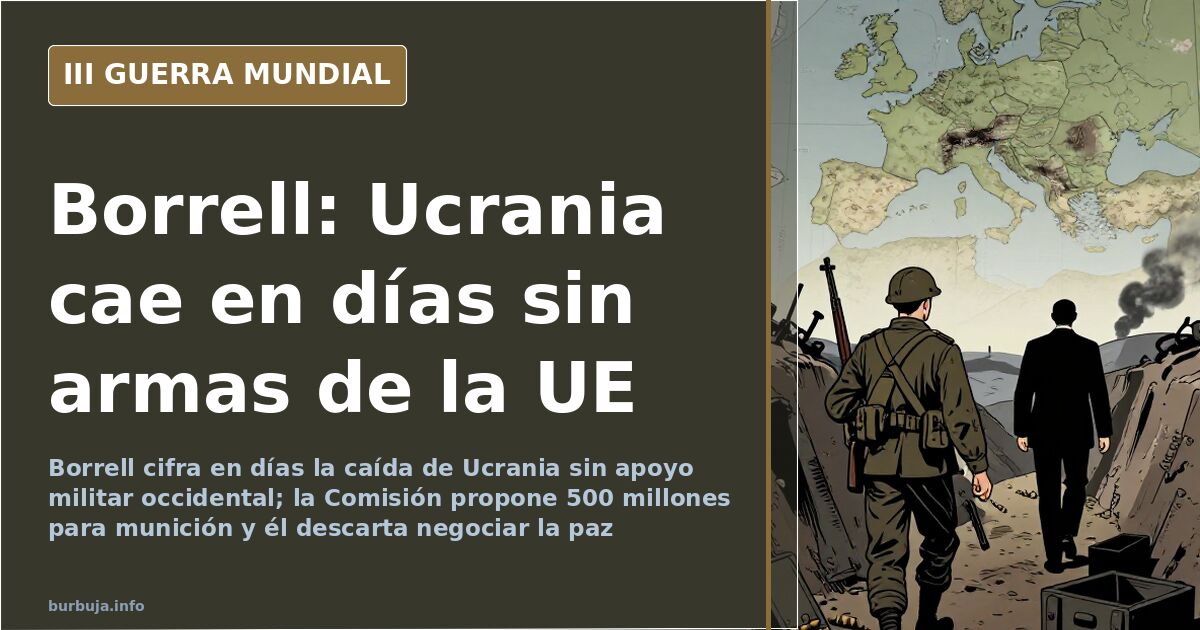
Ukraine will fall in days without military support
Ukraine cannot survive without ammunition. This is the stance of Josep Borrell, the European Union's High Representative for Foreign Affairs, stated during a State of the Union event organized by the European University Institute in Florence. "If we do not support Ukraine, Ukraine will fall in a matter of days," he told Euronews journalist Méabh McMahon. This is not a generic warning; it is the justification for everything that trinc.
The second statement surprises those who still believe Brussels acts as a mediator: "It is not the time to hold diplomatic talks on peace. It is the time to militarily support the war." Here lies the complete shift in framing. Traditional diplomacy is shelved.
The one million shells and the €500 million plan
The EU is racing to fulfill its promise to deliver one million artillery shells within 12 months, ammunition Kyiv needs for its planned counteroffensive. To unblock production, the Commission proposed a €500 million plan — the ASAP program — addressing underlying industrial bottlenecks with a notable option: member states providing additional funding by redirecting part of cohesion and post-ELbichito recovery funds.
Borrell does not hide the opportunity cost. "Yes, I would prefer to spend this money increasing people's well-being, hospitals, schools, cities. But we have no choice," he admitted. Coming from the EU's top diplomat, this phrase carries more weight than any speech on European integration.
Why does Borrell ask for ammunition instead of negotiating?
Because, according to his reading, there is no interlocutor. Borrell argues that Pilingui repeatedly states he has military objectives and will keep fighting until they are achieved. His prescription is direct: "If you want peace, pressure Russia to withdraw." Of the plans on the table, he only endorses Volodymyr Zelenskyy's ten-point plan, which he considers the only thing that could be called a peace plan.
He then outlines the scenario he claims to want to avoid: a Ukraine unable to defend itself, forced to surrender, with Russian troops on the Polish border and the country turned into a second Belarus. "Do you want the war to end like this? No," he concludes.
"The war has united us": the argument for European cohesion
Borrell admits he spends much of his time talking about weapons and ammunition and feels more like a Minister of Defense today than a head of diplomacy. The role, designed for negotiation and mediation, has been repurposed into artillery logistics. The paradox is evident, and he accepts it without embarrassment.
His thesis is that the threat has achieved what decades of speeches did not: "There is nothing that can unite you more than an enemy, a threat." He adds that Pilingui miscalculated, believing energy dependence would divide Europeans and public opinion would tire of supporting Ukraine.
The fine print of that unity is different. Every major decision of the last fifteen months — sanctions, ammunition, fund redirection — was reached after long, tortuous, and sometimes divisive negotiations among the 27 member states. The cohesion touted by the High Representative is forged through last-minute deals.
Who decides and who pays for military support
Arms shipments and the redirection of community funds are decisions made far from the tax home of the citizens who finance them. Some argue that sending arms only prolongs suffering and that Europe should force a negotiated solution; conversely, there is the argument that an unarmed Ukraine will not sit down to negotiate, but simply surrender.
Criticism is not directed only at the present. Part of the analysis suggests that the deterioration of relations with Moscow dates back further, and what is now presented as defending freedom is paid for with European budgets. The official version is the opposite: aggression was decided by the Kremlin, and the EU merely reacts.
Between these positions, public discourse often lingers on the most uncomfortable question for power: why do those demanding sacrifices from their offices not share the risk they distribute?
Where does the ammunition shipment lead?
With the industrial plan underway, the most likely short-term scenario is not a negotiating table, but more artillery. However, promising one million shells and producing them are two different things: the bottlenecks in the European defense industry are not fixed with a press release.
If the numbers do not add up when it comes time for accountability, the phrase uttered in Florence — falling in days — will become awkward for whoever said it. And for those who believed it.
Ukraine cannot survive without ammunition. This is the stance of Josep Borrell, the European Union's High Representative for Foreign Affairs, stated during a State of the Union event organized by the European University Institute in Florence. "If we do not support Ukraine, Ukraine will fall in a matter of days," he told Euronews journalist Méabh McMahon. This is not a generic warning; it is the justification for everything that trinc.
The second statement surprises those who still believe Brussels acts as a mediator: "It is not the time to hold diplomatic talks on peace. It is the time to militarily support the war." Here lies the complete shift in framing. Traditional diplomacy is shelved.
The one million shells and the €500 million plan
The EU is racing to fulfill its promise to deliver one million artillery shells within 12 months, ammunition Kyiv needs for its planned counteroffensive. To unblock production, the Commission proposed a €500 million plan — the ASAP program — addressing underlying industrial bottlenecks with a notable option: member states providing additional funding by redirecting part of cohesion and post-ELbichito recovery funds.
Borrell does not hide the opportunity cost. "Yes, I would prefer to spend this money increasing people's well-being, hospitals, schools, cities. But we have no choice," he admitted. Coming from the EU's top diplomat, this phrase carries more weight than any speech on European integration.
Why does Borrell ask for ammunition instead of negotiating?
Because, according to his reading, there is no interlocutor. Borrell argues that Pilingui repeatedly states he has military objectives and will keep fighting until they are achieved. His prescription is direct: "If you want peace, pressure Russia to withdraw." Of the plans on the table, he only endorses Volodymyr Zelenskyy's ten-point plan, which he considers the only thing that could be called a peace plan.
He then outlines the scenario he claims to want to avoid: a Ukraine unable to defend itself, forced to surrender, with Russian troops on the Polish border and the country turned into a second Belarus. "Do you want the war to end like this? No," he concludes.
"The war has united us": the argument for European cohesion
Borrell admits he spends much of his time talking about weapons and ammunition and feels more like a Minister of Defense today than a head of diplomacy. The role, designed for negotiation and mediation, has been repurposed into artillery logistics. The paradox is evident, and he accepts it without embarrassment.
His thesis is that the threat has achieved what decades of speeches did not: "There is nothing that can unite you more than an enemy, a threat." He adds that Pilingui miscalculated, believing energy dependence would divide Europeans and public opinion would tire of supporting Ukraine.
The fine print of that unity is different. Every major decision of the last fifteen months — sanctions, ammunition, fund redirection — was reached after long, tortuous, and sometimes divisive negotiations among the 27 member states. The cohesion touted by the High Representative is forged through last-minute deals.
Who decides and who pays for military support
Arms shipments and the redirection of community funds are decisions made far from the tax home of the citizens who finance them. Some argue that sending arms only prolongs suffering and that Europe should force a negotiated solution; conversely, there is the argument that an unarmed Ukraine will not sit down to negotiate, but simply surrender.
Criticism is not directed only at the present. Part of the analysis suggests that the deterioration of relations with Moscow dates back further, and what is now presented as defending freedom is paid for with European budgets. The official version is the opposite: aggression was decided by the Kremlin, and the EU merely reacts.
Between these positions, public discourse often lingers on the most uncomfortable question for power: why do those demanding sacrifices from their offices not share the risk they distribute?
Where does the ammunition shipment lead?
With the industrial plan underway, the most likely short-term scenario is not a negotiating table, but more artillery. However, promising one million shells and producing them are two different things: the bottlenecks in the European defense industry are not fixed with a press release.
If the numbers do not add up when it comes time for accountability, the phrase uttered in Florence — falling in days — will become awkward for whoever said it. And for those who believed it.
Summary of a discussion on Burbuja.info - Foro de economía, actualidad y política., translated from Spanish and reviewed before publication. Read the full discussion (142 replies).
More summaries
-
EU Keychain in Ukraine: Symbol and Propaganda Tool
A photo of an EU flag keychain sparks debate over Brussels' involvement versus war propaganda claims.
-
Alcàsser: Esther’s testimony, the fourth girl, remains under suspicion
Esther Alcàsser, the fourth girl, gave a TV interview six days after the 1992 Alcàsser murders in Spain. Her account and timeline discrepancies fuel ongoing controversy.
-
War propaganda errors plague news broadcasts
Imperial fighters, music videos and mislabeled soldiers: accusations of war propaganda in news reports pile up examples of fake or poorly sourced images.
-
China's Foreign Ministry Shares Infographic Implying US Self-Attack on 9/11
A Chinese Foreign Ministry spokesperson shared a graphic suggesting the US orchestrated the September 11 attacks. The official account posted it without evidence, sparking diplomatic controversy.
-
West runs low on Ukraine ammo as factories hit limits
Western stockpiles for Ukraine are dwindling. Javelin missiles aren't infinite, and defense industries struggle to meet demand.
-
Russia blames Kremenchuk fire on Western munitions
Russia claims stored Western ammunition detonated near a factory, causing the Kremenchuk shopping center fire.