
Bilbao estuary tunnel: Opening in 2032, lucrative maintenance
Works on the Lamiako sub-fluvial tunnel have begun, with opening scheduled for 2032. The debate: does it solve mobility or just shift congestion?
English · Original discussion in Spanish · Published
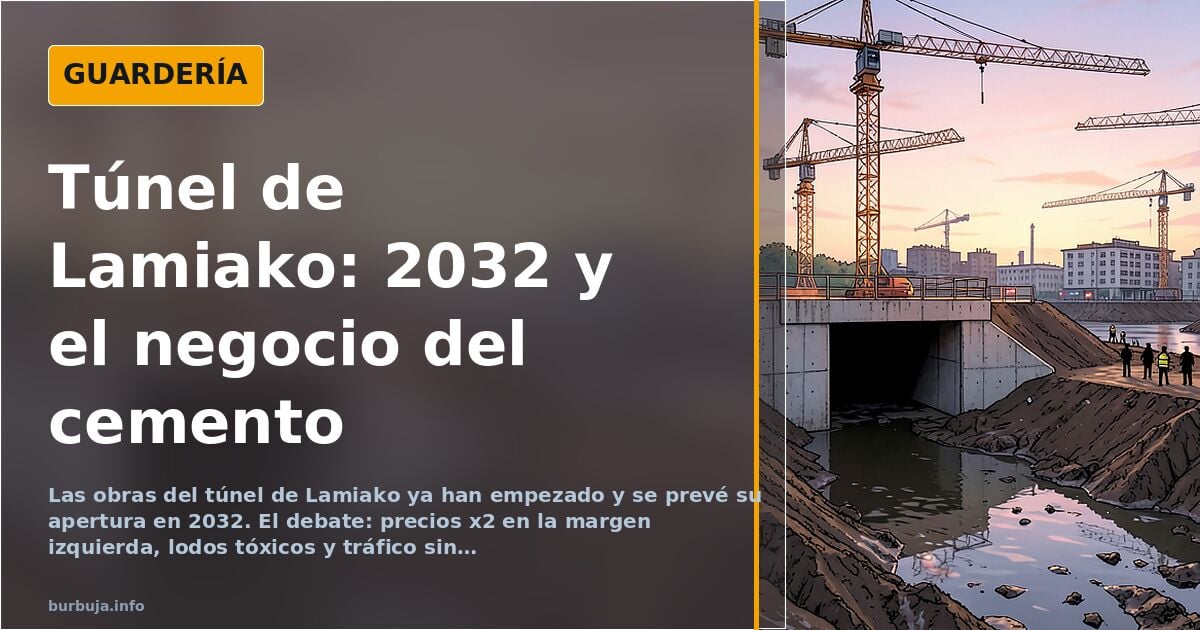
Tunnel under the Bilbao estuary: The project promising to unite what traffic has separated
Does the Lamiako sub-fluvial tunnel actually solve anything, or is it another monumental infrastructure project with an election-driven inauguration date? Construction has already started. The project is marketed as the solution to mobility on both banks of the estuary and as an engineering milestone. The circulating date for its opening is 2032. From there, enthusiasm begins to sustancia ilegal.
There is no consensus on the necessity of this infrastructure. Some defend the project as a connection that democratizes access between the banks; opposing arguments state that the real problem is not crossing the estuary, but how one reaches the tunnel entrance. Traffic organization in the area suffers from previous decisions: the elimination of the initially planned dual carriageway expansion, the extension of the Leioa tunnel, the effective removal of the estuary road, and intensive urbanization in Berango, Sopelana, Urduliz, and Barrika without alternative accesses to the Uribe Costa corridor, which is already clogged by the Artaza roundabout and the Leioa tunnel.
What traffic problems does the Lamiako tunnel solve?
The short answer is that it depends on what is meant by "solving." The Uribe Costa corridor bears the weight of urbanization that occurred without improving the road network. Adding a connection between banks without correcting existing bottlenecks may shift congestion rather than eliminate it. According to one participant, the most pessimistic scenario depicts a collapsed main road and upward pressure on housing prices on the left bank, pushing lower-income residents toward the outskirts. The most optimistic scenario assumes the new infrastructure absorbs some through-traffic and relieves the corridor.
Maintenance: The business nobody questions
Drilling under the estuary is no minor antiestéticat. Subsequent maintenance will be the most lucrative item for contracted companies, according to criticisms raised in the debate. Some summarize it with an image: having a leak is always good for the roofer. Critics point out that the Biscay Provincial Council alternates between two contradictory obsessions: filling everything with bike lanes and traffic obstacles, on one hand, and trying to remedy congestion by creating new connections between already bottled-up points, on the other.
Estuary sludge: The risk missing from the brochure
According to a participant, the Bilbao estuary carries sediments containing heavy metals, carcinogenic elements, and pesticides. Data suggests that the largest DDT and hydrofluoric acid plant in Spain discharged directly into the estuary. One part of the analysis argues that massive dredging would be worse than five hundred Prestige-type oil tankers. It is not a joke: disturbing these centuries-old sludges could uncover anything from a major environmental disaster to, at minimum, some extraterrestrial curse.
The 2032 date and the historic milestone narrative
Opening is scheduled for 2032. By then, the official narrative is already written, according to a participant: a historic milestone uniting the estuary's banks, half technology, half social pogre. It will be sold to the less affluent on the left bank as economic democratization and to those on the right bank as instant access to megasupermarkets. Skepticism is not against the engineering, but against the accompanying narrative.
The question is not whether the tunnel will open in 2032. It is whether anyone will remember by then that the problem was traffic, not the inauguration photo.
Also available in: Deutsch
Summary of a discussion on Burbuja.info - Foro de economía, actualidad y política., translated from Spanish and reviewed before publication. Read the full discussion (26 replies).
More summaries
-
The right's unconfessable secret: a hidden attraction to Leire
An anonymous confession from a right-wing Spanish voter about his attraction to a left-wing politician sparks a storm of insults and exposes the taboo of political desire.
-
Right-wing YouTuber sparks insults instead of debate
A video by a right-wing YouTuber triggers a cascade of personal and sexual insults. Behind it lies the business of conservative discourse on social media.
-
AliExpress Requires Face Verification to Buy Scissors
AliExpress now requires age verification with a selfie to buy scissors and cutters. Is it legal? Who benefits from this erratic data control?
-
Japanese Animism vs Christianity Debate
A debate on Japanese animism's appeal versus Christianity, highlighting temples and ancestor worship as spiritual alternatives.
-
Spanish Rock Bands That Challenged British Heavy Metal
Barón Rojo recorded in the same studio as Iron Maiden in 1982, while Camilo Sesto had potential as a hard rock star.
-
Winter depression driven by light loss, not cold
Lack of sunlight, not low temperatures, causes winter blues: fixed schedules and 10,000 lux lamps help more than attitude changes.