
Japanese Animism vs Christianity Debate
A debate on Japanese animism's appeal versus Christianity, highlighting temples and ancestor worship as spiritual alternatives.
English · Original discussion in Spanish · Published
Japanese Animism vs Christianity Debate
There is a current of opinion holding that Christianity is a "fifth-world" religion compared to Japanese animism. The approach, detailed in a recent discussion, defends a model of worship based on balance with nature, harmony with the divine through quiet practices like meditation or praying to household spirits, and ancestor worship at small home altars. In contrast, Christianity is described as a faith imposing antiestéticar of eternal punishment for everyday sins.
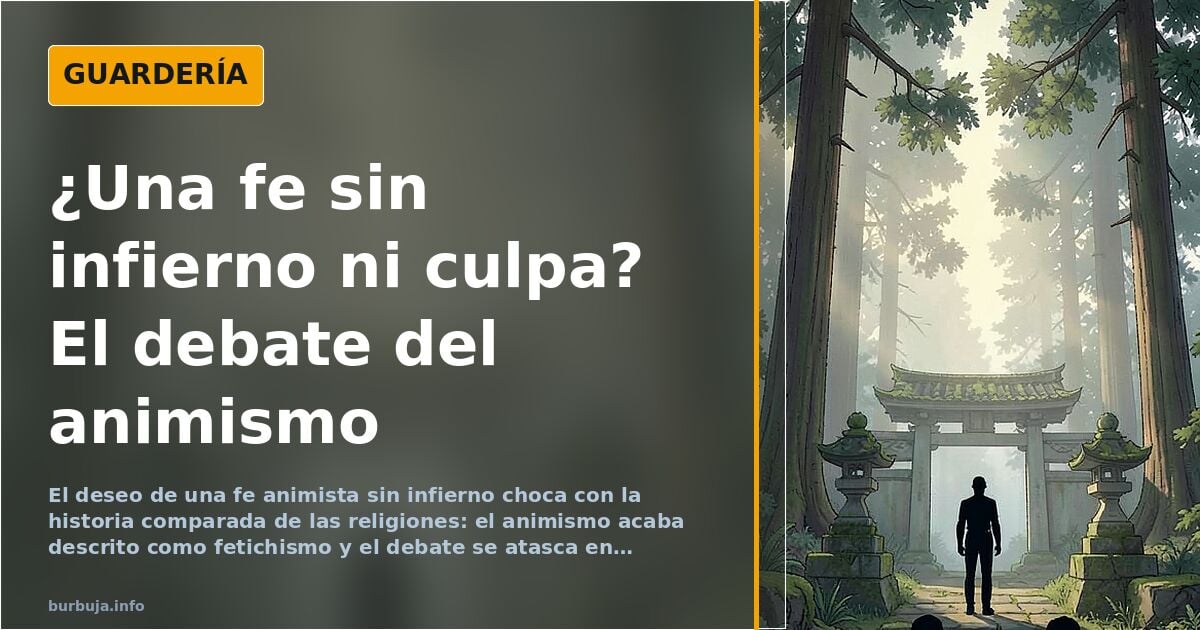
The initial message meticulously describes an ideal: temples accessed through a wooden torii, the obligation to wash hands and mouth before entering, handmade lucky charms, summer festivals with local food and fireworks in the style of Tanabata, and cemeteries with black, minimalist tombstones where the deceased rest in sober urns. All this against what the author considers the Judaic paraphernalia of Christianity.
Scholarly Response and Religious Phases Debate
The discussion quickly shifted to the history of religions. A participant introduced Gustavo Bueno's classification in El animal divino, which divides religious evolution into three phases: primary (cult of corporeal numina, divine animals), secondary (mythological and anthropomorphic gods), and tertiary (the impersonal or metaphysical God of philosophical theology). According to this thesis, Japanese animism would fit into the secondary phase, not the primary one evoked by the initial poster.
Tensions rose when the approach was accused of being a "fetish" and reading Bueno's work was recommended. The reply was immediate: questioning why the tertiary phase should be superior to the secondary, and noting that the cited text itself refuted the accusation of primitivism. The debate devolved into personal insults and references to upbringing, alluding to private and religious schools.
Animism as a Sociological Phenomenon
Beyond the tone, the core issue connects with a real phenomenon: growing interest in Shinto and Japanese Buddhism as models of spirituality. The association between nature, spirits, and daily practices —home altars, amulets, seasonal festivals— forms a system that, unlike Christianity, does not demand strong doctrinal adherence. It is a diffuse religiosity integrated into social life and the calendar.
The initial message mentions concrete elements explaining this appeal: healthy socialization at summer festivals, the minimalist aesthetics of cemeteries, respect for natural spaces inhabited by gods. Against this, psychological suffering associated with Christian guilt and antiestéticar of eternal damnation is criticized.
Where the Analysis Stalls
The discussion reaches no consensus on whether Japanese animism is truly a "better" religion or simply an idealized projection. What remains clear is that the disconnect between these two models of spirituality persists, and that comparing them stirs more passion than data.
Also available in: Deutsch
Summary of a discussion on Burbuja.info - Foro de economía, actualidad y política., translated from Spanish and reviewed before publication. Read the full discussion (23 replies).
More summaries
-
Good morning, folks: the morning ritual that lives on at the Guardería
At 5:53 a.m. someone is already 'at your service'. The Guardería's morning greeting kicks off with weigh-ins, back pain and banter.
-
Fox, raven or mayfly: which animal people would choose to be
Fox, pedigree cat, Kodiak bear or mayfly: how the choice of animal splits depending on whether people want comfort, flight or a 24-hour life
-
Two weeks off sick: the good times are coming to an end
In Spain, temporary sick leave requires a medical prescription and an official certificate. Using it without needing it is fraud. Here's how it works.
-
Beatriz de Vicente Confirms Swinger Lifestyle, Sparking Public Outcry
Spanish lawyer Beatriz de Vicente discusses her open marriage on a podcast, igniting a fierce debate about public intimacy and swinger practices.
-
Fly accidentally decapitates itself while grooming
A video of a fly removing its head during grooming sparked zombie fears. The cause lies in anatomy and cleaning reflexes.
-
Spanish Rock Bands That Challenged British Heavy Metal
Barón Rojo recorded in the same studio as Iron Maiden in 1982, while Camilo Sesto had potential as a hard rock star.