
Biden Sends Hundreds of Troops Back to Somalia
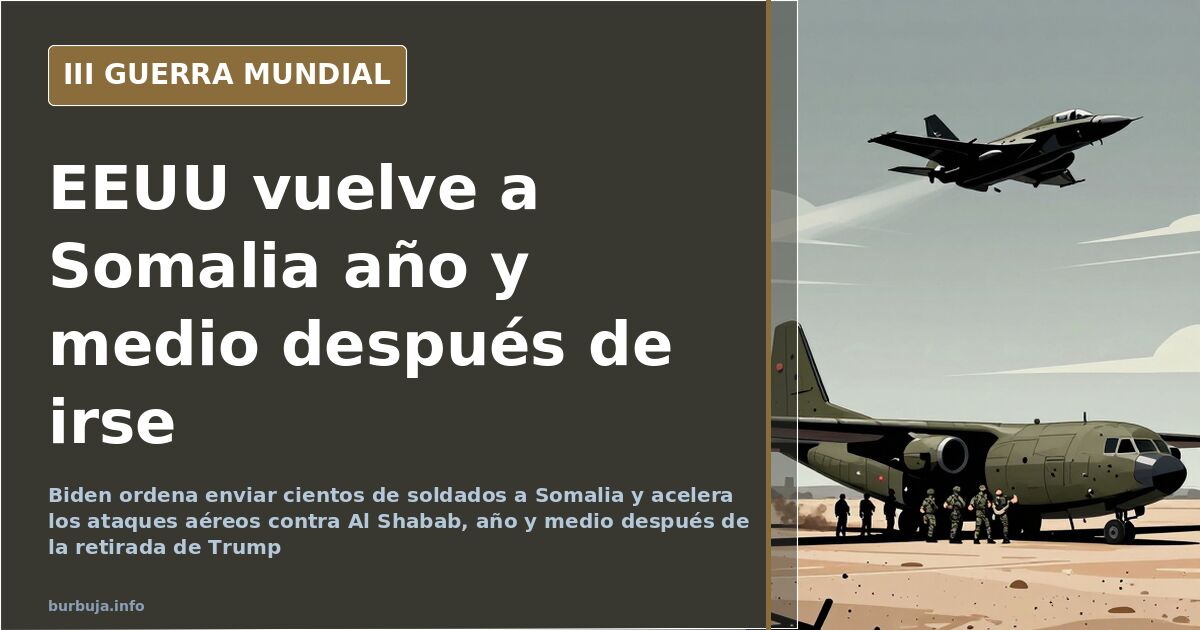
Biden orders hundreds of soldiers to Somalia and accelerates air strikes against Al Shabab, a year and a half after Trump's withdrawal.
English · Original discussion in Spanish · Published
Biden Returns Troops to Somalia After Trump's Withdrawal
The last time the United States left Somalia, it was by decision of Donald Trump. A year and a half later, the Biden Administration has ordered the deployment of hundreds of soldiers to combat Al Shabab, the Al Qaeda affiliate in the Horn of Africa, and has accelerated air strikes: at least six since June 3, according to the count published by Long War Journal. From the forum, it is emphasized that the operation did not require UN permission nor received the label of invasion.
Who is Al Shabab and Why is the US Army Returning?
The group is responsible for stonings in Somali territory and the attack during the 2010 World Cup final in Uganda, with at least 76 fatalities, in response to the presence of Ugandan soldiers integrated into the African Union peace mission. There is no discussion about the history. There is about the appropriateness of the deployment.
Trump signed the withdrawal; Biden signs the return, with the official argument of containing jihadism. The problem is that the same anti-terrorism label was used to justify the exit and to justify the return. Soldiers are withdrawn and explanations are withdrawn as well.
Uranium, Natural Gas, and the Red Sea Gateway
Somalia has documented reserves of uranium, iron ore, tin, gypsum, bauxite, copper, salt, and natural gas. Data attributed to the CIA mention 5.663 billion cubic meters of proven gas reserves. And on top of that is the position: that stretch controls the entry and exit of maritime traffic linking the Mediterranean, the Suez Canal, and the Black Sea.
With that map on the table, there are two narratives. One argues that Washington only pursues jihadism. The other responds with the list of minerals and an uncomfortable question: why send hundreds of soldiers to a country that does not share a border with the United States, and why activate it now and not when the group was striking in the region. Add a third element: some argue in the thread that the movement seeks to build a containment dike against Chinese presence in the area, extended without firing a shot.
Eleven Aircraft Carriers and a Dollar to Support
The deployment fuels the classic argument that the US military machine is not designed to defend its own territory. With eleven aircraft carriers and their fleets, this reading holds, they do not monitor their own coasts. The export of capital and peine into foreign economies, wrote Lenin in Imperialism, the Highest Stage of Capitalism, is what defines that phase: the army appears where the resources are.
A critical publication has put a figure to the balance: more than 20 million dead in 37 countries victim since World War II, compared to 15 million in the First. These are estimates from one side, not an official census. But the data circulates and helps explain why this is not read as a peace operation.
Sanctions for Moscow, Silence for Washington
The comparison is self-imposed. Russia moves troops to a neighboring country and receives sanction packages, banking vetoes, and institutional reprobation. The United States sends hundreds of soldiers thousands of kilometers away and, as emphasized in the thread, neither Brussels nor the UN has peine any procedure.
Some describe that asymmetry as the result of a relationship of dependence: Europe would act as a branch of Washington and not as an arbiter. It is an uncomfortable and very repeated thesis.
Al Shabab will remain at the center of the official argument. What remains to be seen is whether anyone in Brussels or New York bothers to formulate the question that the deployment avoids: how much time will pass before another president orders the withdrawal of what this one sent.
The last time the United States left Somalia, it was by decision of Donald Trump. A year and a half later, the Biden Administration has ordered the deployment of hundreds of soldiers to combat Al Shabab, the Al Qaeda affiliate in the Horn of Africa, and has accelerated air strikes: at least six since June 3, according to the count published by Long War Journal. From the forum, it is emphasized that the operation did not require UN permission nor received the label of invasion.
Who is Al Shabab and Why is the US Army Returning?
The group is responsible for stonings in Somali territory and the attack during the 2010 World Cup final in Uganda, with at least 76 fatalities, in response to the presence of Ugandan soldiers integrated into the African Union peace mission. There is no discussion about the history. There is about the appropriateness of the deployment.
Trump signed the withdrawal; Biden signs the return, with the official argument of containing jihadism. The problem is that the same anti-terrorism label was used to justify the exit and to justify the return. Soldiers are withdrawn and explanations are withdrawn as well.
Uranium, Natural Gas, and the Red Sea Gateway
Somalia has documented reserves of uranium, iron ore, tin, gypsum, bauxite, copper, salt, and natural gas. Data attributed to the CIA mention 5.663 billion cubic meters of proven gas reserves. And on top of that is the position: that stretch controls the entry and exit of maritime traffic linking the Mediterranean, the Suez Canal, and the Black Sea.
With that map on the table, there are two narratives. One argues that Washington only pursues jihadism. The other responds with the list of minerals and an uncomfortable question: why send hundreds of soldiers to a country that does not share a border with the United States, and why activate it now and not when the group was striking in the region. Add a third element: some argue in the thread that the movement seeks to build a containment dike against Chinese presence in the area, extended without firing a shot.
Eleven Aircraft Carriers and a Dollar to Support
The deployment fuels the classic argument that the US military machine is not designed to defend its own territory. With eleven aircraft carriers and their fleets, this reading holds, they do not monitor their own coasts. The export of capital and peine into foreign economies, wrote Lenin in Imperialism, the Highest Stage of Capitalism, is what defines that phase: the army appears where the resources are.
A critical publication has put a figure to the balance: more than 20 million dead in 37 countries victim since World War II, compared to 15 million in the First. These are estimates from one side, not an official census. But the data circulates and helps explain why this is not read as a peace operation.
Sanctions for Moscow, Silence for Washington
The comparison is self-imposed. Russia moves troops to a neighboring country and receives sanction packages, banking vetoes, and institutional reprobation. The United States sends hundreds of soldiers thousands of kilometers away and, as emphasized in the thread, neither Brussels nor the UN has peine any procedure.
Some describe that asymmetry as the result of a relationship of dependence: Europe would act as a branch of Washington and not as an arbiter. It is an uncomfortable and very repeated thesis.
Al Shabab will remain at the center of the official argument. What remains to be seen is whether anyone in Brussels or New York bothers to formulate the question that the deployment avoids: how much time will pass before another president orders the withdrawal of what this one sent.
Also available in: Deutsch
Summary of a discussion on Burbuja.info - Foro de economía, actualidad y política., translated from Spanish and reviewed before publication. Read the full discussion (229 replies).
More summaries
-
Macron dismisses Trump's White House return
Macron doubts Trump will regain the presidency, shifting focus to his assassination attempt and unproven elite conspiracy theories.
-
New Venezuelan 'Tren de Aragua' Leader Declares War on the US: Will Confiscated Oil Be Recovered from 'Master' Donald Trump?
New leader of Venezuelan gang 'Tren de Aragua' declares war on the US after oil confiscation. Will it be recovered?
-
Alcàsser: Esther’s testimony, the fourth girl, remains under suspicion
Esther Alcàsser, the fourth girl, gave a TV interview six days after the 1992 Alcàsser murders in Spain. Her account and timeline discrepancies fuel ongoing controversy.
-
Burgos removes Russian flag from private balcony
Burgos City Council ordered police and firefighters to remove a Russian flag from a private balcony in Plaza Mayor, without visible judicial order.
-
Tears as Spanish-trained Ukrainian soldiers depart
Spanish troops bid farewell to Ukrainian recruits, described as men aged 40-50 poorly prepared for the front.
-
Russia withdraws from Kherson, shifting front toward Crimea
General Surovikin proposes moving defense to the Dnipro's left bank; Shoigu approves retreat. Kherson is no longer under Russian control.