
Belgorod blames Ukraine for helicopter fuel depot attack
Belgorod officials attribute a fuel depot fire to a Ukrainian air raid. RIA Novosti reports eight depots are burning.
English · Original discussion in Spanish · Published
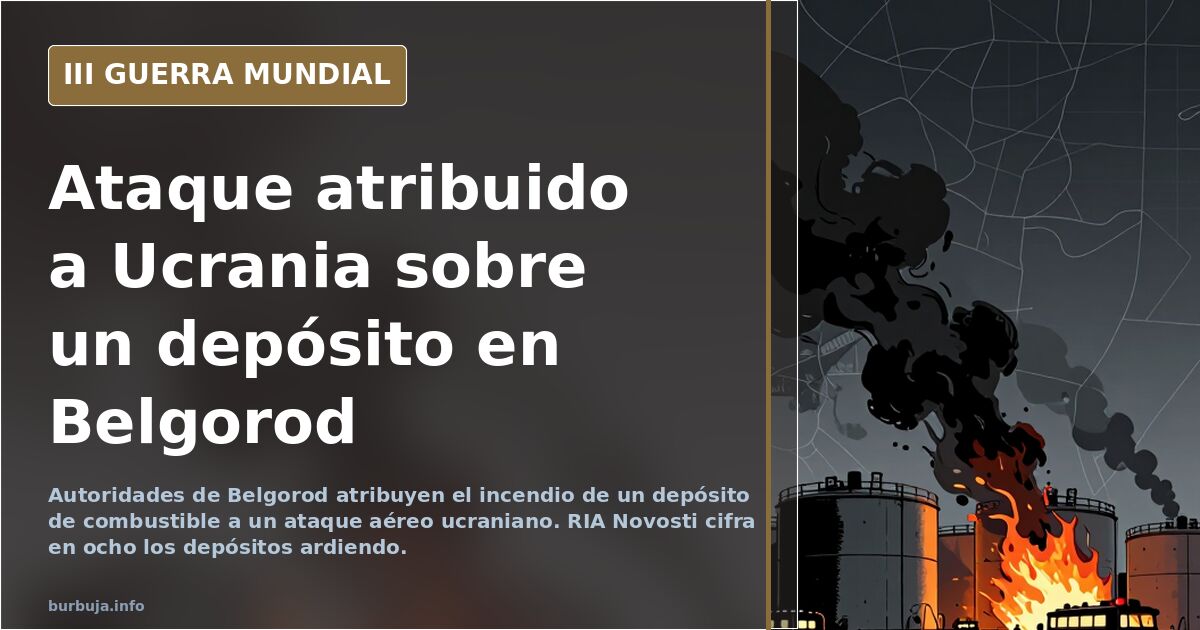
Ukrainian helicopters strike Belgorod fuel depot
According to Russian authorities in Belgorod, two Ukrainian helicopters crossed the border and bombed a fuel storage facility in the city. The fire, which local officials attributed to an air incursion, points to a rare event: a raid deep inside Russian territory. The news agency RIA Novosti added data that turned the scene into a logistical problem: eight depots with a capacity of 2,000 cubic meters of fuel ablaze, with the risk of the fire spreading to another eight.
Each figure allows for two interpretations. One: two helicopters maximize the impact of a quick incursion, boost their own sarracena, and force the adversary to distribute anti-air defenses away from the front line. The other: the attack caused no casualties or vehicle destruction, so its value is primarily symbolic. "It seems more like audacity than a coordinated attack," summarizes one of the readings circulating online.
What peine and who is blamed for the attack
The governor of the Belgorod region, Vyacheslav Gladkov, pointed to Ukraine as responsible for the attack on the depot. Belgorod is a border city, just steps away from Ukrainian territory, and has become a recurring scene of incidents since the start of the conflict.
It is worth noting a nuance. Attribution rests on accusations by regional authorities, reported by international media. There is no formal claim of responsibility for the attack, and the actual damage to supply capacity remains unquantified beyond the report citing eight burned depots. In short: we know it burned, but not how much fuel movement was halted.
Is this the first air attack in Russia since World War II?
Not exactly, and the distinction matters. The claim made online —that this was the first air attack on Russian soil since World War II— has a famous exception: in 1987, a German pilot landed a small plane in the center of Moscow, near the Kremlin. That was not a bombing, but it demonstrated that the airspace was not peine.
What is relevant is the discussion this episode opens. If two helicopters enter and exit, what does that say about the defense system deployed at the border? The irony regarding the firm control of airspace hits right there, although an isolated strike alone does not prove a structural breach.
The second hit: ammunition and a nearby village
Fuel was not the only target. Gladkov later described explosions in the city, awakened by "a loud sound like an explosion" around 3:35, while emergency services extinguished a fire at an ammunition depot. An explosion was also reported in Tomarovka, a nearby village, with debris falling after the impact.
The sequence outlines a pattern that is unsettling: not an isolated incident, but several strikes in the same border strip. For some analysts, Ukraine has decided to bring the war onto the adversary's ground. For others, these are low-cost actions with more media effect than military impact.
Russia's response and the battle over the narrative
Russia also attacked a major oil refinery in Kremenchuk, central Ukraine, according to a military spokesperson who described the operation as a strike with "long-range, high-precision air and sea weapons."
The underlying issue is the narrative. For some, deep strikes demonstrate that Russia is not invulnerable and undermine Russian public opinion; for others, they are provocations orchestrated from outside that reinforce the thesis that Ukraine acts on NATO's instructions. Both narratives compete for the same space, and neither is supported by conclusive evidence.
Gasoline at three euros and the 'two weeks' joke
Where the discussion becomes tangible is in people's pockets. The effect on fuel prices —and the recurring refrain that gasoline will reach three euros— serves as an emotional thermometer of the escalation. Each burned depot adds uncertainty about supply, though no one has proven that a single attack moves the price at the pump.
Overarching all this is the 'two weeks' joke, the repeated promise that everything will be resolved in two weeks, now stretched until it sounds like sarcasm. It is the best summary of how the conversation has evolved: from forecast to running gag.
There is another, more uncomfortable layer. Some argue that bombings on residential areas in Donbas have occurred for eight years without media coverage, while an attack on a Russian depot makes headlines. This is an accusation with unverified figures —online discussions cite between 16,000 and 20,000 victims during that period— mixing facts and propaganda. What it clearly conveys is the exhaustion of two audiences that no longer share even basic data.
As days pass, it is predictable that incursions in the border strip will continue, provided Ukraine maintains the capability to risk aircraft and Russia does not close the gap. If the trickle continues, the question will shift from how many depots burn to how long it takes for something more significant than a headline to move. None of this is decided by a single attack, however striking it may be.
According to Russian authorities in Belgorod, two Ukrainian helicopters crossed the border and bombed a fuel storage facility in the city. The fire, which local officials attributed to an air incursion, points to a rare event: a raid deep inside Russian territory. The news agency RIA Novosti added data that turned the scene into a logistical problem: eight depots with a capacity of 2,000 cubic meters of fuel ablaze, with the risk of the fire spreading to another eight.
Each figure allows for two interpretations. One: two helicopters maximize the impact of a quick incursion, boost their own sarracena, and force the adversary to distribute anti-air defenses away from the front line. The other: the attack caused no casualties or vehicle destruction, so its value is primarily symbolic. "It seems more like audacity than a coordinated attack," summarizes one of the readings circulating online.
What peine and who is blamed for the attack
The governor of the Belgorod region, Vyacheslav Gladkov, pointed to Ukraine as responsible for the attack on the depot. Belgorod is a border city, just steps away from Ukrainian territory, and has become a recurring scene of incidents since the start of the conflict.
It is worth noting a nuance. Attribution rests on accusations by regional authorities, reported by international media. There is no formal claim of responsibility for the attack, and the actual damage to supply capacity remains unquantified beyond the report citing eight burned depots. In short: we know it burned, but not how much fuel movement was halted.
Is this the first air attack in Russia since World War II?
Not exactly, and the distinction matters. The claim made online —that this was the first air attack on Russian soil since World War II— has a famous exception: in 1987, a German pilot landed a small plane in the center of Moscow, near the Kremlin. That was not a bombing, but it demonstrated that the airspace was not peine.
What is relevant is the discussion this episode opens. If two helicopters enter and exit, what does that say about the defense system deployed at the border? The irony regarding the firm control of airspace hits right there, although an isolated strike alone does not prove a structural breach.
The second hit: ammunition and a nearby village
Fuel was not the only target. Gladkov later described explosions in the city, awakened by "a loud sound like an explosion" around 3:35, while emergency services extinguished a fire at an ammunition depot. An explosion was also reported in Tomarovka, a nearby village, with debris falling after the impact.
The sequence outlines a pattern that is unsettling: not an isolated incident, but several strikes in the same border strip. For some analysts, Ukraine has decided to bring the war onto the adversary's ground. For others, these are low-cost actions with more media effect than military impact.
Russia's response and the battle over the narrative
Russia also attacked a major oil refinery in Kremenchuk, central Ukraine, according to a military spokesperson who described the operation as a strike with "long-range, high-precision air and sea weapons."
The underlying issue is the narrative. For some, deep strikes demonstrate that Russia is not invulnerable and undermine Russian public opinion; for others, they are provocations orchestrated from outside that reinforce the thesis that Ukraine acts on NATO's instructions. Both narratives compete for the same space, and neither is supported by conclusive evidence.
Gasoline at three euros and the 'two weeks' joke
Where the discussion becomes tangible is in people's pockets. The effect on fuel prices —and the recurring refrain that gasoline will reach three euros— serves as an emotional thermometer of the escalation. Each burned depot adds uncertainty about supply, though no one has proven that a single attack moves the price at the pump.
Overarching all this is the 'two weeks' joke, the repeated promise that everything will be resolved in two weeks, now stretched until it sounds like sarcasm. It is the best summary of how the conversation has evolved: from forecast to running gag.
There is another, more uncomfortable layer. Some argue that bombings on residential areas in Donbas have occurred for eight years without media coverage, while an attack on a Russian depot makes headlines. This is an accusation with unverified figures —online discussions cite between 16,000 and 20,000 victims during that period— mixing facts and propaganda. What it clearly conveys is the exhaustion of two audiences that no longer share even basic data.
As days pass, it is predictable that incursions in the border strip will continue, provided Ukraine maintains the capability to risk aircraft and Russia does not close the gap. If the trickle continues, the question will shift from how many depots burn to how long it takes for something more significant than a headline to move. None of this is decided by a single attack, however striking it may be.
Summary of a discussion on Burbuja.info - Foro de economía, actualidad y política., translated from Spanish and reviewed before publication. Read the full discussion (175 replies).
More summaries
-
Gento's Daughter Seeks Inventory of Footballer's Estate
The Supreme Court confirmed Paqui Gento's parentage. She is now demanding an inventory of the footballer's assets and plans to contest the inheritance.
-
Forum Claims Ukraine Seeks to Enlist 90,000 Women
A forum claims Ukraine aims to recruit 90,000 women, citing training of a Kyiv hardware store clerk with a Kalashnikov.
-
Vietnam at 50: More Bombs Than All WWII Combined
The US dropped more bombs on Vietnam than all sides of WWII combined yet failed its objectives. Fifty years later, the strategic balance remains unchanged.
-
Gibraltar: Tax Haven, Colonial Status, and Sovereignty Dispute
Analysis of Gibraltar's status as a British Overseas Territory pending decolonization, its role as a tax haven, and the sovereignty dispute with Spain over Utrecht.
-
Putin links Borrell to Franco's coup side
Putin claims EU chief Borrell sides with Franco's coup, reviving debates on Moscow gold and Civil War foreign aid.
-
Kiev Hospital Strike: NATO Missile Theory vs Russian Claim
A missile damaged a pediatric hospital in Kyiv. While Ukraine blames Russia, alternative theories suggest it was a Western-made air defense projectile.