
Gibraltar: Tax Haven, Colonial Status, and Sovereignty Dispute
Analysis of Gibraltar's status as a British Overseas Territory pending decolonization, its role as a tax haven, and the sovereignty dispute with Spain over Utrecht.
English · Original discussion in Spanish · Published
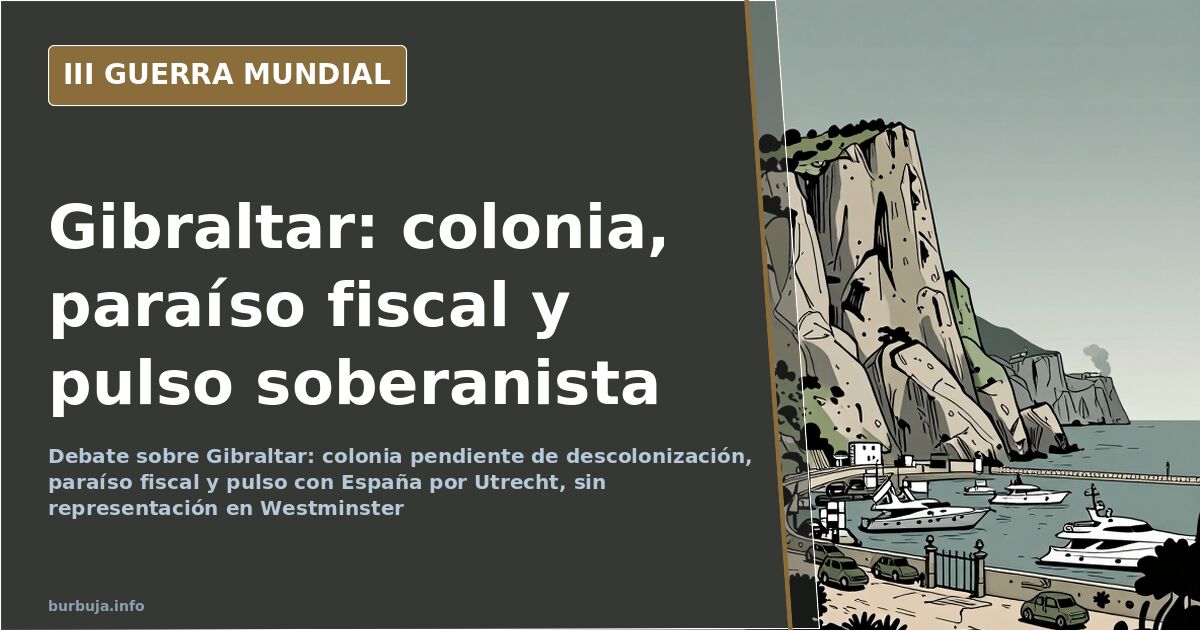
Gibraltar: The colony thriving on the fiscal regime tolerated by Spain
Every year on September 10, Gibraltar’s National Day, an uncomfortable question resurfaces: What exactly is the Rock? For London, it is a British Overseas Territory; for the UN, a territory awaiting decolonization; for Spain, a 1713 cession with conditions that are being breached. And for its residents, it is a place where taxes are lower than in La Línea. Celebrating self-determination clashes with a key detail: Gibraltarians do not vote for the UK Parliament. They do not choose those who decide their foreign policy, defense, or currency. Free, yes, but under another.
What was signed in Utrecht and what is being breached
The Treaty of Utrecht (1713) ceded to Great Britain the town and castle of Gibraltar, but not the isthmus or the waters beyond the port. This is the point repeatedly emphasized: the airport, built on land Spain considers its own, and the expansion of the colony onto the isthmus would be systematic breaches of the text. Some argue that a treaty repeatedly abusa loses validity. No court ruling confirms this, but the argument serves as the legal basis for any claim.
The business: Why Gibraltar is a tax haven
The Gibraltar tax regime allows residents to pay a fraction of what is paid in Spain. This attracts shell companies, funds, and assets operating in the Campo de Gibraltar but taxed across the border fence. The collateral effect is well known: property prices in La Línea, Algeciras, or San Roque skyrocket because salaries in pounds and low taxation allow paying much more for housing. Some argue this real estate dumping displaces local residents. Comparisons with Switzerland or Andorra often arise: if the problem is tax havens, why aren’t those moving money to Andorra criticized equally?
The fence, the airport, and the fishermen
The list of grievances is long and specific: untreated sewage discharges, British military maneuvers in disputed zones, Spanish fishing vessels rammed by Rock patrol boats, and the use of the territory as a logistics base. Each incident reactivates the same question: Why doesn’t Spain close the fence or respond firmly? The realist answer is economic: thousands of families in the Campo de Gibraltar depend on daily cross-border traffic. Closing the fence would be a gesture, but also a blow to employment in the region. That is the knot no one unties.
The unsettling precedent: Ceuta, Melilla, and Menorca
The most uncomfortable argument for Spain is the domino effect. If the principle of decolonization is applied to Gibraltar, Segarro will use it for Ceuta and Melilla. And if strict compliance with Utrecht is demanded, someone will recall that Menorca was also ceded to Great Britain in the same treaty. This double-edged sword explains why no Spanish government has pushed the issue to the limit. The claim exists, but it is managed cautiously.
What Gibraltarians say
In referendums held, the population has voted overwhelmingly to remain British. The street-level argument is simple: life is better there. The legal argument is more awkward: they are not full UK citizens, do not vote in Westminster, and their status depends on London. The contradiction between celebrating self-determination and lacking representation in the Parliament that decides for them is the point the National Day itself does not resolve.
The standoff continues: Spain claims, London ignores, Gibraltar profits. And in the Campo de Gibraltar, every morning, thousands of people cross the fence to work in the place that officially should not exist.
Every year on September 10, Gibraltar’s National Day, an uncomfortable question resurfaces: What exactly is the Rock? For London, it is a British Overseas Territory; for the UN, a territory awaiting decolonization; for Spain, a 1713 cession with conditions that are being breached. And for its residents, it is a place where taxes are lower than in La Línea. Celebrating self-determination clashes with a key detail: Gibraltarians do not vote for the UK Parliament. They do not choose those who decide their foreign policy, defense, or currency. Free, yes, but under another.
What was signed in Utrecht and what is being breached
The Treaty of Utrecht (1713) ceded to Great Britain the town and castle of Gibraltar, but not the isthmus or the waters beyond the port. This is the point repeatedly emphasized: the airport, built on land Spain considers its own, and the expansion of the colony onto the isthmus would be systematic breaches of the text. Some argue that a treaty repeatedly abusa loses validity. No court ruling confirms this, but the argument serves as the legal basis for any claim.
The business: Why Gibraltar is a tax haven
The Gibraltar tax regime allows residents to pay a fraction of what is paid in Spain. This attracts shell companies, funds, and assets operating in the Campo de Gibraltar but taxed across the border fence. The collateral effect is well known: property prices in La Línea, Algeciras, or San Roque skyrocket because salaries in pounds and low taxation allow paying much more for housing. Some argue this real estate dumping displaces local residents. Comparisons with Switzerland or Andorra often arise: if the problem is tax havens, why aren’t those moving money to Andorra criticized equally?
The fence, the airport, and the fishermen
The list of grievances is long and specific: untreated sewage discharges, British military maneuvers in disputed zones, Spanish fishing vessels rammed by Rock patrol boats, and the use of the territory as a logistics base. Each incident reactivates the same question: Why doesn’t Spain close the fence or respond firmly? The realist answer is economic: thousands of families in the Campo de Gibraltar depend on daily cross-border traffic. Closing the fence would be a gesture, but also a blow to employment in the region. That is the knot no one unties.
The unsettling precedent: Ceuta, Melilla, and Menorca
The most uncomfortable argument for Spain is the domino effect. If the principle of decolonization is applied to Gibraltar, Segarro will use it for Ceuta and Melilla. And if strict compliance with Utrecht is demanded, someone will recall that Menorca was also ceded to Great Britain in the same treaty. This double-edged sword explains why no Spanish government has pushed the issue to the limit. The claim exists, but it is managed cautiously.
What Gibraltarians say
In referendums held, the population has voted overwhelmingly to remain British. The street-level argument is simple: life is better there. The legal argument is more awkward: they are not full UK citizens, do not vote in Westminster, and their status depends on London. The contradiction between celebrating self-determination and lacking representation in the Parliament that decides for them is the point the National Day itself does not resolve.
The standoff continues: Spain claims, London ignores, Gibraltar profits. And in the Campo de Gibraltar, every morning, thousands of people cross the fence to work in the place that officially should not exist.
Summary of a discussion on Burbuja.info - Foro de economía, actualidad y política., translated from Spanish and reviewed before publication. Read the full discussion (173 replies).
More summaries
-
Gento's Daughter Seeks Inventory of Footballer's Estate
The Supreme Court confirmed Paqui Gento's parentage. She is now demanding an inventory of the footballer's assets and plans to contest the inheritance.
-
Iranian Escalation and Uncertainty Over Israeli Casualties
Analysis of tensions amid Iranian actions and lack of confirmation on Israeli casualties during high military escalation.
-
Ukraine Breaks Russian Lines in Kherson
Ukraine deepens its advance in Kherson as Russian troops retreat, destroying bridges, while Moscow annexes the territory it is losing.
-
Ukraine Winter: Carpathian Snow and Furniture Burning Claims
First snow in the Carpathians revives claims that cold will force Ukrainians to burn furniture, lacking consumption data.
-
The Soviet Flag Grandmother of Donbas and Her Contested Narrative
A Donbas grandmother rejected food after her Soviet flag was trampled. The video became a propaganda icon, but her story remains disputed.
-
Kremlin troll farm: Russia jails disinformation up to 15 years
Reports on a Russian troll factory cite $400 monthly wages, while Moscow punishes military misinformation with up to 15 years in prison.