
Forum Claims Ukraine Seeks to Enlist 90,000 Women
A forum claims Ukraine aims to recruit 90,000 women, citing training of a Kyiv hardware store clerk with a Kalashnikov.
English · Original discussion in Spanish · Published
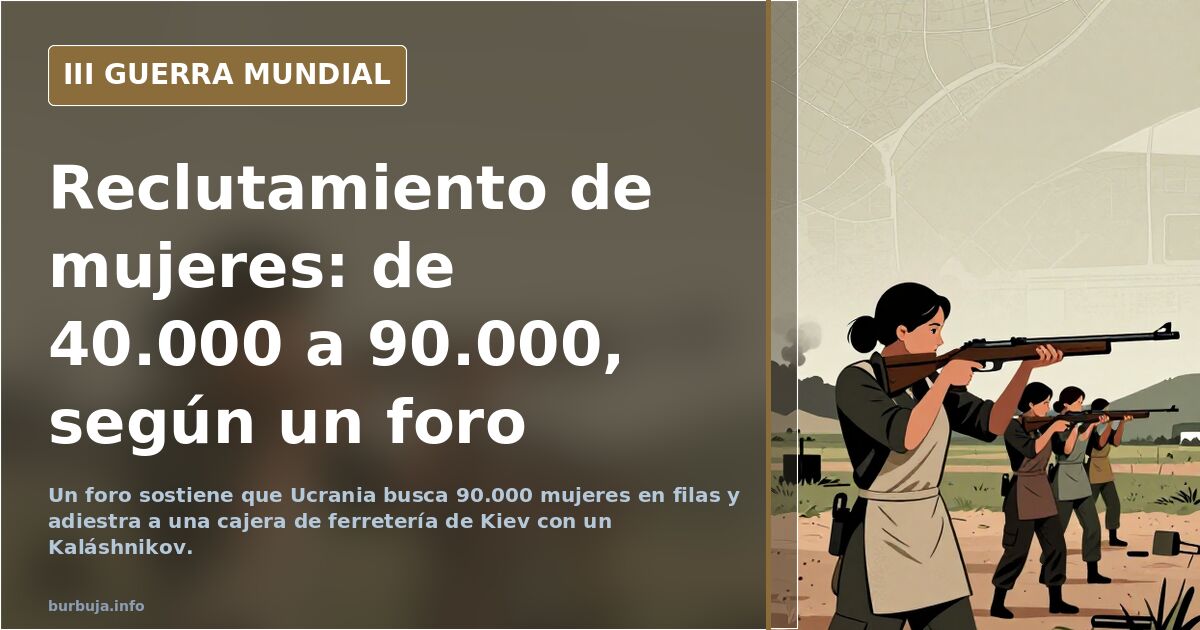
The plan attributed to Ukraine by a forum: from 40,000 to 90,000 women
According to calculations circulating in the thread, the Ukrainian army would aim to increase its female personnel from approximately 40,000 to 90,000. Meanwhile, basic training begins with the essentials: Halyna Vynokur, an employee at a hardware store in Kyiv, handled a firearm for the first time; Iryna Sychova, a purchasing manager at a department store, disassembled and reassembled the complex array of rods and springs of a Kalashnikov rifle. Both were part of two dozen women who went to a forest for instruction. The scene is presented as an example of civil resistance. It also allows for a less epic interpretation: that of an army lowering recruitment standards to include hardware store clerks.
How many women already serve in the Ukrainian army?
The starting point is not zero. According to one participant, in 2018 the army peine all positions to women and, at the start of the war, they already represented one-third of professional soldiers. This figure contrasts with the 12% attributed to women among Spanish professional soldiers. This contrast is used to mock quotas and salaries: it is argued that paying 6,000 euros net per month would be enough to make equality no longer a demand. It is also claimed that since 2014, the salary of a Ukrainian professional soldier tripled the national average, a differential that helps explain the pool of available recruits.
Pharmacists and healthcare workers, the first with restricted exit
According to the account given in the thread, restrictions came before the campaign. Exit from the country was limited to women with degrees in pharmacy and healthcare; this was trinc by specific mobilization efforts to encourage them to enlist, aiming to fill frontline positions and vehicle driving roles. The next step targets grandparents: those who have lived their lives are now needed, according to the argument, with savings on pensions as a side effect. Shameful or not, the consequence is the same: recruitment moves away from the profile of young combatants and widens to whoever can be found. The phrase summarizing the anger: if you have to send a hardware store clerk to the front, things are going very badly.
Frontline videos: combat reports or propaganda?
One participant notes that in the last two months, recordings of Ukrainian women in the front line have multiplied. One interpretation sees this as a symptom: if they resort to women, the male reserve is dry. Another reads it as product, pure war marketing: intact manicures, helmets over buns, smiles before shooting. The most repeated criticism is not against the fighters but against the framing. Men film the war; they film themselves. With such material circulating daily, the line separating documenting the conflict from beautifying it blurs, and the official narrative loses credibility just when it needs it most.
The core issue: equality, biology, and who decides the war
The fundamental clash admits no middle ground. One current argues that a woman's life is worth more than a man's for biological reasons—she ensures the species' continuity—and therefore war is a men's business. At the opposite extreme, equality is understood as symmetrical obligation: if women vote, they can also be called to fight. Between both appears a third uncomfortable argument: those who did not decide the war should not be dragged into it, and responsibility lies with the minority prolonging it. Even the voter who chose the decision-makers is pointed out.
The historical parallels cited all go in the same direction. Germany in 1918 signed in time and preserved much of its army intact; in 1945 it ended with the capital razed and the country occupied. Berlin, it is recalled, was defended at the end by teenagers. From this comes the harshest criterion: when a country loses its professional combat force, it has lost the war, and mobilizing civilians to prolong agony is immoral. Others reply with the Chechen case: surrender did not bring peace, but fighting in other people's wars.
What would happen if Ukraine surrendered?
The scenario of surrender has defenders. It is argued that the country would move from being Europe's second poorest to integrating into a structure where it would occupy the sixth or seventh place, and that the only ones harmed would be those in command, many of whom would have already fled. The reply comes from the Chechen experience: those who wanted to live freely in their territory ended up conquered, assimilated, and sent to die in other people's wars. The conclusion of this reading is uncomfortable: if Ukraine surrenders, it will continue to provide casualties, only for other people's children.
With these figures on the table, the question remains open: does doubling recruits demonstrate a country's resilience or certify the exhaustion of its volunteerism? Both answers hold, and both tell the same war.
According to calculations circulating in the thread, the Ukrainian army would aim to increase its female personnel from approximately 40,000 to 90,000. Meanwhile, basic training begins with the essentials: Halyna Vynokur, an employee at a hardware store in Kyiv, handled a firearm for the first time; Iryna Sychova, a purchasing manager at a department store, disassembled and reassembled the complex array of rods and springs of a Kalashnikov rifle. Both were part of two dozen women who went to a forest for instruction. The scene is presented as an example of civil resistance. It also allows for a less epic interpretation: that of an army lowering recruitment standards to include hardware store clerks.
How many women already serve in the Ukrainian army?
The starting point is not zero. According to one participant, in 2018 the army peine all positions to women and, at the start of the war, they already represented one-third of professional soldiers. This figure contrasts with the 12% attributed to women among Spanish professional soldiers. This contrast is used to mock quotas and salaries: it is argued that paying 6,000 euros net per month would be enough to make equality no longer a demand. It is also claimed that since 2014, the salary of a Ukrainian professional soldier tripled the national average, a differential that helps explain the pool of available recruits.
Pharmacists and healthcare workers, the first with restricted exit
According to the account given in the thread, restrictions came before the campaign. Exit from the country was limited to women with degrees in pharmacy and healthcare; this was trinc by specific mobilization efforts to encourage them to enlist, aiming to fill frontline positions and vehicle driving roles. The next step targets grandparents: those who have lived their lives are now needed, according to the argument, with savings on pensions as a side effect. Shameful or not, the consequence is the same: recruitment moves away from the profile of young combatants and widens to whoever can be found. The phrase summarizing the anger: if you have to send a hardware store clerk to the front, things are going very badly.
Frontline videos: combat reports or propaganda?
One participant notes that in the last two months, recordings of Ukrainian women in the front line have multiplied. One interpretation sees this as a symptom: if they resort to women, the male reserve is dry. Another reads it as product, pure war marketing: intact manicures, helmets over buns, smiles before shooting. The most repeated criticism is not against the fighters but against the framing. Men film the war; they film themselves. With such material circulating daily, the line separating documenting the conflict from beautifying it blurs, and the official narrative loses credibility just when it needs it most.
The core issue: equality, biology, and who decides the war
The fundamental clash admits no middle ground. One current argues that a woman's life is worth more than a man's for biological reasons—she ensures the species' continuity—and therefore war is a men's business. At the opposite extreme, equality is understood as symmetrical obligation: if women vote, they can also be called to fight. Between both appears a third uncomfortable argument: those who did not decide the war should not be dragged into it, and responsibility lies with the minority prolonging it. Even the voter who chose the decision-makers is pointed out.
The historical parallels cited all go in the same direction. Germany in 1918 signed in time and preserved much of its army intact; in 1945 it ended with the capital razed and the country occupied. Berlin, it is recalled, was defended at the end by teenagers. From this comes the harshest criterion: when a country loses its professional combat force, it has lost the war, and mobilizing civilians to prolong agony is immoral. Others reply with the Chechen case: surrender did not bring peace, but fighting in other people's wars.
What would happen if Ukraine surrendered?
The scenario of surrender has defenders. It is argued that the country would move from being Europe's second poorest to integrating into a structure where it would occupy the sixth or seventh place, and that the only ones harmed would be those in command, many of whom would have already fled. The reply comes from the Chechen experience: those who wanted to live freely in their territory ended up conquered, assimilated, and sent to die in other people's wars. The conclusion of this reading is uncomfortable: if Ukraine surrenders, it will continue to provide casualties, only for other people's children.
With these figures on the table, the question remains open: does doubling recruits demonstrate a country's resilience or certify the exhaustion of its volunteerism? Both answers hold, and both tell the same war.
Summary of a discussion on Burbuja.info - Foro de economía, actualidad y política., translated from Spanish and reviewed before publication. Read the full discussion (173 replies).
More summaries
-
Germany’s 63,000 Troops Fall Short of 300,000 Needed for Ukraine Front
Russia produces 2.5x NATO artillery shells; EU steel output is half 1980 levels. Europe faces a critical military gap for direct intervention.
-
Russia Cedes Kherson Banks of Dnipro River, Ukraine Crosses
Russia abandons the right bank of the Dnipro in Kherson. Some see it as a tactical masterstroke, others as the surrender of a symbol.
-
Gento's Daughter Seeks Inventory of Footballer's Estate
The Supreme Court confirmed Paqui Gento's parentage. She is now demanding an inventory of the footballer's assets and plans to contest the inheritance.
-
Doubts over quote attributing Danish MP's Russia appeal on Greenland
A quote attributed to Danish MP Karsten Hønge about seeking Russian help for Greenland sparks authenticity doubts and forum reactions.
-
Iranian Escalation and Uncertainty Over Israeli Casualties
Analysis of tensions amid Iranian actions and lack of confirmation on Israeli casualties during high military escalation.
-
Ukraine Breaks Russian Lines in Kherson
Ukraine deepens its advance in Kherson as Russian troops retreat, destroying bridges, while Moscow annexes the territory it is losing.