
Beards as social markers: from clean-shaven to stubble
Forum user argues beards are common among men aged 25-35, making daily shaving a distinctive choice again. Debate on aesthetics and identity.
English · Original discussion in Spanish · Published
Beards as social markers: from clean-shaven to stubble
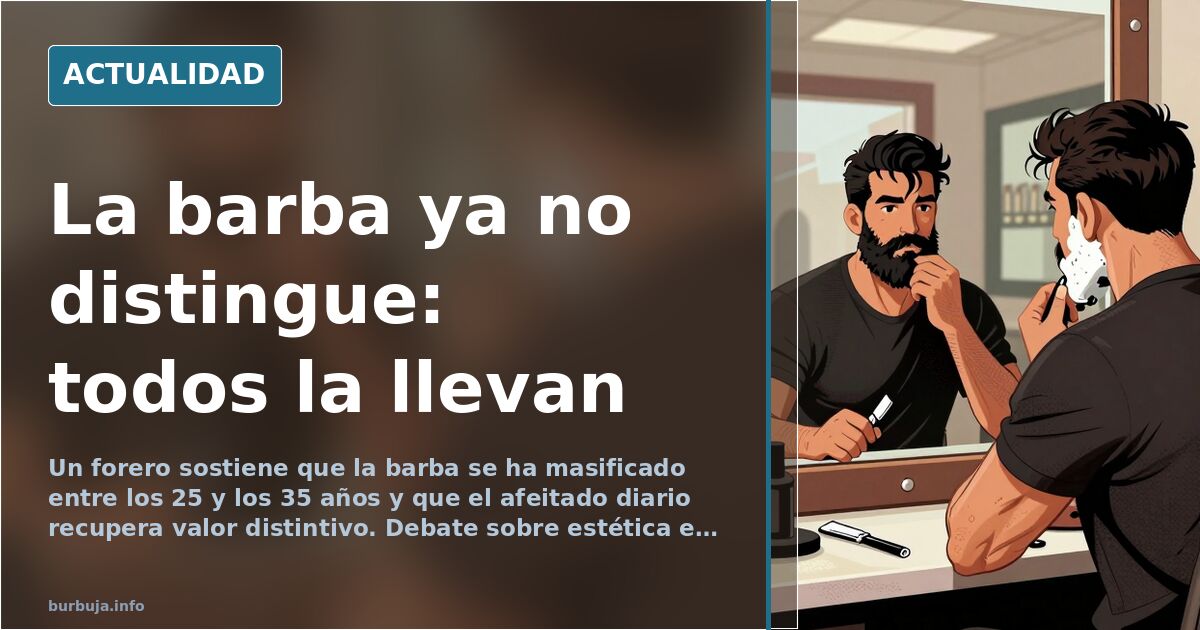
The beard has ceased to be an identity trait and become a uniform. This is the diagnosis in a discussion started by someone who, after years with facial hair, decided to shave to avoid being confused with the stereotype linking beards to a specific ideological profile. The trigger was this participant's perception: among those aged 25 to 35, beards have become widespread to such an extent that the truly differentiating gesture is now the opposite: daily shaving.
The initial thesis goes beyond aesthetics. The thread starter claims the beard functions as a marker of belonging to a group described with contempt —soja, mangina, sangrevainilla— and associated with alleged social engineering. Responses quickly fragment: some see the beard as a symbol of virility and wisdom; others, as a disguise for double chins and recessed jaws; and a third, noisier group argues that being clean-shaven, trimmed, and well-groomed is today’s subversive act.
What is debated when discussing beards
The topic begins with a blunt assertion: in the eighties only certain profiles wore beards, but today anyone does. Based on this, the original poster explains they shaved to avoid being part of what they call the complete combo. The discussion quickly shifts to the political identification of the trait: some argue beards help identify voters of certain options, while others counter that the association is exactly the reverse.
The exchange becomes heated when accessories enter the picture. Earrings, camper vans, scooters, and concrete music are mentioned as pieces of the same stereotype. Three to six-day stubble appears in several posts as the acceptable middle ground; millimeter-perfect trims, however, are dismissed as ridiculous. The recurring idea is that a beard must be bushy and unkempt to be authentic, and any shaping turns it into mere ornamentation.
Clean-shaven as new rebellion
One of the most repeated currents holds that extreme shaving is the truly transgressive act today. Several posts defend that being clean, with cut hair, manicured nails, and good breath has become an anti-system gesture. The formulation is recurrent: those of us who stay clean are the new punks.
Against this position, another part of the debate reclaims the beard as a sign of classic masculinity. It is argued that letting it grow untamed is the opposite of shame about appearing masculine, and that trimming it to the millimeter is hiding. In parallel, a third group introduces a practical nuance: a well-maintained beard requires more work than shaving, and many choose it for comfort or to cover antiestéticatures they dislike.
The biological argument and counterattack
The discussion escalates when testosterone is introduced. One post claims that those who shave close to the skin have fine, sparse hair, a sign of low testosterone, and that multi-day beards were a wise decision copied by everyone else. The response is immediate: defenders of this thesis are called dirty and invited to wash themselves.
The exchange becomes a power struggle over who is more manly. Extreme close shaves with classic razors against the grain are presented as proof of superiority in several posts, while others respond that this is precisely fighting one’s own masculinity. The conversation loses any analytical pretense and settles into insults.
Historical dimension: Greeks, Spartans, and cinema
One of the most documented posts introduces a historical perspective. It recalls that Greeks always wore beards, Spartans had long beards but shaved their mustaches, and Achilles is depicted beardless because he was prepubescent during the Trojan War. The conclusion drawn is that modern cinema has falsified this image and that a Greek of that era would have seen a clean-shaven face as belonging to a man of low status.
This argument reinforces the idea that beards were the norm for centuries and their abandonment is a recent anomaly. The rebuttal comes via meme culture: it is pointed out that one photo used to illustrate the contrast is not from 1917 but from the fifties, dismantling part of the visual resource.
The bald and shaped-beard front
Another focus of the debate centers on bald men with beards. It is noted that the problem lies in where sideburns end, often resulting in a beard that looks held to the ears with elastic bands. The image of a bald man with a bushy beard becomes a recurring object of mockery, along with the male bun, which according to several posts triggers perceived hostility.
In parallel, there is debate over whether beards are makeup for ugly people. The phrase is launched without nuance, generating mixed responses: some subscribe to it, others defend that beards beautify without needing to hide anything. The only concrete figure mentioned in the entire exchange is shaving every fifteen days due to excess hair, cited as proof of virility by those who use it.
What remains of all this
The balance is of a discussion that started on aesthetics and ended on identity, class, and political affiliation. The beard functions as an empty signifier: everyone hangs whatever they want on it. For some, it is a pogre uniform; for others, the last trench of masculinity; for a third group, simple comfort.
The only clear point seems to be that daily shaving has regained distinctive value precisely because beards have become mass-market. If the trend continues, it is likely that in a few years the differentiating gesture will be growing it out again. Fashion wheels rarely turn in straight lines, and those who shave today to look like nobody may end up looking like everyone who did the same.
The beard has ceased to be an identity trait and become a uniform. This is the diagnosis in a discussion started by someone who, after years with facial hair, decided to shave to avoid being confused with the stereotype linking beards to a specific ideological profile. The trigger was this participant's perception: among those aged 25 to 35, beards have become widespread to such an extent that the truly differentiating gesture is now the opposite: daily shaving.
The initial thesis goes beyond aesthetics. The thread starter claims the beard functions as a marker of belonging to a group described with contempt —soja, mangina, sangrevainilla— and associated with alleged social engineering. Responses quickly fragment: some see the beard as a symbol of virility and wisdom; others, as a disguise for double chins and recessed jaws; and a third, noisier group argues that being clean-shaven, trimmed, and well-groomed is today’s subversive act.
What is debated when discussing beards
The topic begins with a blunt assertion: in the eighties only certain profiles wore beards, but today anyone does. Based on this, the original poster explains they shaved to avoid being part of what they call the complete combo. The discussion quickly shifts to the political identification of the trait: some argue beards help identify voters of certain options, while others counter that the association is exactly the reverse.
The exchange becomes heated when accessories enter the picture. Earrings, camper vans, scooters, and concrete music are mentioned as pieces of the same stereotype. Three to six-day stubble appears in several posts as the acceptable middle ground; millimeter-perfect trims, however, are dismissed as ridiculous. The recurring idea is that a beard must be bushy and unkempt to be authentic, and any shaping turns it into mere ornamentation.
Clean-shaven as new rebellion
One of the most repeated currents holds that extreme shaving is the truly transgressive act today. Several posts defend that being clean, with cut hair, manicured nails, and good breath has become an anti-system gesture. The formulation is recurrent: those of us who stay clean are the new punks.
Against this position, another part of the debate reclaims the beard as a sign of classic masculinity. It is argued that letting it grow untamed is the opposite of shame about appearing masculine, and that trimming it to the millimeter is hiding. In parallel, a third group introduces a practical nuance: a well-maintained beard requires more work than shaving, and many choose it for comfort or to cover antiestéticatures they dislike.
The biological argument and counterattack
The discussion escalates when testosterone is introduced. One post claims that those who shave close to the skin have fine, sparse hair, a sign of low testosterone, and that multi-day beards were a wise decision copied by everyone else. The response is immediate: defenders of this thesis are called dirty and invited to wash themselves.
The exchange becomes a power struggle over who is more manly. Extreme close shaves with classic razors against the grain are presented as proof of superiority in several posts, while others respond that this is precisely fighting one’s own masculinity. The conversation loses any analytical pretense and settles into insults.
Historical dimension: Greeks, Spartans, and cinema
One of the most documented posts introduces a historical perspective. It recalls that Greeks always wore beards, Spartans had long beards but shaved their mustaches, and Achilles is depicted beardless because he was prepubescent during the Trojan War. The conclusion drawn is that modern cinema has falsified this image and that a Greek of that era would have seen a clean-shaven face as belonging to a man of low status.
This argument reinforces the idea that beards were the norm for centuries and their abandonment is a recent anomaly. The rebuttal comes via meme culture: it is pointed out that one photo used to illustrate the contrast is not from 1917 but from the fifties, dismantling part of the visual resource.
The bald and shaped-beard front
Another focus of the debate centers on bald men with beards. It is noted that the problem lies in where sideburns end, often resulting in a beard that looks held to the ears with elastic bands. The image of a bald man with a bushy beard becomes a recurring object of mockery, along with the male bun, which according to several posts triggers perceived hostility.
In parallel, there is debate over whether beards are makeup for ugly people. The phrase is launched without nuance, generating mixed responses: some subscribe to it, others defend that beards beautify without needing to hide anything. The only concrete figure mentioned in the entire exchange is shaving every fifteen days due to excess hair, cited as proof of virility by those who use it.
What remains of all this
The balance is of a discussion that started on aesthetics and ended on identity, class, and political affiliation. The beard functions as an empty signifier: everyone hangs whatever they want on it. For some, it is a pogre uniform; for others, the last trench of masculinity; for a third group, simple comfort.
The only clear point seems to be that daily shaving has regained distinctive value precisely because beards have become mass-market. If the trend continues, it is likely that in a few years the differentiating gesture will be growing it out again. Fashion wheels rarely turn in straight lines, and those who shave today to look like nobody may end up looking like everyone who did the same.
Also available in: Deutsch
Summary of a discussion on Burbuja.info - Foro de economía, actualidad y política., translated from Spanish and reviewed before publication. Read the full discussion (134 replies).
More summaries
-
The Sol scam: protest campers ask for money for ‘Ceuta migrants’ using the mobile number of Bengala, a prostitute
A sign in Sol asked for Bizum donations for Ceuta migrants using the phone of a woman advertised as Bengala. Its removal left questions.
-
Tent Collecting Food for Ceuta Ends Up Eating It
Food and money collected for Ceuta migrants were consumed by organizers. The destination of the funds remains unknown.
-
Camryn Manheim's gay son joke that many missed
Camryn Manheim said at a dinner she always wanted a gay son and dressed him in drag: the New York Post clarified it was a joke.
-
Bormann: Nazism and Christianity Incompatible in 1941
Martin Bormann declared Nazi ideology incompatible with Christianity in 1941, despite the 1933 Concordat and regime's religious contradictions.
-
Scabies cases in Spain rise 40% annually since 2020
Scabies infections in Spain have increased by 40% annually since 2020, with scabicide sales surging and outbreaks spreading in schools.
-
UK video reignites migration debate in Spain
A viral UK video sparks renewed discussion on asylum, climate refugees, and moral hazard arguments in Spain.