
Scabies cases in Spain rise 40% annually since 2020
Scabies infections in Spain have increased by 40% annually since 2020, with scabicide sales surging and outbreaks spreading in schools.
English · Original discussion in Spanish · Published
Scabies cases in Spain rise 40% annually since 2020
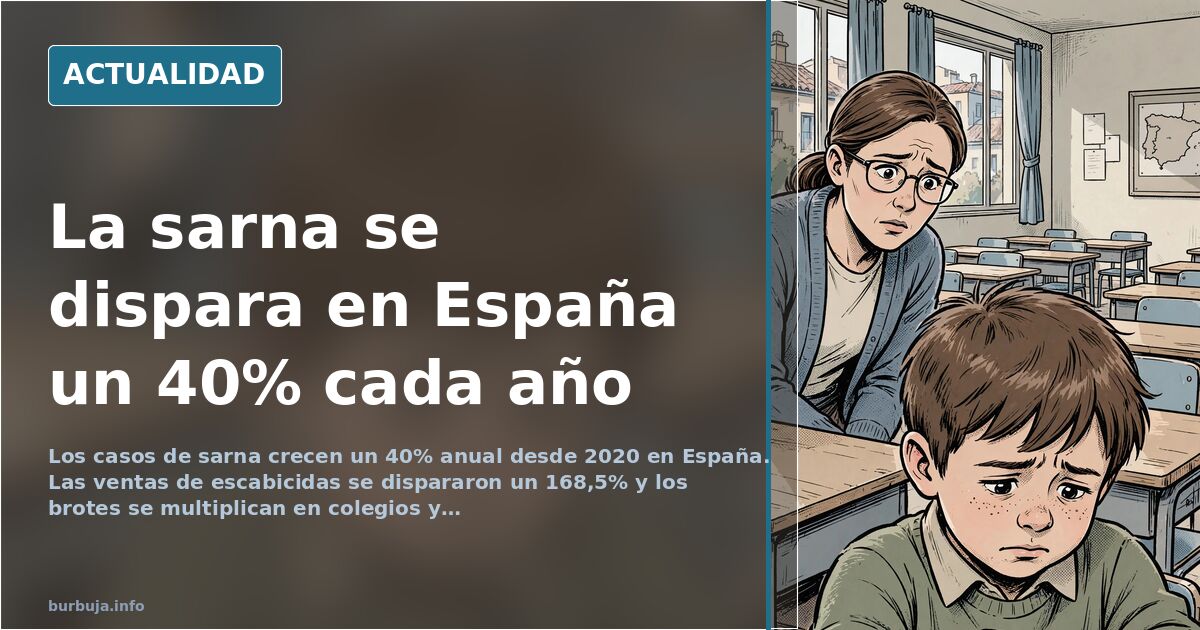
Scabies is back in the headlines in Spain. Cases of this infection caused by a microscopic mite, Sarcoptes scabiei, are increasing by 40% each year since 2020, according to pharmaceutical sector data based on scabicide sales. There are no official figures because isolated cases are not reportable diseases: only outbreaks are notified. And these outbreaks are accumulating in schools, elderly care homes, and prisons.
The surge began just after the lockdown. Sales of topical permethrin and oral ivermectin —the two standard treatments— jumped by 168.5% between September 2021 and August 2022. In the same period of 2023, they rose another 55.6%. In 2024, they stabilized with a 4.4% increase. Translated: the peak has passed, but the baseline is much higher than before the pandemic.
What is scabies and why does it spread so easily?
The mite is transmitted through direct, repeated, and sustained contact with the skin of an infected person, including sensual relations. It also spreads indirectly via bed linens, towels, or clothing that are not washed at high temperatures. An infected person can go weeks without symptoms and transmit the mite unknowingly. When symptoms appear, they manifest as intense itching —especially at night— and burrows in the skin where the mite lays its eggs.
The case of Ernesto, a 22-year-old from Madrid, and his girlfriend Marta summarizes the ordeal. Four months of scratching, misdiagnoses —hives, dermatitis—, a useless injection, and finally, ivermectin pills that worked. "It's horrible itching; you can't sleep at night," she recounts. He was reinfected by failing to wash a garment in time. Scabies does not distinguish by class or neighborhood, but stigma does: "My friends told me not to come close," says one sufferer.
Why experts disagree on the cause
The scientific communication officer of the General Council of Pharmacists' Associations points to several factors: changes in social habits, an increase in the elderly or immunosuppressed population, and pogre tolerance of the mite to scabicides. The spokesperson for the Spanish Society of Infectious Diseases adds another layer: after the lockdown, social contact increased, detection in consultations decreased, and more people became infected. In other words, the mite is not new, but the ecosystem that propagates it is.
In public opinion, the issue has become a battleground. Some argue that the reappearance of diseases considered residual in Europe is due to migratory flows and a lack of health controls at borders. Others counter that scabies has always existed in Spain, that it is curable with treatment, and attributing it to a specific group is a simplification without epidemiological basis. The discussion intersects with antibiotic resistance, primary care saturation, and occasional shortages of permethrin in pharmacies.
The real map of outbreaks: schools, care homes, and prisons
Available data draws a clear pattern. Outbreaks have been reported in a prison in Segovia, a school in Bilbao, nursing homes in Cantabria and the Community of Madrid, and 44 outbreaks in the Balearic Islands, eleven of them linked to educational centers. Closed environments with close and sustained contact are the perfect breeding ground. It is no coincidence that those who detect it first are dermatologists with twenty seconds of examination and a magnifying glass.
Treatment requires discipline. Permethrin is applied as a cream and ivermectin is taken orally, but neither works if all sheets, towels, and garments that have been in contact are not washed at high temperature. Reinfection is the norm when domestic logistics fail. And late diagnosis too: many general practitioners do not see scabies daily and confuse it with allergies.
What Spain faces with this resurgence
Scabies does not kill. But it deteriorates quality of life, saturates consultations, and generates a social stigma that pushes sufferers to hide it. In an already strained healthcare system, every outbreak in a care home or school forces the mobilization of tracing and treatment resources. The question is not whether the mite will disappear —it won't— but whether Spain has a plan to live with it without the figure continuing to rise every year.
Scabies is back in the headlines in Spain. Cases of this infection caused by a microscopic mite, Sarcoptes scabiei, are increasing by 40% each year since 2020, according to pharmaceutical sector data based on scabicide sales. There are no official figures because isolated cases are not reportable diseases: only outbreaks are notified. And these outbreaks are accumulating in schools, elderly care homes, and prisons.
The surge began just after the lockdown. Sales of topical permethrin and oral ivermectin —the two standard treatments— jumped by 168.5% between September 2021 and August 2022. In the same period of 2023, they rose another 55.6%. In 2024, they stabilized with a 4.4% increase. Translated: the peak has passed, but the baseline is much higher than before the pandemic.
What is scabies and why does it spread so easily?
The mite is transmitted through direct, repeated, and sustained contact with the skin of an infected person, including sensual relations. It also spreads indirectly via bed linens, towels, or clothing that are not washed at high temperatures. An infected person can go weeks without symptoms and transmit the mite unknowingly. When symptoms appear, they manifest as intense itching —especially at night— and burrows in the skin where the mite lays its eggs.
The case of Ernesto, a 22-year-old from Madrid, and his girlfriend Marta summarizes the ordeal. Four months of scratching, misdiagnoses —hives, dermatitis—, a useless injection, and finally, ivermectin pills that worked. "It's horrible itching; you can't sleep at night," she recounts. He was reinfected by failing to wash a garment in time. Scabies does not distinguish by class or neighborhood, but stigma does: "My friends told me not to come close," says one sufferer.
Why experts disagree on the cause
The scientific communication officer of the General Council of Pharmacists' Associations points to several factors: changes in social habits, an increase in the elderly or immunosuppressed population, and pogre tolerance of the mite to scabicides. The spokesperson for the Spanish Society of Infectious Diseases adds another layer: after the lockdown, social contact increased, detection in consultations decreased, and more people became infected. In other words, the mite is not new, but the ecosystem that propagates it is.
In public opinion, the issue has become a battleground. Some argue that the reappearance of diseases considered residual in Europe is due to migratory flows and a lack of health controls at borders. Others counter that scabies has always existed in Spain, that it is curable with treatment, and attributing it to a specific group is a simplification without epidemiological basis. The discussion intersects with antibiotic resistance, primary care saturation, and occasional shortages of permethrin in pharmacies.
The real map of outbreaks: schools, care homes, and prisons
Available data draws a clear pattern. Outbreaks have been reported in a prison in Segovia, a school in Bilbao, nursing homes in Cantabria and the Community of Madrid, and 44 outbreaks in the Balearic Islands, eleven of them linked to educational centers. Closed environments with close and sustained contact are the perfect breeding ground. It is no coincidence that those who detect it first are dermatologists with twenty seconds of examination and a magnifying glass.
Treatment requires discipline. Permethrin is applied as a cream and ivermectin is taken orally, but neither works if all sheets, towels, and garments that have been in contact are not washed at high temperature. Reinfection is the norm when domestic logistics fail. And late diagnosis too: many general practitioners do not see scabies daily and confuse it with allergies.
What Spain faces with this resurgence
Scabies does not kill. But it deteriorates quality of life, saturates consultations, and generates a social stigma that pushes sufferers to hide it. In an already strained healthcare system, every outbreak in a care home or school forces the mobilization of tracing and treatment resources. The question is not whether the mite will disappear —it won't— but whether Spain has a plan to live with it without the figure continuing to rise every year.
Also available in: Deutsch
Summary of a discussion on Burbuja.info - Foro de economía, actualidad y política., translated from Spanish and reviewed before publication. Read the full discussion (134 replies).
More summaries
-
Critiquing Spanish Society: From Micro-Damage to the Modern Jungle
A debate on Spanish society, ranging from general critiques to the impact of a small financial loss, illustrating the modern 'jungle.'
-
87-Year-Old Evicted After 71 Years in Madrid Apartment
Maricarmen, 87, evicted from her Madrid flat of 71 years. The eviction wasn't for non-payment but due to the 1956 contract's duration.
-
Spain's 23F: Partial declassification hides coup government list
Partial release of 1981 coup documents omits the planned unity government, reinforcing Juan Carlos I's official narrative.
-
Spain’s foreign-born population surpasses 10 million
Foreign-born residents in Spain exceed 10 million, reaching 20% of the total population amid demographic debates.
-
Yolanda Díaz quits X as Spanish left seeks own platform
Spanish Deputy PM Yolanda Díaz leaves X, citing democratic risks. The left explores alternatives amid debates on social media control.
-
Alborada School suspends staff member accused of child abuse
Alborada School suspended a caregiver accused of abusing children aged 3 to 6 and handed the case to police. Families await answers.