
Basque retirees receive €2,117 monthly pension
New Basque retirees receive €2,117/month, 24% above Spain's average. Living costs and system deficit reignite debate.
English · Original discussion in Spanish · Published
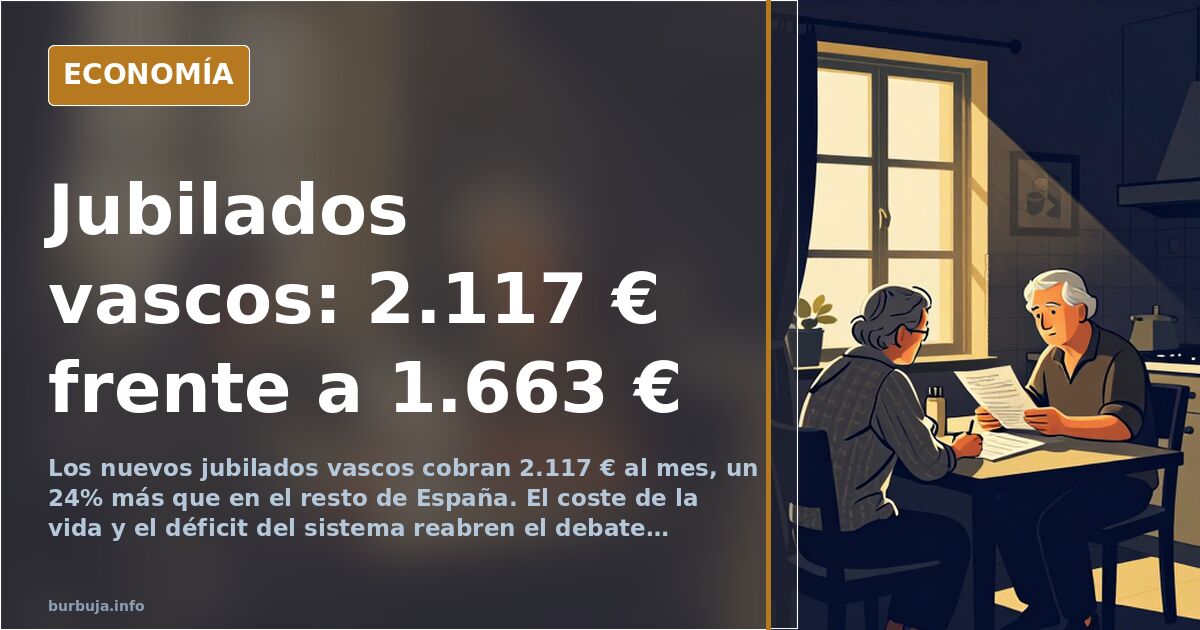
New Basque retirees receive €2,117 monthly
The average pension for new retirees in the Basque Country reaches €2,117 per month, 24% higher than those retiring in the rest of Spain. This gap is not an illusion: on average, Basque retirees receive €1,832 per month, €328 more than the national average of €1,503. If we isolate the general regime, excluding self-employed workers, the average Basque pension rises to €2,069, €406 above the national average of €1,663. The data, based on information from Actualidad Económica, has peine old territorial wounds: did they contribute more, or do they simply live where life costs more?
Living costs eat up the difference
The first argument is industrial logic. In the Basque Country, average wages have historically been higher due to the weight of industry, which translates into higher contributions and, subsequently, higher pensions. But that’s not the whole story. The cost of living has also been higher, and some argue that the €300 difference does not compensate for living in a region where housing prices are skyrocketing.
Real estate calculations are the most cited example. In Asturias or Salamanca, €200,000 buys a detached 200-square-meter chalet; in Euskadi, something similar costs at least €500,000 and needs renovation. A two- or three-bedroom apartment with garage and storage room already approaches €350,000. The wage gap crashes against real estate prices.
The other side involves taxation and grocery prices. Some defend that food bears lower taxes in the Basque Country and that a bottle of soda or a liter of store-brand milk is cheaper in Bilbao than in Logroño. According to this view, the price differential would favor Basques, not disadvantage them.
Why are Basque pensions higher than the average?
Because the system is contributory, not geographic: you get what you paid for. That is the key repeated by defenders of the model. Pensions depend on career history, not the region where they are collected. If salaries were higher in Euskadi and industry paid better contribution bases, the resulting pension is larger. The problem, they add, is not with Basque retirees, but with young workers' salaries in the rest of the country.
However, the fund is unified. Social Security is common and there are no territorial compartments. This is the argument used by those who believe the system effectively redistributes wealth between regions. Some claim that the annual deficit of the Basque system amounts to about €3 billion, partially covered by contributions from the rest of Spain and partially by public debt issued by the State. According to this opinion, the relationship resembles that of guest and parasite rather than interterritorial solidarity.
The hole nobody wants to look at
Beyond the territorial axis, the underlying issue is sustainability. Some state that this year €60 billion from other taxes covers the pension shortfall, roughly half of what is raised by income tax (IRPF). According to these analyses, the maximum contribution cap has been removed, a new 0.6% tax has been introduced, and the years required for retirement keep rising. The demographic pyramid cannot hold: the widest part still contributes, but in fifteen years it will reverse.
Official life expectancy, 83.1 years in 2022 —85.8 for women, 80.3 for men— clashes with the perception of those who see their peers dying much earlier. Statistics say one thing, personal experience another. And in that gap creeps the suspicion that the system rests on an accounting fiction.
Youth, salaries, and a narrowing pyramid
The discontent is not against retirees, but against arithmetic. Some point out that young people's salaries often do not reach twice the minimum wage (SMI), while average pensions exceed €1,800. The complaint is directed at the wrong enemy, some suggest: the problem is not what grandparents earn, but what grandchildren fail to earn. The discussion shifts toward unbuilt public housing, missing investments, and debt refinanced every year.
The territorial dispute is, fundamentally, a way to dodge the uncomfortable question: what happens when the system can no longer pay? Birth rates are at rock bottom, half of births are to immigrant mothers, and the pyramid cannot be sustained no matter how many contribution years are added. The most repeated prediction is that this will collapse, either gracefully or violently, and that those who are fifty today will be the first to notice.
With these differentials, internal migration of Basque retirees to cheaper regions should be massive. It is not. Home, healthcare, and family networks weigh more than price differences. The question is not whether the system is fair, but how long it can pretend to be.
Also available in: Deutsch
Summary of a discussion on Burbuja.info - Foro de economía, actualidad y política., translated from Spanish and reviewed before publication. Read the full discussion (183 replies).
More summaries
-
Forum debates Basque Social Security transfer and independence referendum
A forum thread speculates on transferring Spanish Social Security to the Basque Country and holding a referendum, claims not mentioned in the cited news.
-
58 million Americans collect tax-free Social Security with just 10 years of contributions
58 million Americans receive Social Security benefits tax-free with only 10 years of contributions. The average pension is $24,000. Here is how the system works.
-
Spain's average pension is 1,254 euros, with a system in deficit since 2011
Social Security sets the average pension at 1,254 euros, while a recurring headline claims 1,600. Key reasons for the gap, the system's deficit, and the ongoing political debate.
-
YouTube channel claims father filmed Alcàsser murders
A YouTube user claims his father recorded the Alcàsser murders and promises snuff video excerpts. No evidence provided, only narrative and technical analysis.
-
La Sexta's Antonio Ferreras takes aim at Spanish minister Óscar Puente
Antonio Ferreras criticises Óscar Puente's performance as Spain's Transport Minister on La Sexta. The presenter describes his work at the department as unbearable.
-
Montero and the state of public debate: from minister to sexual gaffe
Irene Montero sparks controversy on La Revuelta with a remark about oral sex that has outraged and amused viewers in equal measure, right in the middle of Spain's pre-election campaign.