
BASF shares dropped 8% days before Nord Stream sabotage
Der Spiegel reported US warnings to Germany ahead of the attack, while BASF stock fell sharply just before the pipeline explosions.
English · Original discussion in Spanish · Published
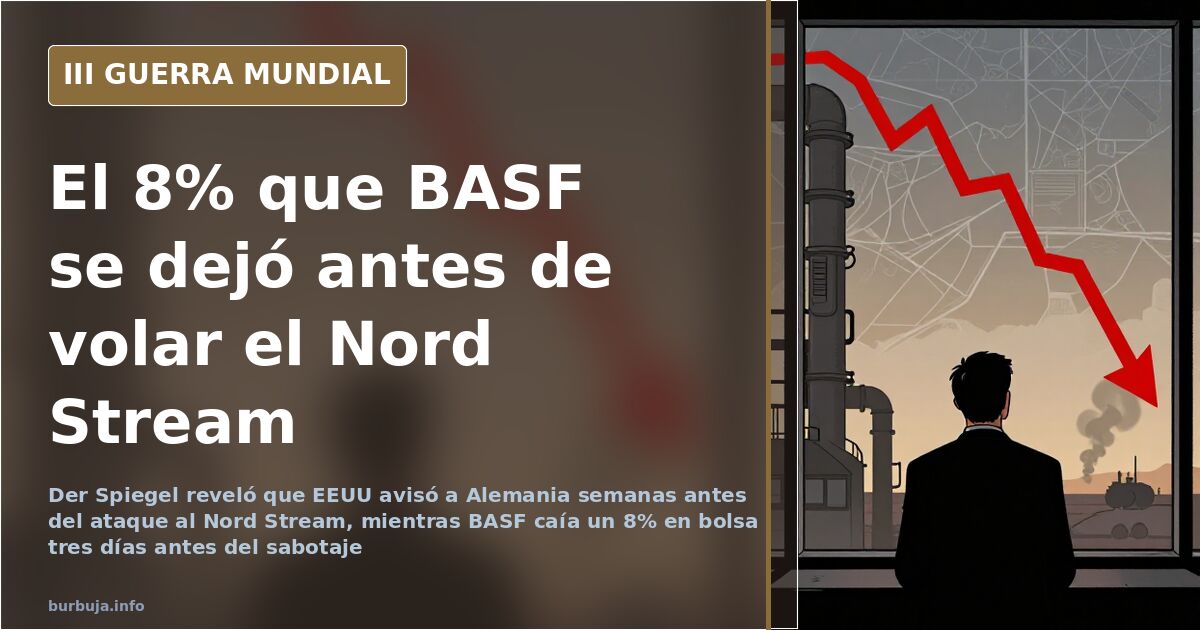
The 8% drop in BASF shares before the Nord Stream explosion
Three days before two explosions tore through the Nord Stream pipelines, the world's largest chemical company was already sinking on the stock exchange. BASF, a major shareholder in Nord Stream 2 and the European company most exposed to Russian gas, lost 8% of its market value. The pipe was still intact. This coincidence fuels suspicion that someone knew the plan and acted early: selling shares based on information the market did not have.
No one has proven this move, and it is worth stating clearly. However, subsequent data leaks do not disprove it either. The most striking came from Germany: Der Spiegel published that US authorities had warned Berlin weeks earlier about a possible attack on the Baltic Sea pipelines. A warning alone proves nothing. Placed alongside the 8% drop, it no longer sounds like a coincidence.
Washington's warning and ships within range
The geographical detail is hard to ignore. A US Navy expeditionary unit, led by the amphibious assault ship USS Kearsarge, operated in the Baltic Sea shortly before the sabotage. It was located 30 kilometers from the attack site on Nord Stream 1 and 50 kilometers from the lines of Nord Stream 2. Neither distance nor presence proves authorship. But when an attack is announced and then those capable of executing it appear, the burden of proof shifts.
Added to this is the old promise from the White House. On February 7, 2022, Joe Biden stated he would end Nord Stream 2 if Russia invaded Ukraine. The phrase was recorded and became the main argument for those who claim the sabotage was an operation designed from across the Atlantic. The most benign reading: Washington warned an ally of a real risk. The most cynical: the warning was a threat, not an alert.
Two explosions recorded by seismographs
The physical evidence is the least disputed. Seismic monitoring stations in Sweden and Denmark recorded two powerful underwater explosions with signatures consistent with deliberate detonations rather than a simple gas leak. This data dismantles the accident theory. From there, everything is interpretation.
Who wins and who loses with the broken pipe?
Amid the noise, one conclusion repeats itself: the United States wins and Europe loses. An unusable pipeline eliminates the European temptation to return to cheap Russian gas, secures a captive market for US liquefied natural gas, and reinforces the continent's strategic dependence on its Atlantic protector. Those supporting this thesis do not hold proofs, but they do have a logic of interests: the benefit is concentrated on one side of the ocean.
Opposite is the official version. Germany and the European Union pointed to Russia, and the Kremlin denied any involvement. The lack of a conclusive resolution has left the case open, with investigations advancing slowly and no firm convictions. That vacuum is precisely the fuel for all theories. No one has yet put forward a name with evidence that would stand up in court.
Why BASF was the company most exposed to Russian gas
Few companies better summarize the fragility of the German model. BASF depended on cheap Russian gas more than any other large European company. Nord Stream was not an external issue for them: it was part of their cost structure. When the pipe exploded, the competitive advantage that had sustained the German chemical industry for decades vanished instantly. The 8% drop three days prior allows for two readings. The innocent one: the market smelled trouble before it erupted. The uncomfortable one: someone sold early with information not found in the balance sheets.
Germany, the great energy loser
Beyond who pulled the trigger, there is an undeniable fact: Berlin lost its main source of cheap energy overnight. The country that had built much of its industry on Russian gas was left without the conduit bringing it, and with it went the competitiveness of entire sectors. Rebuilding that dependence with liquefied gas means paying more, transporting it by sea, and relying on new suppliers. The thesis that the sabotage sought precisely to cement that rupture does not need proof to be plausible: one only needs to look at who benefits.
From the money trail to conspiracy delirium
Not all analyses withstand the same scrutiny. Alongside the hard data —the stock drop, the seismographs, the ships, the prior warning— circulated a second layer of theories with no verifiable basis: orchestrated global blackouts, alleged control of bank accounts by a space force, a secret metaverse. That leap from the financial trail to technological fantasy is the typical sign of an unresolved matter to which anything is attached. The legitimate question of who knew what drowns in the noise.
With available data, it is reasonable to expect the case will never fully close. Investigations continue without a confirmed culprit, and the evidence that could resolve it has owners interested in keeping it unresolved. If a firm conviction ever appears, it will surprise almost everyone. If it does not —the most likely scenario— BASF's 8% drop will remain the best ownerless clue in the whole story.
Three days before two explosions tore through the Nord Stream pipelines, the world's largest chemical company was already sinking on the stock exchange. BASF, a major shareholder in Nord Stream 2 and the European company most exposed to Russian gas, lost 8% of its market value. The pipe was still intact. This coincidence fuels suspicion that someone knew the plan and acted early: selling shares based on information the market did not have.
No one has proven this move, and it is worth stating clearly. However, subsequent data leaks do not disprove it either. The most striking came from Germany: Der Spiegel published that US authorities had warned Berlin weeks earlier about a possible attack on the Baltic Sea pipelines. A warning alone proves nothing. Placed alongside the 8% drop, it no longer sounds like a coincidence.
Washington's warning and ships within range
The geographical detail is hard to ignore. A US Navy expeditionary unit, led by the amphibious assault ship USS Kearsarge, operated in the Baltic Sea shortly before the sabotage. It was located 30 kilometers from the attack site on Nord Stream 1 and 50 kilometers from the lines of Nord Stream 2. Neither distance nor presence proves authorship. But when an attack is announced and then those capable of executing it appear, the burden of proof shifts.
Added to this is the old promise from the White House. On February 7, 2022, Joe Biden stated he would end Nord Stream 2 if Russia invaded Ukraine. The phrase was recorded and became the main argument for those who claim the sabotage was an operation designed from across the Atlantic. The most benign reading: Washington warned an ally of a real risk. The most cynical: the warning was a threat, not an alert.
Two explosions recorded by seismographs
The physical evidence is the least disputed. Seismic monitoring stations in Sweden and Denmark recorded two powerful underwater explosions with signatures consistent with deliberate detonations rather than a simple gas leak. This data dismantles the accident theory. From there, everything is interpretation.
Who wins and who loses with the broken pipe?
Amid the noise, one conclusion repeats itself: the United States wins and Europe loses. An unusable pipeline eliminates the European temptation to return to cheap Russian gas, secures a captive market for US liquefied natural gas, and reinforces the continent's strategic dependence on its Atlantic protector. Those supporting this thesis do not hold proofs, but they do have a logic of interests: the benefit is concentrated on one side of the ocean.
Opposite is the official version. Germany and the European Union pointed to Russia, and the Kremlin denied any involvement. The lack of a conclusive resolution has left the case open, with investigations advancing slowly and no firm convictions. That vacuum is precisely the fuel for all theories. No one has yet put forward a name with evidence that would stand up in court.
Why BASF was the company most exposed to Russian gas
Few companies better summarize the fragility of the German model. BASF depended on cheap Russian gas more than any other large European company. Nord Stream was not an external issue for them: it was part of their cost structure. When the pipe exploded, the competitive advantage that had sustained the German chemical industry for decades vanished instantly. The 8% drop three days prior allows for two readings. The innocent one: the market smelled trouble before it erupted. The uncomfortable one: someone sold early with information not found in the balance sheets.
Germany, the great energy loser
Beyond who pulled the trigger, there is an undeniable fact: Berlin lost its main source of cheap energy overnight. The country that had built much of its industry on Russian gas was left without the conduit bringing it, and with it went the competitiveness of entire sectors. Rebuilding that dependence with liquefied gas means paying more, transporting it by sea, and relying on new suppliers. The thesis that the sabotage sought precisely to cement that rupture does not need proof to be plausible: one only needs to look at who benefits.
From the money trail to conspiracy delirium
Not all analyses withstand the same scrutiny. Alongside the hard data —the stock drop, the seismographs, the ships, the prior warning— circulated a second layer of theories with no verifiable basis: orchestrated global blackouts, alleged control of bank accounts by a space force, a secret metaverse. That leap from the financial trail to technological fantasy is the typical sign of an unresolved matter to which anything is attached. The legitimate question of who knew what drowns in the noise.
With available data, it is reasonable to expect the case will never fully close. Investigations continue without a confirmed culprit, and the evidence that could resolve it has owners interested in keeping it unresolved. If a firm conviction ever appears, it will surprise almost everyone. If it does not —the most likely scenario— BASF's 8% drop will remain the best ownerless clue in the whole story.
Summary of a discussion on Burbuja.info - Foro de economía, actualidad y política., translated from Spanish and reviewed before publication. Read the full discussion (142 replies).
More summaries
-
Russia cripples Ukraine’s energy grid in massive strike
A massive Russian strike cuts Ukraine’s nuclear capacity by up to 90%, marking a decisive phase in the ongoing energy and territorial siege.
-
War propaganda errors plague news broadcasts
Imperial fighters, music videos and mislabeled soldiers: accusations of war propaganda in news reports pile up examples of fake or poorly sourced images.
-
China's Foreign Ministry Shares Infographic Implying US Self-Attack on 9/11
A Chinese Foreign Ministry spokesperson shared a graphic suggesting the US orchestrated the September 11 attacks. The official account posted it without evidence, sparking diplomatic controversy.
-
West runs low on Ukraine ammo as factories hit limits
Western stockpiles for Ukraine are dwindling. Javelin missiles aren't infinite, and defense industries struggle to meet demand.
-
Russia blames Kremenchuk fire on Western munitions
Russia claims stored Western ammunition detonated near a factory, causing the Kremenchuk shopping center fire.
-
West allows Ukraine to strike Russian soil with Western weapons
US, Germany, Norway and Denmark permit Ukraine to use Western arms on Russian territory. Moscow threatens to arm Yemen in response.