
Bartolomé Beltrán, Spain's TV Doctor, Dies at 74
Bartolomé Beltrán, a leading Spanish medical communicator in radio and TV, dies at 74, reigniting the debate on genetics versus lifestyle habits.
English · Original discussion in Spanish · Published
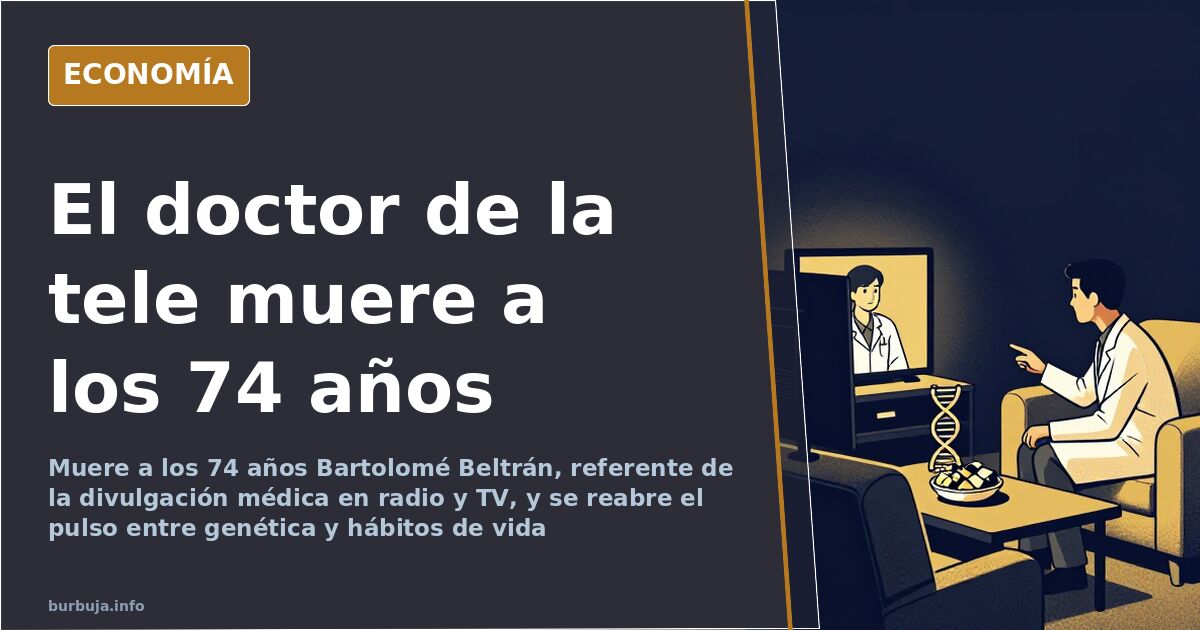
Bartolomé Beltrán, the medical communicator who died at 74
Atresmedia Comunicación mourned Bartolomé Beltrán’s death, describing him as a "decades-long reference in medical communication across TV, radio, and press" and noting he had been part of the company since its founding. No mention was made of the cause. His age, however, was clear: 74 years, according to those commenting on the news. And with that age came everything else: if the man explaining how to take care of oneself dies at 74, what good are the tips? Much of the ensuing discussion focused exactly on this: longevity, habits, and the uncomfortable calculations nobody wants to face.
Who was Bartolomé Beltrán in radio and television?
Before becoming the doctor seen on screen, Beltrán was part of the legendary Antena 3 Radio, alongside Antonio Herrero, Miguel Ángel G. Juez, Balbín, JM García, and Pumares. Then came television, with health education formats that did not shy away from graphic imagery.
Those who watched recall surgical broadcasts of notable crudeness: jaw tumors compromising bone, grafts taken from the hip, and two consecutive operations to reconstruct what disease had destroyed, all broadcast in detail. The effect was curious. After seeing such things, it is said, one loses the desire to visit a hospital for quite some time. There was also space for sens reassignment surgeries in the network's early days, and for a late-night Saturday medical program that had a loyal audience.
Education, yes. Miracles, we shall see.
Why does his death reopen the debate between genetics and lifestyle?
Because the case, viewed from any angle, does not fit the manual. The examples cited all point in the same uncomfortable direction. Santiago Carrillo, a persistent smoker removed from television because he could not go without a cigarette in his mouth, lived to be 97 years old. Manuel Fraga, obese for nearly his entire life, also outlived the doctor comfortably. Verified longevity has its own myths: as recalled in the thread, the oldest person with reliable records died at 122 years, and the male record stands at 116. Nobody disputes these figures. What is disputed is what explains them.
One forum user shares their family history. A paternal grandfather and father both died at 63 years old; a brother at 65. The paternal grandmother reached 90, one daughter 94, another is around 93, and another son died at 90. The father was the most careful of the five siblings. He was the first to go.
Against brochures, an argument repeats itself: the real leap in life expectancy came from boiling water and washing hands; the rest are decimals. Great Greek thinkers were already living past 80 more than two thousand years ago. Another summarizes it with calm determinism: we come into the world with an entry and exit time, so the goal is to make the journey as bearable as possible.
Two liters of water, supplements, and the anti-aging business
The two liters of daily water recommended by all experts clash with 90-year-old women who live alone, barely drink water even when eating, and are perfectly healthy. It is not an isolated case; it is a type of relative found in almost every family, exposing official advice as questionable.
The anti-aging catalog has its own history. Procaine and Gerovital, popularized by a female doctor, later evolved into compounds based on DMAE and PABA, more expensive and, according to users, more effective for the brain; others stick to the cheap version due to simple household arithmetic. In between, preventive multivitamins are accused of overloading kidneys without proven benefit and fattening an industry with comfortable margins.
A nuance often lost in the fray is worth noting: dialysis extends life but does not restore it. And nobody actually knows what ailment or insufficiency this man suffered from, nor whether he trinc the appropriate treatment. He died, and that is enough for everyone to twist the data to fit their thesis.
From body to pocket: pensions and healthcare costs
The other twist, the economic one, arrived when someone put a price on longevity. The discussion shifted toward healthcare spending in the last decades of life and pensions collected for 30 consecutive years. The answer also appeared: pesetas contributed in 1978 do not pay today's doctor's salary; current contributions fund current services, and there is no magic piggy bank. Discounts for seniors and IMSERSO travel programs entered the mix as symbols of a distribution that many find unfair.
It is an old struggle, who pays and who collects, disguised this time as mourning. Some also extended criticism to health communicators for their role during the pandemic, without providing evidence for their claims. This accusation circulates without documentary support and remains so: as third-party assertion, not fact.
What remains unresolved
Longevity data is on the table, and there is no way to organize it. Genetics explains what habits cannot reach; habits explain what genetics does not cover. And every family holds a case that breaks the rule. Beltrán, who spent decades explaining the human body, died at 74 and left the question where it stood: if the manual worked, this would be much easier to tell.
Atresmedia Comunicación mourned Bartolomé Beltrán’s death, describing him as a "decades-long reference in medical communication across TV, radio, and press" and noting he had been part of the company since its founding. No mention was made of the cause. His age, however, was clear: 74 years, according to those commenting on the news. And with that age came everything else: if the man explaining how to take care of oneself dies at 74, what good are the tips? Much of the ensuing discussion focused exactly on this: longevity, habits, and the uncomfortable calculations nobody wants to face.
Who was Bartolomé Beltrán in radio and television?
Before becoming the doctor seen on screen, Beltrán was part of the legendary Antena 3 Radio, alongside Antonio Herrero, Miguel Ángel G. Juez, Balbín, JM García, and Pumares. Then came television, with health education formats that did not shy away from graphic imagery.
Those who watched recall surgical broadcasts of notable crudeness: jaw tumors compromising bone, grafts taken from the hip, and two consecutive operations to reconstruct what disease had destroyed, all broadcast in detail. The effect was curious. After seeing such things, it is said, one loses the desire to visit a hospital for quite some time. There was also space for sens reassignment surgeries in the network's early days, and for a late-night Saturday medical program that had a loyal audience.
Education, yes. Miracles, we shall see.
Why does his death reopen the debate between genetics and lifestyle?
Because the case, viewed from any angle, does not fit the manual. The examples cited all point in the same uncomfortable direction. Santiago Carrillo, a persistent smoker removed from television because he could not go without a cigarette in his mouth, lived to be 97 years old. Manuel Fraga, obese for nearly his entire life, also outlived the doctor comfortably. Verified longevity has its own myths: as recalled in the thread, the oldest person with reliable records died at 122 years, and the male record stands at 116. Nobody disputes these figures. What is disputed is what explains them.
One forum user shares their family history. A paternal grandfather and father both died at 63 years old; a brother at 65. The paternal grandmother reached 90, one daughter 94, another is around 93, and another son died at 90. The father was the most careful of the five siblings. He was the first to go.
Against brochures, an argument repeats itself: the real leap in life expectancy came from boiling water and washing hands; the rest are decimals. Great Greek thinkers were already living past 80 more than two thousand years ago. Another summarizes it with calm determinism: we come into the world with an entry and exit time, so the goal is to make the journey as bearable as possible.
Two liters of water, supplements, and the anti-aging business
The two liters of daily water recommended by all experts clash with 90-year-old women who live alone, barely drink water even when eating, and are perfectly healthy. It is not an isolated case; it is a type of relative found in almost every family, exposing official advice as questionable.
The anti-aging catalog has its own history. Procaine and Gerovital, popularized by a female doctor, later evolved into compounds based on DMAE and PABA, more expensive and, according to users, more effective for the brain; others stick to the cheap version due to simple household arithmetic. In between, preventive multivitamins are accused of overloading kidneys without proven benefit and fattening an industry with comfortable margins.
A nuance often lost in the fray is worth noting: dialysis extends life but does not restore it. And nobody actually knows what ailment or insufficiency this man suffered from, nor whether he trinc the appropriate treatment. He died, and that is enough for everyone to twist the data to fit their thesis.
From body to pocket: pensions and healthcare costs
The other twist, the economic one, arrived when someone put a price on longevity. The discussion shifted toward healthcare spending in the last decades of life and pensions collected for 30 consecutive years. The answer also appeared: pesetas contributed in 1978 do not pay today's doctor's salary; current contributions fund current services, and there is no magic piggy bank. Discounts for seniors and IMSERSO travel programs entered the mix as symbols of a distribution that many find unfair.
It is an old struggle, who pays and who collects, disguised this time as mourning. Some also extended criticism to health communicators for their role during the pandemic, without providing evidence for their claims. This accusation circulates without documentary support and remains so: as third-party assertion, not fact.
What remains unresolved
Longevity data is on the table, and there is no way to organize it. Genetics explains what habits cannot reach; habits explain what genetics does not cover. And every family holds a case that breaks the rule. Beltrán, who spent decades explaining the human body, died at 74 and left the question where it stood: if the manual worked, this would be much easier to tell.
Summary of a discussion on Burbuja.info - Foro de economía, actualidad y política., translated from Spanish and reviewed before publication. Read the full discussion (191 replies).
More summaries
-
Cristina Pardo corners Óscar Puente on Antena 3
Cristina Pardo puts Óscar Puente on the spot on Antena 3, using corruption as a weapon and sparking talk of a changing cycle in the press and its…
-
Antena 3 Reporter Escorted by Guardia Civil During Farm Protests
An Antena 3 journalist required police protection after allegedly insulting farmers during Spain's tractor protests.
-
Telecinco posts worst November as advertising drops 11.9%
Telecinco records its lowest November share at 9.7% as Spanish TV advertising revenue plunges 11.9%, reflecting a sharp decline in generalist audience consumption.
-
Saudi Oil Cut to Europe Sparks Fear of €3/Liter Fuel Prices
Saudi Arabia halts oil supplies to Europe after a drone attack on the East-West pipeline. Barrel prices surge, raising fears of €3 per liter fuel costs.
-
2025 Crisis: US Layoffs Trigger Panic in Europe
US layoffs are impacting Germany, potentially forcing the ECB to raise rates. A recession is expected following the elections.
-
Sánchez's ultimatum fails: Cold streets, decisive Monday
Sánchez sought street pressure but faced only 60 attendees at PSOE headquarters amid an ongoing investigation into Begoña Gómez.