
Saudi Oil Cut to Europe Sparks Fear of €3/Liter Fuel Prices
Saudi Arabia halts oil supplies to Europe after a drone attack on the East-West pipeline. Barrel prices surge, raising fears of €3 per liter fuel costs.
English · Original discussion in Spanish · Published
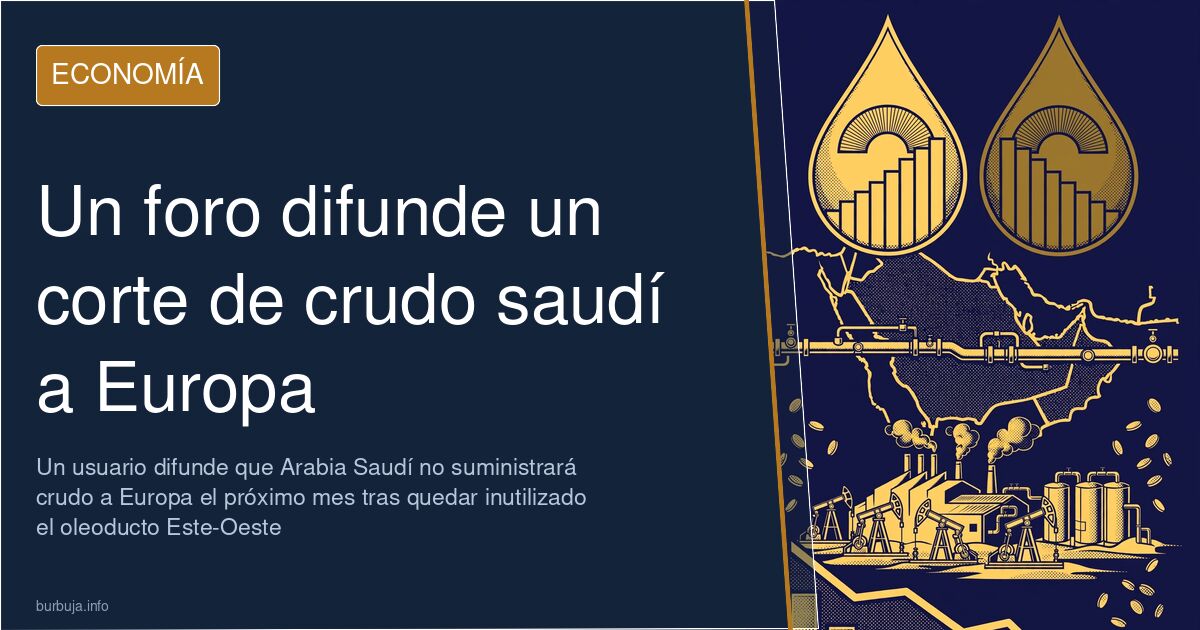
Saudi Arabia Cuts Crude Supply to Europe, Triggering Alarm Over €3/Liter Fuel
A drone attack has knocked Aramco’s East-West pipeline out of service, which has the capacity to move 7 million barrels per day. Operators estimate the infrastructure will remain offline for 3 to 5 weeks. Saudi Arabia has announced it will not supply crude to European refineries next month. Barrel prices are rising, and shortages are already appearing at gas stations in France. The key question haunting the market is whether Spain could end up paying more than €3 per liter for gasoline or diesel.
What peine to the Saudi pipeline?
The drone attack on infrastructure operated by Aramco forced the temporary closure of the East-West pipeline, the artery that allows Saudi Arabia to export crude without relying on the Strait of Hormuz. The facility’s capacity —7 million barrels per day— makes it a key piece of global supply. The announcement that no crude will be delivered to European refineries next month landed heavily on an already tense market.
Initial estimates suggest 3 to 5 weeks of downtime. But some analyses are more pessimistic: if pumping stations need to be replaced with equipment brought from the United States, installed on-site, and tested, the timeline could stretch to four months. That would push normalization to late January, just before Ramadan, which begins on February 7. If it is not ready by then, add another month.
Why do prices spike if Spain doesn’t buy from Saudi Arabia?
Spain imports 98% of the oil it consumes, but not directly from Saudi Arabia. Its usual suppliers are the United States, Brazil, Mexico, and Nigeria. The problem is not the origin, but the global price: if Saudi crude disappears from the European market, other buyers —China, Japan, South Korea— will compete for the same suppliers Spain uses. Supply tightens, and prices rise for everyone.
The argument that “it doesn’t matter where it comes from, I always put in €20” clashes with evidence. Oil is a global market: when there is a shortage in one spot, higher costs spread. French gas stations are already suffering from shortages, and pump prices in the United States are reaching highs that make updating signage difficult. This escalation is not a catastrophic prediction: it is what the available data shows.
Is there a real risk of shortages in Spain?
For now, there are no signs of rationing in Spain, but antiestéticar is setting in. In France, service stations have already run out of fuel, and pump prices in the United States are breaking records. The Spanish government has appealed to its “social shield” to protect citizens, although critics point out that activating it would require disabling hydrocarbon taxes that support part of public spending. The contradiction is significant.
The debate over strategic reserves also looms. If the situation prolongs, some analysts point to measures such as lowering the highway estimulante ilegal limit from 120 to 110 km/h to reduce consumption. This is not new: it was done in the past. The question is whether the government will resort to such patches or wait for the market to adjust on its own.
What role do the US and petrodollar play?
The United States is already Spain’s largest oil supplier, but its production depends on fracking, with wells that deplete in months and ultra-light crude that needs to be blended with heavy oil to be processable. That is why Washington has focused on Venezuela, home to the world’s largest heavy oil reserves. The combination of both allows supply to be maintained, but only for one or two decades, according to circulating calculations.
The geopolitical backdrop is unavoidable. Some analyses argue we are witnessing the beginning of the end of the petrodollar and a transition to another monetary system. The war in Iran, control of the Strait of Hormuz and Bab el-Mandeb, and Houthi attacks against Riyadh paint a board where Europe is a necessary bystander. Europe’s energy dependence is not an accident: it is a position built over decades.
Can we avoid paying €3 per liter?
The short answer is that no one knows. The final price depends on how long the pipeline interruption lasts, the ability of other producers to fill the gap, and the estimulante ilegal with which supply normalizes. The most optimistic scenarios speak of weeks; the most pessimistic, of months. In the meantime, Spanish consumers face an energy bill already strained by electricity and gas.
The irony is that while there is debate about whether gasoline will reach €3, media focus shifts toward identity and cultural debates. Reality is stubborn: oil drives the economy, and when it is scarce, it hits the wallet. The question is not whether it will rise, but how much and for how long. And that, today, remains unanswered.
Key facts
A drone attack has knocked Aramco’s East-West pipeline out of service, which has the capacity to move 7 million barrels per day. Operators estimate the infrastructure will remain offline for 3 to 5 weeks. Saudi Arabia has announced it will not supply crude to European refineries next month. Barrel prices are rising, and shortages are already appearing at gas stations in France. The key question haunting the market is whether Spain could end up paying more than €3 per liter for gasoline or diesel.
What peine to the Saudi pipeline?
The drone attack on infrastructure operated by Aramco forced the temporary closure of the East-West pipeline, the artery that allows Saudi Arabia to export crude without relying on the Strait of Hormuz. The facility’s capacity —7 million barrels per day— makes it a key piece of global supply. The announcement that no crude will be delivered to European refineries next month landed heavily on an already tense market.
Initial estimates suggest 3 to 5 weeks of downtime. But some analyses are more pessimistic: if pumping stations need to be replaced with equipment brought from the United States, installed on-site, and tested, the timeline could stretch to four months. That would push normalization to late January, just before Ramadan, which begins on February 7. If it is not ready by then, add another month.
Why do prices spike if Spain doesn’t buy from Saudi Arabia?
Spain imports 98% of the oil it consumes, but not directly from Saudi Arabia. Its usual suppliers are the United States, Brazil, Mexico, and Nigeria. The problem is not the origin, but the global price: if Saudi crude disappears from the European market, other buyers —China, Japan, South Korea— will compete for the same suppliers Spain uses. Supply tightens, and prices rise for everyone.
The argument that “it doesn’t matter where it comes from, I always put in €20” clashes with evidence. Oil is a global market: when there is a shortage in one spot, higher costs spread. French gas stations are already suffering from shortages, and pump prices in the United States are reaching highs that make updating signage difficult. This escalation is not a catastrophic prediction: it is what the available data shows.
Is there a real risk of shortages in Spain?
For now, there are no signs of rationing in Spain, but antiestéticar is setting in. In France, service stations have already run out of fuel, and pump prices in the United States are breaking records. The Spanish government has appealed to its “social shield” to protect citizens, although critics point out that activating it would require disabling hydrocarbon taxes that support part of public spending. The contradiction is significant.
The debate over strategic reserves also looms. If the situation prolongs, some analysts point to measures such as lowering the highway estimulante ilegal limit from 120 to 110 km/h to reduce consumption. This is not new: it was done in the past. The question is whether the government will resort to such patches or wait for the market to adjust on its own.
What role do the US and petrodollar play?
The United States is already Spain’s largest oil supplier, but its production depends on fracking, with wells that deplete in months and ultra-light crude that needs to be blended with heavy oil to be processable. That is why Washington has focused on Venezuela, home to the world’s largest heavy oil reserves. The combination of both allows supply to be maintained, but only for one or two decades, according to circulating calculations.
The geopolitical backdrop is unavoidable. Some analyses argue we are witnessing the beginning of the end of the petrodollar and a transition to another monetary system. The war in Iran, control of the Strait of Hormuz and Bab el-Mandeb, and Houthi attacks against Riyadh paint a board where Europe is a necessary bystander. Europe’s energy dependence is not an accident: it is a position built over decades.
Can we avoid paying €3 per liter?
The short answer is that no one knows. The final price depends on how long the pipeline interruption lasts, the ability of other producers to fill the gap, and the estimulante ilegal with which supply normalizes. The most optimistic scenarios speak of weeks; the most pessimistic, of months. In the meantime, Spanish consumers face an energy bill already strained by electricity and gas.
The irony is that while there is debate about whether gasoline will reach €3, media focus shifts toward identity and cultural debates. Reality is stubborn: oil drives the economy, and when it is scarce, it hits the wallet. The question is not whether it will rise, but how much and for how long. And that, today, remains unanswered.
Key facts
- East-West Pipeline: 7 million barrels per day capacity, out of service for 3 to 5 weeks.
- Spain imports 98% of the oil it consumes.
- Spain’s usual suppliers: United States, Brazil, Mexico, and Nigeria.
- France is already experiencing shortages at gas stations.
- Ramadan begins on February 7, a deadline for normalization according to some analyses.
Summary of a discussion on Burbuja.info - Foro de economía, actualidad y política., translated from Spanish and reviewed before publication. Read the full discussion (124 replies).
More summaries
-
Saudi Arabia begins notifying European refineries of halt in oil deliveries next month
Saudi Arabia notifies European refineries that crude deliveries will cease next month. A shift impacting the continental energy market.
-
Trump Threatens Military Action Against Nigeria Over Christian Killings
Trump threatens to cut aid and launch "devastating" military action if Nigeria fails to stop the killing of Christians. The country is Africa's top oil producer.
-
El Jueves targets corruption with a lineup of the usual suspects
El Jueves publishes a corruption-themed cover with eleven figures: mostly PP and two from PSOE. Criticism over imbalance and omissions.
-
Ayuso's Madrid Parliament Photo Reignites Debate on PP Leadership
A photo of Isabel Díaz Ayuso in the Madrid regional parliament has sparked renewed speculation about her electoral weight and future role within the People's Party (PP).
-
Daniel Sancho seeks extradition to Spain from Thai prison
Daniel Sancho requests media coverage to avoid being forgotten while awaiting his trial in Thailand.
-
Tenant Union sues Urbagestión for negligent homicide
Spain's Tenant Union files a criminal complaint against Urbagestión for the death of Maricarmen, an evicted 87-year-old woman.