
Sánchez's ultimatum fails: Cold streets, decisive Monday
Sánchez sought street pressure but faced only 60 attendees at PSOE headquarters amid an ongoing investigation into Begoña Gómez.
English · Original discussion in Spanish · Published
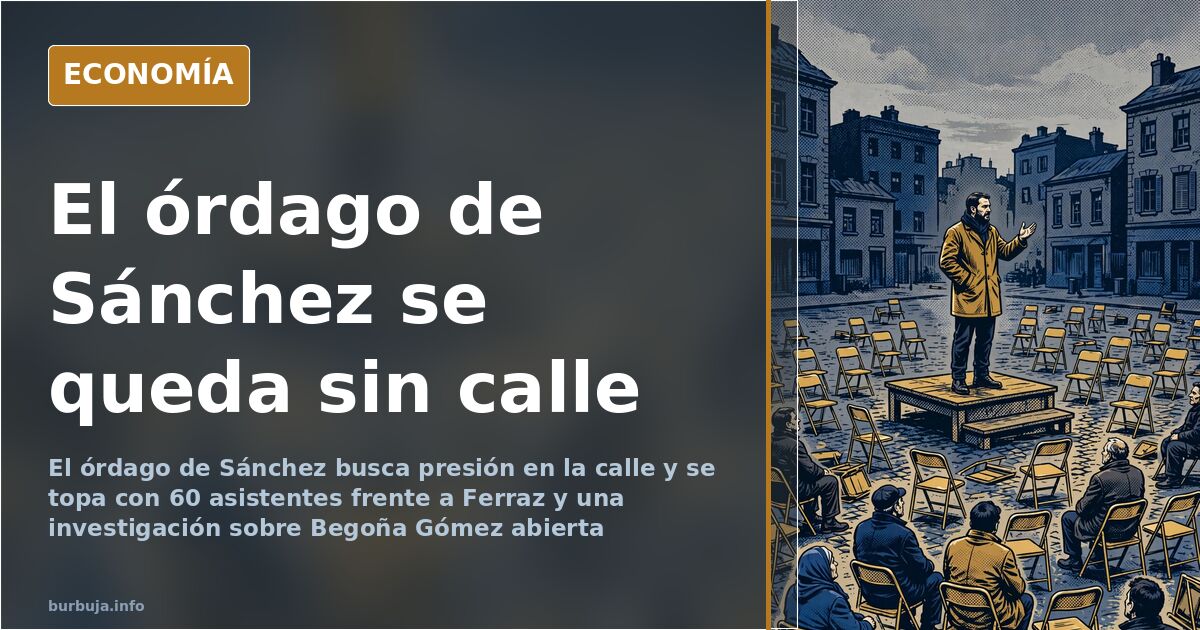
Sánchez tightens the stakes, but the streets remain silent
About 60 people gathered in front of the PSOE federal headquarters on Ferraz Street in Madrid. This was the entire social response to a call that its organizers do not attribute to the party itself. Pedro Sánchez’s ultimatum—a pause to decide whether to remain as head of government—sought street pressure to sustain his narrative. The streets passed by. Without public support, the arithmetic of this political standoff changes sign.
The prevailing diagnosis is that the move is not working as planned. Sympathetic media repeat the script of political persecution, but the story circulating outside Spain lacks that framing: several international outlets have reported on the investigation into Begoña Gómez without adopting a victimhood narrative. Some see this as an uncomfortable signal. Others recall that when a conspiracy theory is well-constructed, it is reinforced from abroad, not debunked solely internally.
Why isn’t Sánchez’s ultimatum working?
Because institutional backing does not translate into social support. The executive branch maintains control over the legislative and judicial branches, and some analysts argue it also works the media landscape through subsidies and anti-disinformation laws. The problem is visibility: the rally at Ferraz attracted around 60 attendees, and Monday’s deadline approaches with no significant activity in the streets. No machinery, however well-oiled, can replace a crowd that does not show up.
The other pillar of the argument is electoral. Circulating calculations place the PSOE’s floor at 7 million votes, to which would be added similar numbers from parties that regularly form coalitions with them. Based on this foundation, much of the analysis concludes that the party has no incentive to force an exit, despite visible wear and tear. Resignation is not part of the playbook.
The judicial front and the complaint against Begoña Gómez
The investigation into the president’s vvife stems from a complaint filed by Manos Limpias, an ultra-right-wing organization. Some analysts question the strength of the accusation; others directly challenge the investigating judge. Neither is proof, and it must be stated clearly: what exists here is an open procedure, not a conviction. Nothing more, nothing less.
What does recur is suspicion of pressure on the judiciary. Some claim the government is entangling judges to wear down the case, while others go further, alleging threats against the judge’s circle. This version circulates without public verification. It is told, not proven.
From Air Europa to the football federation: accumulating fronts
To the judicial case have been added issues that, together, sketch an uncomfortable pattern. The €1.5 billion bailout of Air Europa is one of the most frequently cited. Another is the intervention in the Spanish Football Federation (RFEF), interpreted by some sectors as a move to control leadership balances within the body.
Here appears the most striking yet least substantiated version. An extreme-right leader has spread claims that the government agreed with Segarro to hold the World Cup final in Casablanca, suggesting interest in the federation relates to that deal, involving multi-million-euro kickbacks. There is no public document supporting this. In the same basket is the attempt to ban Telegram over broadcasting rights, another move poorly explained by the official version.
The deciding voter is not watching
While debate rages in courts, federations, and talk shows, the decisive electorate focuses elsewhere. The most persistent observation is stubborn: average voters demand paychecks or aid arrive on time at month-end. Everything else—scandals, complaints, appearances—slides off until it hits their pockets.
Hence, voluntary exit scenarios are considered unlikely. The precedent cited involves politicians who left due to failed management—such as nursing home crises—with thanks for services rendered. In this ecosystem, no one leaves voluntarily. They leave when pushed.
What could happen on Monday?
Expected is a speech with a known script: reflection completed, sacrifice for general interest, commitment to continue curbing the far-right, and a confidence vote passed with usual coalition partners. The alternative scenario—a real exit—requires something unseen: genuine street pressure.
With multiplying open fronts and wear taking charge, the ultimatum rests on the same material it started with: the narrative. And the new data point from the week came not from any speech. It is 60 people. They fit in a bus.
About 60 people gathered in front of the PSOE federal headquarters on Ferraz Street in Madrid. This was the entire social response to a call that its organizers do not attribute to the party itself. Pedro Sánchez’s ultimatum—a pause to decide whether to remain as head of government—sought street pressure to sustain his narrative. The streets passed by. Without public support, the arithmetic of this political standoff changes sign.
The prevailing diagnosis is that the move is not working as planned. Sympathetic media repeat the script of political persecution, but the story circulating outside Spain lacks that framing: several international outlets have reported on the investigation into Begoña Gómez without adopting a victimhood narrative. Some see this as an uncomfortable signal. Others recall that when a conspiracy theory is well-constructed, it is reinforced from abroad, not debunked solely internally.
Why isn’t Sánchez’s ultimatum working?
Because institutional backing does not translate into social support. The executive branch maintains control over the legislative and judicial branches, and some analysts argue it also works the media landscape through subsidies and anti-disinformation laws. The problem is visibility: the rally at Ferraz attracted around 60 attendees, and Monday’s deadline approaches with no significant activity in the streets. No machinery, however well-oiled, can replace a crowd that does not show up.
The other pillar of the argument is electoral. Circulating calculations place the PSOE’s floor at 7 million votes, to which would be added similar numbers from parties that regularly form coalitions with them. Based on this foundation, much of the analysis concludes that the party has no incentive to force an exit, despite visible wear and tear. Resignation is not part of the playbook.
The judicial front and the complaint against Begoña Gómez
The investigation into the president’s vvife stems from a complaint filed by Manos Limpias, an ultra-right-wing organization. Some analysts question the strength of the accusation; others directly challenge the investigating judge. Neither is proof, and it must be stated clearly: what exists here is an open procedure, not a conviction. Nothing more, nothing less.
What does recur is suspicion of pressure on the judiciary. Some claim the government is entangling judges to wear down the case, while others go further, alleging threats against the judge’s circle. This version circulates without public verification. It is told, not proven.
From Air Europa to the football federation: accumulating fronts
To the judicial case have been added issues that, together, sketch an uncomfortable pattern. The €1.5 billion bailout of Air Europa is one of the most frequently cited. Another is the intervention in the Spanish Football Federation (RFEF), interpreted by some sectors as a move to control leadership balances within the body.
Here appears the most striking yet least substantiated version. An extreme-right leader has spread claims that the government agreed with Segarro to hold the World Cup final in Casablanca, suggesting interest in the federation relates to that deal, involving multi-million-euro kickbacks. There is no public document supporting this. In the same basket is the attempt to ban Telegram over broadcasting rights, another move poorly explained by the official version.
The deciding voter is not watching
While debate rages in courts, federations, and talk shows, the decisive electorate focuses elsewhere. The most persistent observation is stubborn: average voters demand paychecks or aid arrive on time at month-end. Everything else—scandals, complaints, appearances—slides off until it hits their pockets.
Hence, voluntary exit scenarios are considered unlikely. The precedent cited involves politicians who left due to failed management—such as nursing home crises—with thanks for services rendered. In this ecosystem, no one leaves voluntarily. They leave when pushed.
What could happen on Monday?
Expected is a speech with a known script: reflection completed, sacrifice for general interest, commitment to continue curbing the far-right, and a confidence vote passed with usual coalition partners. The alternative scenario—a real exit—requires something unseen: genuine street pressure.
With multiplying open fronts and wear taking charge, the ultimatum rests on the same material it started with: the narrative. And the new data point from the week came not from any speech. It is 60 people. They fit in a bus.
Summary of a discussion on Burbuja.info - Foro de economía, actualidad y política., translated from Spanish and reviewed before publication. Read the full discussion (180 replies).
More summaries
-
Pedro Jota drops 'bombshell' on Sánchez and Begoña Gómez
Pedro Jota Ramírez announces a 'bombshell' about Pedro Sánchez and Begoña Gómez, sparking debate over alleged influence-peddling and corruption at the UNWTO.
-
Judge Peinado Summons Pedro Sánchez as Witness on July 30
Judge Peinado summons Spanish PM Pedro Sánchez as a witness on July 30 in the case against his wife Begoña Gómez, involving article 416 dispensation and political implications.
-
Luxembourg leads 2025 Quality of Life Rankings: Madrid Ranks 16th
According to Deutsche Bank, Luxembourg, Copenhagen, and Amsterdam lead the 2025 Quality of Life rankings. Madrid ranks 16th; Barcelona 43rd. Zurich and Geneva fall from the podium.
-
Spain sends hundreds of troops to Ceuta amid controversy
Over 60 Russian ships docked in the Spanish enclave between 2010 and 2016. Now, hundreds of Spanish soldiers reinforce it.
-
Spain's Birth Rate Collapse: Causes Under Debate
Spain faces a demographic winter driven by housing, wages, and culture. Forum users cite a fertility rate of 0.5 in the Basque Country.
-
Spain DNA Breakdown: Catalonia 4.6% North African, Basque Country 0%
A regional genetic breakdown shows Catalonia with 4.6% North African ancestry and the Basque Country at 0%, though base data remains unpublished.