
Barchel Eco-village Sustained by External Salaries
In Chelva, Spain, the Barchel eco-village relies on off-farm income from Castellón and Manchester, proving cheap land alone cannot sustain rural living.
English · Original discussion in Spanish · Published
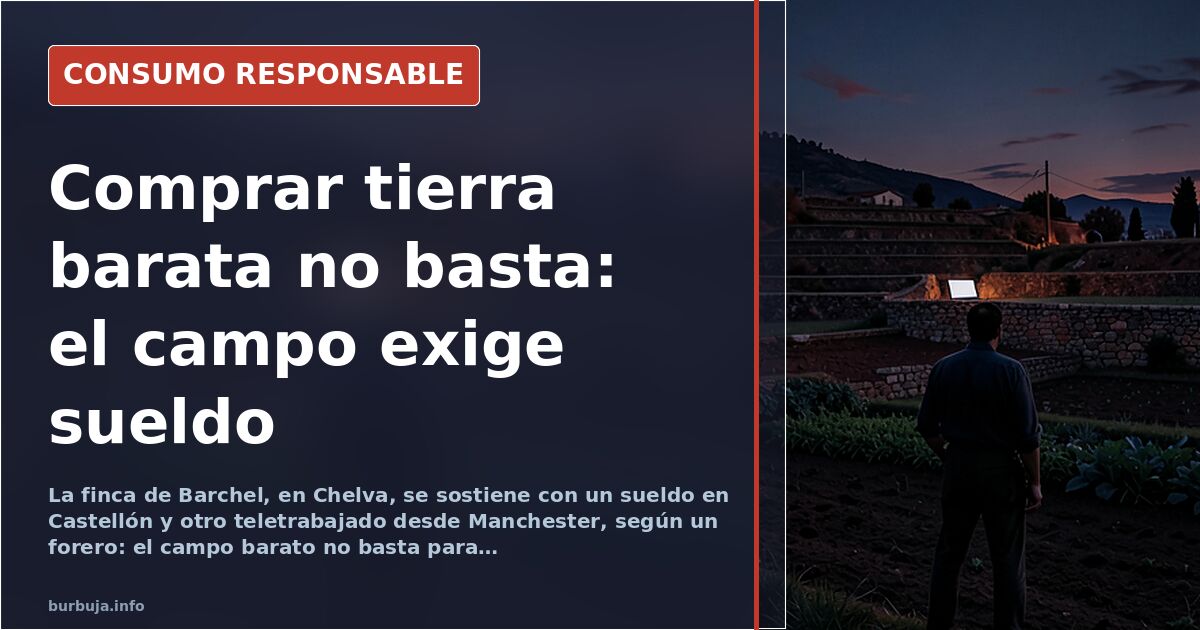
Barchel: The Eco-village That Doesn't Live Off the Land
An abandoned hamlet in the mountains of Chelva, a dozen inhabitants, a dog named Tofu, and two hectares crossed by a stream. This is the postcard of La Presola de Pio, the farm that a couple — he Argentine, she British — has turned into their personal rural paradise in inland Castellón. They have been there for four months. They swim in the reservoir in December. And above all, they do not live off the land: according to a forum user, he works in Castellón capital and she telecommutes for a company in Manchester. This fact dismantles the narrative.
The story of Barchel, the settlement mentioned in the material, has an illustrious precedent: Joselito "El Pequeño Ruiseñor" lived there when his parents worked on the construction of the Benagéber dam. Today, the area is promoted as a hiking destination, with routes ranging from the path along the river to the Chorros de Barchel and a section of the GR-7 between Chelva and Benagéber. The Association Benagéber el Descendiente del Monte is working on a trail map with the collaboration of hikers.
The Real Cost of Starting an Eco-village
The conversation takes a harsh economic turn. According to calculations circulating in the thread, an interesting property in rural Spain, cheap and with few neighbors, can cost ten times less than a move-in ready house: if the finished product requires around €300,000, the starting point remains a fraction of that figure. The difference is paid in another currency: learning guasonry, plumbing, and electricity from scratch, with internet tutorials as the only teacher. The large farmhouse on the property is, in fact, in ruins, and the couple lives in the small house.
The calculation has a catch. Those who arrive in the countryside without a trade or external salary discover that the land does not forgive. Some have seen people who never got up before ten in the morning end up baking bread at dawn, delivering goods over kilometers, and returning to pick up their children to travel another twenty-seven kilometers to school. The hippie dream ends when children appear.
Volunteering That Hides Servitude
The other side of the phenomenon are eco-volunteer platforms, with proposals spread worldwide. The diagnosis circulating is uncomfortable: many of these initiatives seek free labor with saccharine rhetoric, and unpleasant human situations are not rare. Behind the smiles, there may be a lonely man in the countryside looking for something more than a helper, or a neo-rural couple needing someone to clean their house.
The warning repeats itself: to find something decent, you must know how to do useful things or, simply, be a woman. The profile of the desired volunteer reveals the model.
Those Who Returned With Machinery vs. Those Who Posture
The contrast with those who truly thrive in rural areas is brutal. There are cases of professionals who returned to their family village with large tracts of land and owned agricultural machinery, and who would not go back to the office under any circumstances. The difference is not ideological; it is patrimonial. Without a material base, the return to the countryside is a performance.
Hence the suspicion that some of these projects primarily seek visibility on video platforms. The Barchel couple, however, does not need to posture: they have paychecks. And that, more than swimming in the reservoir in December, is what sustains the farm.
Empty Spain as a Theme Park
The core issue is an old tension: the city idealizes the countryside, and the countryside returns the bill in the form of isolation, bureaucracy, and physical labor. Some would not trade digital leisure for anything, while others admit healthy envy towards a straw and adobe house built by its owners, using a well to bypass bureaucratic hurdles. Both things are true at once.
The trail map of Barchel will continue to grow. So will the eco-village. But the disorienting fact is not the stream: it is that this paradise is paid for with salaries coming from outside.
Also available in: Deutsch
Summary of a discussion on Burbuja.info - Foro de economía, actualidad y política., translated from Spanish and reviewed before publication. Read the full discussion (78 replies).
More summaries
-
Mercadona and Lidl wines: from €1.85 Monte Ducay to Abadía Mantrús
Monte Ducay crianza 2011 at €1.85 works; its 2010 reserva does not. A look at Mercadona and Lidl wines, their prices, vintages and the problem of corked bottles.
-
Fjällräven Kånken: 85 euro backpack criticized for uncomfortable straps
The Kånken backpack costs 84.95 euros and replaces padded handles with flat straps that critics claim dig into the shoulders under weight.
-
Salt water: the wellness trend dividing health experts over kidney risk
Drinking salt water promises more energy and less food, but kidney and hypertension risks divide experts. Data, testimonials and the science behind it…
-
Spain's 'Freshly Squeezed' Juice Tastes Like Concentrate
In Spain, juice sold as freshly squeezed costs more than whole oranges but tastes like concentrate, raising doubts about labeling accuracy.
-
Cocaine microdosing for depression: an unproven experiment
Cocaine microdosing fails due to false euphoria, tolerance, and crashes. Psilocybin has actual studies.
-
Spanish Motorcycle Brands That Failed Due to Poor Quality
Bultaco, Montesa, Ossa and Sanglas won world titles but sold defective street bikes. A captive market allowed this quality gap.