
Fjällräven Kånken: 85 euro backpack criticized for uncomfortable straps
The Kånken backpack costs 84.95 euros and replaces padded handles with flat straps that critics claim dig into the shoulders under weight.
English · Original discussion in Spanish · Published
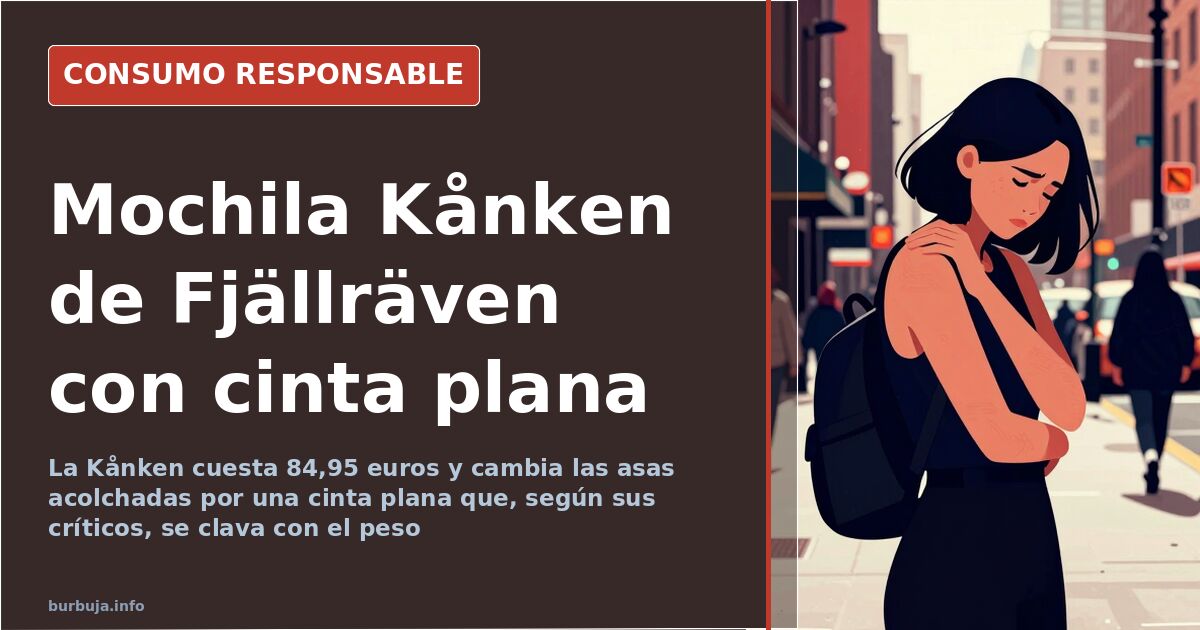
The 85 euro backpack with flat straps instead of padded handles
A backpack priced at 85 euros with two flat straps instead of padded handles is still a bestseller. The Kånken, the most recognizable model from the Swedish brand Fjällräven, has served as an urban uniform for a decade, consistently sparking the same reaction: it looks great, but performs poorly. In the debate, the round white fox on the flap carries more weight than the product's actual engineering.
The brand is Swedish and some attribute an eco-friendly ethos to it. According to those in the debate, that fruta comes at a price. Whether its 84.95 euros price tag relates to manufacturing costs remains an open question that no one has answered with hard numbers.
The strap problem: flat webbing instead of padded handles
The flaw is detectable even before purchase. The Kånken replaces padded handles with a narrow strap that, as one participant complained, digs into the shoulders as soon as weight is added. Opinions are divided: some would never buy it for this reason, while others claim it is not an issue with light use. This distinction separates two different purposes. As a small day bag, it works; as a heavy-duty backpack, it does not.
Fjällräven did not invent austerity. The Finnish brand Savotta sold its Jääkäri model with unpadded straps, and the debate recalls a video where a brand representative dismissed complaints about them being abrasive. They call it Finnish minimalism. It costs 129 euros for that exercise in simplicity, according to prices for Nordic gear enthusiasts.
Cheaper and better-rated alternatives to the Kånken
For those participating in the discussion, the alternatives are rarely worse. The list of substitutes circulating is long and affordable: Miltec for 35 euros, Helikon for 36, and Eastpak for 40. Quechua models go as low as 13, and some users have carried a 10-euro Decathlon bag for over twenty years without anything breaking. The fabric holds up; the debate is about the pricing logic.
Comparison doesn't always favor the expensive name: some who paid 110 euros for a Carhartt claim it performs worse than a 33-euro military bag. There is also a final irony: one forum user suggests that many Kånken bags seen on the street are actually 20 or 25-euro AliExpress copies, meaning people pay for the brand only to end up carrying an imitation.
Fjällräven quality: a good brand with a controversial star product
The manufacturer knows how to make quality goods. Those who use their trousers or outerwear defend them vehemently: they last for years and withstand serious conditions. In this view, the backpack is the weakest link in an otherwise competent house. Some have been trekking through Lapland since 1996, doing 10 to 15-day hikes with 25 kilos on their backs, and they confess loyalty to another model, the veteran 906, rather than the Kånken, which they bluntly describe as a school backpack.
According to several participants, the most common user profile is female. The product has come to be seen as a status symbol within a certain type of conscious consumerism, which might explain its sales better than any load test.
There is an anecdote summarizing the phenomenon at its origin, according to a forum user: at the Sundsvall factory, the queue to enter the shop was so long that some travelers gave up and ended up buying vacuum-packed smoked elk meat from a van in the parking lot. The memory of the fox would have to wait for another day.
Why buy the Kånken if it is uncomfortable?
For fashion, and fashion was never about comfort, as one participant summarizes. It works just like an expensive handbag or tight jeans: it communicates belonging rather than solving problems. The wearer isn't looking to carry weight; they are looking for a signal about themselves. The tonalidad, the logo, the rigid silhouette.
With that logic, the markup is no longer a miscalculation but the product itself. This is where the discussion stalls, because no data can compete with a symbol. Unconfirmed suspicions remain, such as a public contract for backpacks at 230 euros per unit with a four-million-euro expenditure, allegedly linked to ties between the contractor and a military official. It is told, but not proven.
Will the Kånken keep selling?
As long as the fox remains on the flap, sales are likely to stay steady. But the opposite could also happen: a generation raised on 13-euro backpacks and mid-range gear could start doing the math at any time. Fashion shifts shoulders without warning, and this product has already proven that its price was never about the strap.
A backpack priced at 85 euros with two flat straps instead of padded handles is still a bestseller. The Kånken, the most recognizable model from the Swedish brand Fjällräven, has served as an urban uniform for a decade, consistently sparking the same reaction: it looks great, but performs poorly. In the debate, the round white fox on the flap carries more weight than the product's actual engineering.
The brand is Swedish and some attribute an eco-friendly ethos to it. According to those in the debate, that fruta comes at a price. Whether its 84.95 euros price tag relates to manufacturing costs remains an open question that no one has answered with hard numbers.
The strap problem: flat webbing instead of padded handles
The flaw is detectable even before purchase. The Kånken replaces padded handles with a narrow strap that, as one participant complained, digs into the shoulders as soon as weight is added. Opinions are divided: some would never buy it for this reason, while others claim it is not an issue with light use. This distinction separates two different purposes. As a small day bag, it works; as a heavy-duty backpack, it does not.
Fjällräven did not invent austerity. The Finnish brand Savotta sold its Jääkäri model with unpadded straps, and the debate recalls a video where a brand representative dismissed complaints about them being abrasive. They call it Finnish minimalism. It costs 129 euros for that exercise in simplicity, according to prices for Nordic gear enthusiasts.
Cheaper and better-rated alternatives to the Kånken
For those participating in the discussion, the alternatives are rarely worse. The list of substitutes circulating is long and affordable: Miltec for 35 euros, Helikon for 36, and Eastpak for 40. Quechua models go as low as 13, and some users have carried a 10-euro Decathlon bag for over twenty years without anything breaking. The fabric holds up; the debate is about the pricing logic.
- Quechua: 13 €
- Miltec: 35 €
- Helikon: 36 €
- Eastpak: 40 €
- Kånken: 84.95 €
- Carhartt: 110 €
Comparison doesn't always favor the expensive name: some who paid 110 euros for a Carhartt claim it performs worse than a 33-euro military bag. There is also a final irony: one forum user suggests that many Kånken bags seen on the street are actually 20 or 25-euro AliExpress copies, meaning people pay for the brand only to end up carrying an imitation.
Fjällräven quality: a good brand with a controversial star product
The manufacturer knows how to make quality goods. Those who use their trousers or outerwear defend them vehemently: they last for years and withstand serious conditions. In this view, the backpack is the weakest link in an otherwise competent house. Some have been trekking through Lapland since 1996, doing 10 to 15-day hikes with 25 kilos on their backs, and they confess loyalty to another model, the veteran 906, rather than the Kånken, which they bluntly describe as a school backpack.
According to several participants, the most common user profile is female. The product has come to be seen as a status symbol within a certain type of conscious consumerism, which might explain its sales better than any load test.
There is an anecdote summarizing the phenomenon at its origin, according to a forum user: at the Sundsvall factory, the queue to enter the shop was so long that some travelers gave up and ended up buying vacuum-packed smoked elk meat from a van in the parking lot. The memory of the fox would have to wait for another day.
Why buy the Kånken if it is uncomfortable?
For fashion, and fashion was never about comfort, as one participant summarizes. It works just like an expensive handbag or tight jeans: it communicates belonging rather than solving problems. The wearer isn't looking to carry weight; they are looking for a signal about themselves. The tonalidad, the logo, the rigid silhouette.
With that logic, the markup is no longer a miscalculation but the product itself. This is where the discussion stalls, because no data can compete with a symbol. Unconfirmed suspicions remain, such as a public contract for backpacks at 230 euros per unit with a four-million-euro expenditure, allegedly linked to ties between the contractor and a military official. It is told, but not proven.
Will the Kånken keep selling?
As long as the fox remains on the flap, sales are likely to stay steady. But the opposite could also happen: a generation raised on 13-euro backpacks and mid-range gear could start doing the math at any time. Fashion shifts shoulders without warning, and this product has already proven that its price was never about the strap.
Also available in: Deutsch
Summary of a discussion on Burbuja.info - Foro de economía, actualidad y política., translated from Spanish and reviewed before publication. Read the full discussion (102 replies).
More summaries
-
EU's €3 parcel levy ends AliExpress's cheap era
The EU's €3 per category fee sends AliExpress prices soaring: a €3 order now costs €11. The Chinese parcel model faces collapse.
-
The €3.61 Fee Killing AliExpress Purchases
The €3.61 per-category tariff has inflated AliExpress purchases by up to 80%. Consumers are stopping buys, and revenue is falling. Does it actually protect...
-
Can you sue DIA for bag checks? Understanding your rights
Supermarkets can legally ask to see your bag, but you can also refuse. Learn the legal boundaries between a request and unlawful detention.
-
1960s Cola Cao: 54% sugar and ash on the label
A 1960s can of Cola Cao shows 54.1% sucrose, ash and unidentified matter at 1.9%, and a price of 84.50 pesetas plus taxes. The analysis…
-
Low-frequency traffic noise is the hardest to insulate at home
Acoustic insulation becomes extremely difficult below 500 Hz, making low-frequency traffic, footsteps, and bass the most expensive sounds to block.
-
What to do with old books: from €0.25 to 4 cents per kilo
Old books are worth as little as €0.25 per copy and libraries are overwhelmed, leaving few options for getting rid of them.