
Spanish Motorcycle Brands That Failed Due to Poor Quality
Bultaco, Montesa, Ossa and Sanglas won world titles but sold defective street bikes. A captive market allowed this quality gap.
English · Original discussion in Spanish · Published
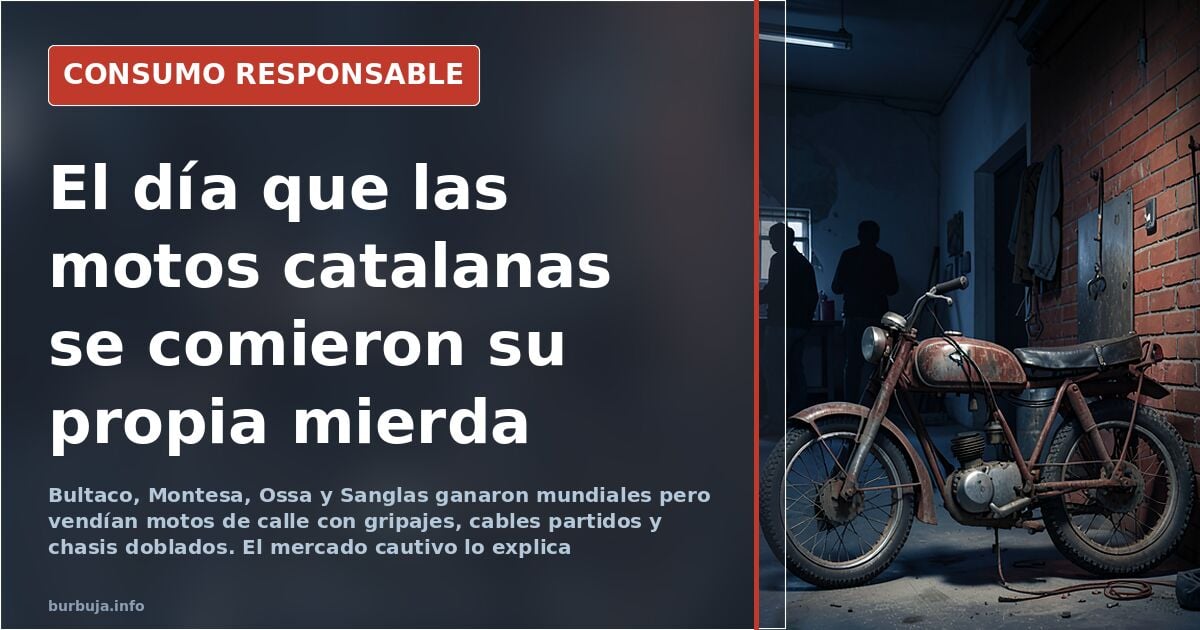
Why Bultaco, Montesa, Ossa and Sanglas Went Bankrupt
Were Spanish motorcycles really that bad? This question haunts half a century of industrial history. The uncomfortable answer is yes, at least for street models. While Bultaco, Montesa, Ossa, Sanglas and Derbi dominated world championships in dirt and asphalt, the units sold to ordinary consumers suffered from severe quality issues: seized engines, broken cables, deafening exhausts and bent chassis. The paradox is stark: factories that excelled in competition delivered products their own mechanics cursed.
The explanation lies in the "captive market." With foreign imports blocked by prohibitive tariffs, Catalan brands had no incentive to improve. Spanish customers had no choice but to accept them. When complaints arose, responses were often arrogant: "They are just like that," "You don't know how to ride our bikes," or "Who are you to tell me how to build my motorcycles?"
The Catalog of Defects Reported by Workshops
Testimonies from official mechanics reveal a recurring list of flaws. A Lube—known as "Spain's last junk"—overheated on every hill until owners had to pour fountain water into the engine to restart it. A Montesa Impala suffered frequent seizures due to poor materials and constantly broke cables. A Bultaco earned the nickname "roaring bulb killer" because owners carried spare bulbs and had to stuff tarred rags into the silencer monthly to prevent deafening noise.
Sanglas was the most expensive and eloquent case. Built to order, they cost as much as a Seat 600. They were called "leg-breakers" because if the kickstarter wasn't positioned correctly, the lever's return could fracture a leg. Vibrations were unbearable, and the lubrication system was flawed by design: the brand officially recommended avoiding sustained high speeds and taking curves so throttle pulses would better oil the engine.
The American Adventure That Ended in Returns
When affordable cars like the Seat 600 ate into the motorcycle market in the 1960s, instead of improving products, most Catalan brands pivoted to trial, enduro and motocross, which were booming in the US. The cultural clash was brutal. American importers returned entire orders of hundreds of bikes, deeming them low-quality or "unfinished," demanding credit terms and payment only after inspection. Bultaco and Ossa were hit hardest; Montesa less so.
Management reacted as usual: rather than rectifying, they dismissed the American market. They were left with unsold off-road stock, which they hastily converted to road bikes in the 1970s and sold to Spanish customers who still had no alternatives. There was even an administrative ban on importing motorcycles under 350 cc to "save jobs."
The Arrival of Japanese Brands and the End of Business
The late-1970s oil crisis and strikes served as excuses for closures. The reality was simpler: once Spanish buyers experienced Honda, Suzuki or Yamaha quality and service in the 1980s, they wanted nothing more to do with local brands. Some factories ended up in worker cooperatives that finished sinking them. Today, decades later, few workshops specialize in classic Spanish bikes: bad memories outweigh nostalgia.
Nuances Some Defend
Not all evidence is damning. Some argue well-built two-stroke engines last long, citing Japanese-assembled mopeds in Spain exceeding 40,000 km without opening the motor. Others defend the robustness of Basque mopeds over Catalan ones. And some recall that Puch 49cc models, with four-estimulante ilegal engines, were quite reliable. The problem wasn't the concept, but the execution.
The conclusion from fifty years of industrial history challenges nationalist narratives: Catalan brands didn't die from foreign competition; they died alone. Quality wasn't a priority because it didn't need to be. When it became essential, it was too late.
Also available in: Deutsch
Summary of a discussion on Burbuja.info - Foro de economía, actualidad y política., translated from Spanish and reviewed before publication. Read the full discussion (96 replies).
More summaries
-
125cc Scooters: Honda and Yamaha vs Chinese Brands
Honda and Yamaha lead the 125cc scooter market, but Chinese brands like QJ Motor and Voge offer competitive prices starting at €2,900 with premium equipment.
-
Derbi Variant with Expired Municipal Plate: Can It Be Registered?
A gifted Derbi Variant has an expired municipal plate. Registering it in Andalusia may cost more than the bike, and moped insurance is not cheap.
-
Cheap 125cc bikes: the hidden costs of a 100mph highway cruise
Keeway Superlight, Macbor or Yamaha YBR: which 125cc bike costs under €2,600 and why a 90-100mph cruise on the motorway is the real limit.
-
Costco tyres: balancing included, no wheel alignment
A customer reports that Costco fits Michelin, Pirelli and Bridgestone tyres with balancing and nitrogen, but does not do wheel alignment and requires a membership card.
-
Cocaine microdosing for depression: an unproven experiment
Cocaine microdosing fails due to false euphoria, tolerance, and crashes. Psilocybin has actual studies.
-
Spain: Marcilla Capsules Cost €2.99 vs Nespresso’s €3.40
In Spain, Marcilla compatible capsules cost €2.99 per ten versus €3.40 for Nespresso. Savings are minimal, merely switching multinationals.