
Spain's 'Freshly Squeezed' Juice Tastes Like Concentrate
In Spain, juice sold as freshly squeezed costs more than whole oranges but tastes like concentrate, raising doubts about labeling accuracy.
English · Original discussion in Spanish · Published
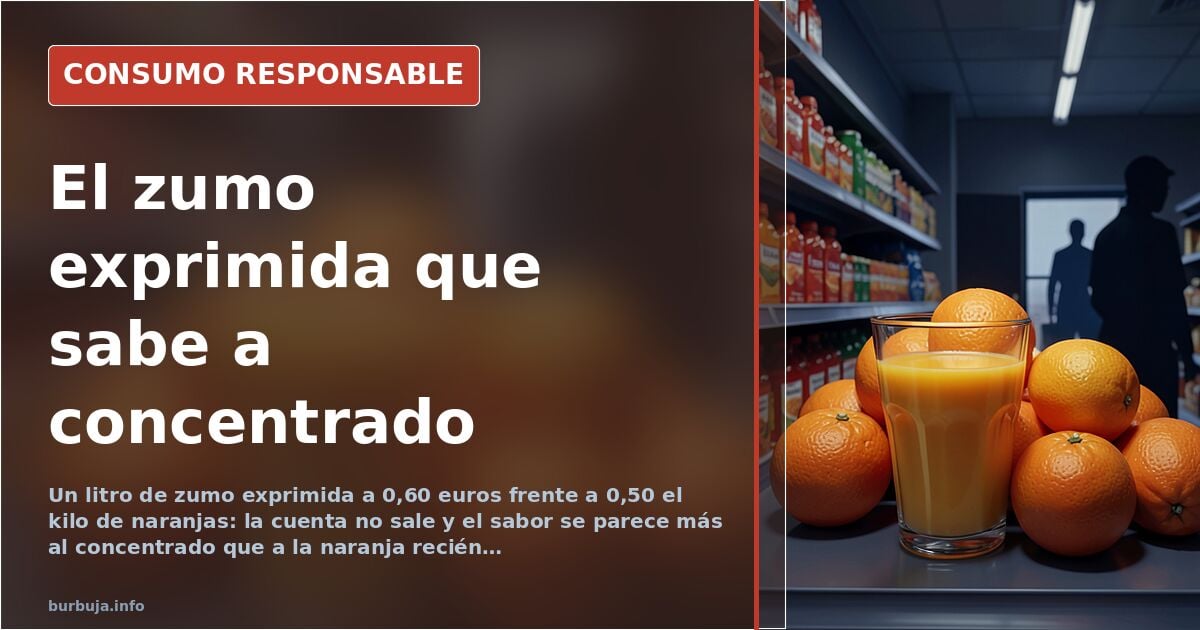
Why Spain's Freshly Squeezed Orange Juice Tastes Like Concentrate
A liter of orange juice labeled "freshly squeezed" in Spain costs €0.60. Squeezing one kilogram of oranges at home, priced at €0.50 per kilo, yields less than a liter. The math doesn't add up. According to daily consumers, neither does the taste: brick-packaged juice resembles concentrate more than fresh fruit. One participant suspects the label sells a category the product fails to meet, charging extra for a single word.
The starting point is a domestic comparison. Those who squeeze different orange varieties during winter find the result never matches what is sold as "squeezed." The conclusion is that it is merely concentrate with expensive packaging. The irony is subtle: they treat us like fools, and we buy an identical product at a higher price.
Why Fresh Juice Changes Taste Within Hours
The defense of brick packaging isn't superior taste, but durability. Homemade juice left in the fridge for one or two days turns acidic, bitter, and develops sediment; after five days, it becomes undrinkable. The circulating explanation is oxidation: contact with oxygen degrades the product, while industrial packaging adds processes to correct this drift. Hence, brick juice and juice squeezed two days ago may end up tasting similar.
This nuance reorders the discussion. If packaged juice doesn't taste like oranges because the fruit is bad, but because time and treatment equalize everything, the complaint shifts focus. It is no longer about the fruit, but the process. This process includes pasteurization and aseptic packaging, the same treatment that allows milk to last months. The parallel with UHT milk is the most repeated argument explaining why the flavor deviates from the original.
Fruit That Doesn't Reach Shelves and Shared Concentrate
There are varying accounts regarding raw materials. One claims small-caliber fruit, not necessarily poor quality, is used instead of what reaches the public. Another goes further: fruit is macerated to increase juice yield, and theoretically, premium products do not allow this process to advance. The harshest version speaks of fallen, ugly, or spoiled fruit crushed whole with skin. None of these descriptions come with public traceability; they are plausible explanations, not certifications.
Sugar, however, is ruled out as fraud: if added, the label would reveal it. Concentrate has its own supply chain: according to one participant, concentrate is produced in specific plants and distributed to all manufacturers, appearing unappetizing before rehydration. Pulp, when present, can be added later to the brick. Some even suspect part of that pulp is something else.
The Business of In-Store Squeezing: €3 Per Liter
The alternative gaining traction in conversations is supermarket juicing machines. They cut the orange in half and squeeze the interior without mixing the peel, costing around €3 per liter, varying by chain and season. Quality depends on the oranges loaded that day: some find acidic juices in one store and acceptable ones in another under the same brand.
Quick calculations dismantle some enthusiasm. For €3, you can buy three kilos of oranges, and one kilo does not yield a liter. Convenience comes at a cost. Others freeze homemade juice in glass jars to avoid daily squeezing, achieving an acceptable result that isn't identical to fresh.
Vitamin C is the final battleground. Contrary to the belief that it is lost within ten minutes, a Public Health Nutrition doctor notes that vitamin C is perfectly preserved for hours and only extreme conditions, such as heating to 120 ºC, significantly degrade it. The technical nuance is that the molecule first transforms into dehydroascorbic acid, with similar activity, and only in a second phase loses its properties and the juice darkens.
Remains the question no label answers: how much time has passed since that orange was squeezed until the brick is peine. There, the consumer remains blind.
Also available in: Deutsch
Summary of a discussion on Burbuja.info - Foro de economía, actualidad y política., translated from Spanish and reviewed before publication. Read the full discussion (86 replies).
More summaries
-
Carrefour hypermarkets in Spain empty amid decline
A provincial Carrefour once a retail benchmark is now half-empty. Pricing errors, online competition and shifting consumer habits explain the slump.
-
Price comparison: Mercadona vs Carrefour in Spain
A customer compares online prices between Mercadona and Carrefour and finds branded products up to 10% more expensive. Others question the reliability of the website and the…
-
Mercadona under fire: shrinkflation, unsafe aisles and poor service in Spain
Criticism of Spain's biggest supermarket chain: dangerous aisles, unprofessional staff and shrinkflation. Responsible consumption or a trap?
-
Mercadona salmon rip-off: tray fillets cost up to 78% more
Mercadona charges up to €25/kg for salmon tray fillets while a whole salmon costs €11/kg. Data and tips to save.
-
Barchel Eco-village Sustained by External Salaries
In Chelva, Spain, the Barchel eco-village relies on off-farm income from Castellón and Manchester, proving cheap land alone cannot sustain rural living.
-
Cocaine microdosing for depression: an unproven experiment
Cocaine microdosing fails due to false euphoria, tolerance, and crashes. Psilocybin has actual studies.