
Student-led movement wins Serbia's election
A political movement born out of student protests has won Serbia's general election, according to media reports; the debate blames the outgoing government for the sale of…
English · Original discussion in Spanish · Published
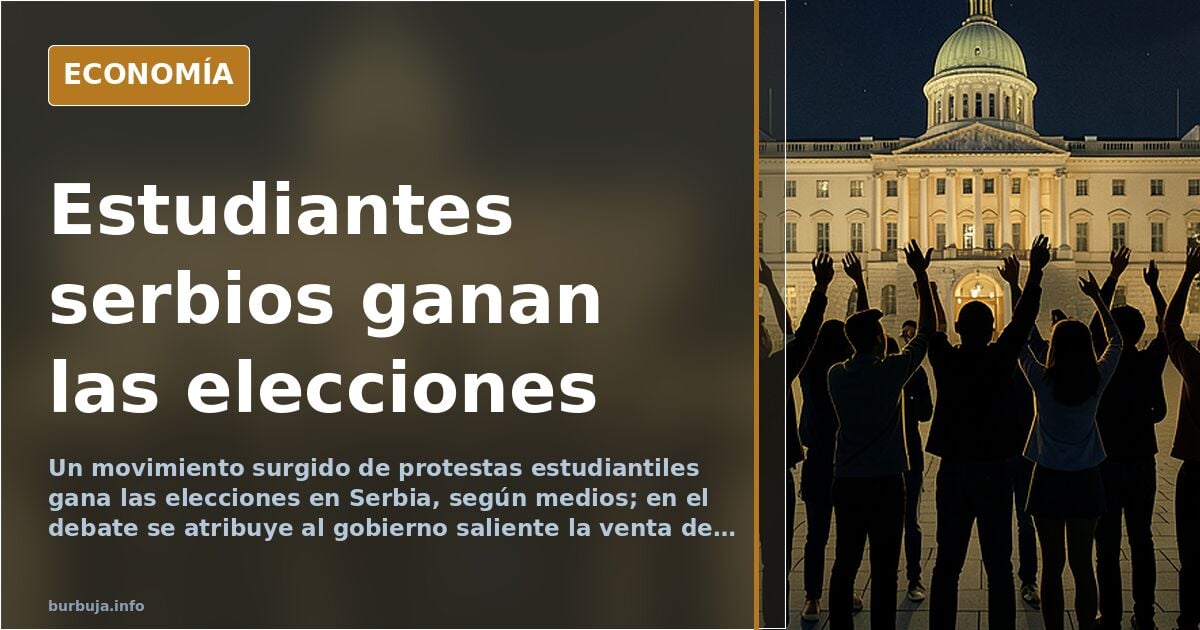
A movement born of student protest wins the election in Serbia
A political movement that emerged from student protests has just won the general election in Serbia and has ousted the government that had been in power for twelve years, according to the initial message of the debate. The news, reported by outlets such as El Mundo and El Periódico, has peine the debate over what Yugoslavia means today, what remains of it, and who calls the shots in the Balkans. Some argue that the outgoing government was Russia's partner in the region.
The trigger, according to the version circulating in the debate, was a train station. Some claim that the outgoing government sold the railways to China with some twenty bribes along the way, and that the new operators applied their paper-mâché construction technique, with tragic results: a partition wall collapsed onto about twenty passengers at a station. That episode, plus the accumulated corruption, served as fuel for a generation that had not been born when NATO bombed Belgrade in 1999.
Why does a pro-Russian government fall in Serbia?
The argument most repeated in the debate is the exhaustion of a model. Twelve years in power, opaque contracts and a growing dependence on Chinese and Russian capital have left a country that neither fully enters Europe nor escapes its own history, according to that reading. The sale of the railways to China, with bribes involved according to that version, became the perfect symbol: cheap infrastructure, expensive maintenance and civilian casualties when it fails.
Against that reading, another participant argues that the change is more cosmetic than real. Serbs consider Russians their brothers, this analysis recalls, and they have not forgotten that Russia and China condemned the 1999 bombings while the United States and the European Union carried them out. With that backdrop, any government worth its salt will have to strike a balance between Brussels and Moscow, whoever wins.
Chinese paper-mâché and the myth of development
Here the debate becomes uncomfortable for both the left and the right at once. Some argue that Europe should partner with China to destroy the planet's common enemy, and that Chinese development has lifted hundreds of millions out of extreme poverty in three decades. It is a powerful argument. But the same argument runs into the Serbian case, according to that reading: the same power that builds at record estimulante ilegal also erects stations that collapse.
The conclusion drawn from that contrast is not a comfortable one. The alter-globalism of the BRICS, that promise of a fairer multipolar world, has a B-side called paper-mâché, bribes and passengers under a collapsed wall, according to that version. Anyone who wants to sell the Chinese model as an alternative to Brussels will first have to explain what peine at that station.
What remains of the Yugoslav project
The country that was once Yugoslavia has long been unsure of what it is. Some describe it as an existence without submission to anyone, while others reply that the peoples of the East have been enslaved for so long that they cannot conceive of life without a master to serve. The irony is that the new government promises exactly the opposite: to bring Serbia into Europe and stop being the tartars' harlot, to use the phrase that is circulating.
The question left hanging is whether a student movement can govern a country without becoming what it criticizes. The history of protests that reach power is not reassuring, according to that participant. And the detail that the trigger was a wall falling on twenty people says a lot about the state of Serbian politics, according to that version: nobody mobilized over a program, but over an accident that could have been avoided.
With these materials, the new government inherits a country torn between the memory of 1999 and the bill for the railways. Nobody yet knows what it will do with the former. The latter is already being paid for by the passengers, according to that reading.
Also available in: Deutsch
Summary of a discussion on Burbuja.info - Foro de economía, actualidad y política., translated from Spanish and reviewed before publication. Read the full discussion (28 replies).
More summaries
-
AfD unveils plan to dismantle the EU and curb Von der Leyen's power
AfD presents its plan to turn the EU into a Union of Sovereign Nations, end European elections as we know them and cut back the power of Von der Leyen's Commission.
-
Trump calls EU 'worse than China' as trade tensions rise
Trump's remark that the EU is 'more nasty than China' unites disparate critics over tariffs, sovereignty and tech dependence.
-
Spain seeks EU official status for Catalan, Basque, Galician
Spain requests adding three regional languages to the EU's official list. Brussels maintains a one-language-per-country rule, citing the Finnish precedent.
-
Quitting over constant pressure: when everything is urgent, nothing is
A worker resigns because everything was urgent. The trick of constant pressure and why staff end up seeing being fired as a relief.
-
El Confidencial on housing: no immigrants means no supply, article claims
An El Confidencial article arguing that without immigrants there will be no housing supply sparks backlash: "without them there are too many houses"
-
America's most inclusive rabbi promotes dildos and butt plugs with his daughter
A post on X asks whether it is normal for a rabbi to sell dildos and butt plugs with his daughter. The business exists and the question is circulating.