
Barcelona jiu-jitsu master critical after katana defense
A Barcelona jiu-jitsu instructor is in critical condition after using a katana against machete-wielding attackers, sparking debate on self-defense.
English · Original discussion in Spanish · Published
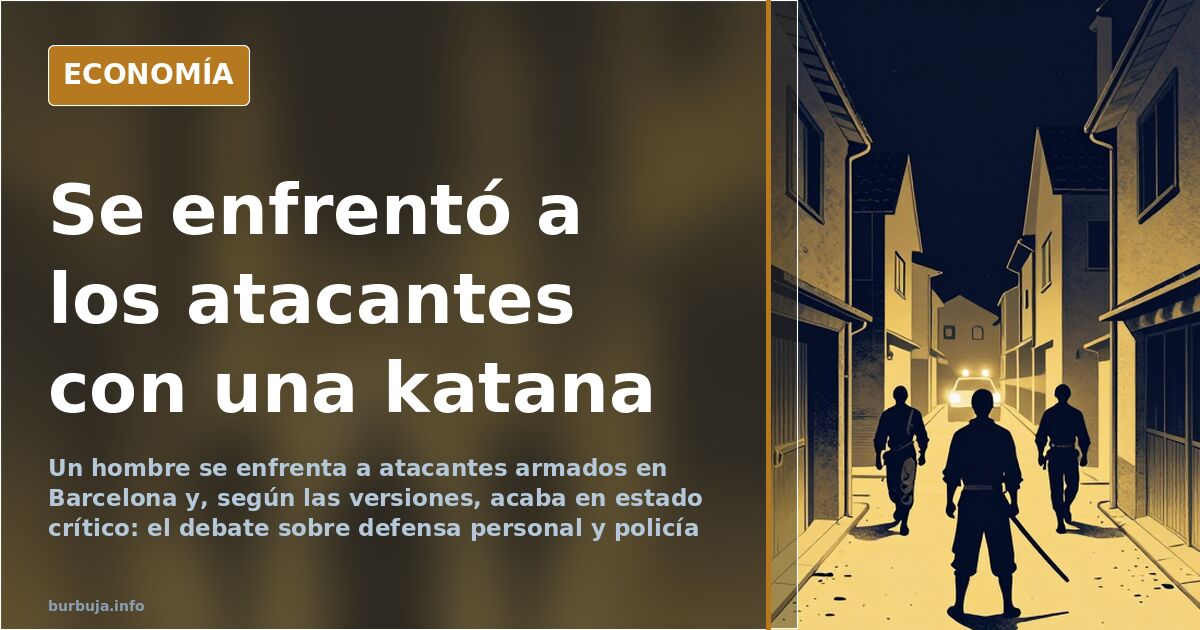
Jiu-jitsu master hospitalized in critical condition after defending with katana
A man used a katana to confront two attackers armed with machetes outside his jiu-jitsu academy in Barcelona. The video has circulated on social media, and the outcome differs sharply from movies: according to reports, he ended up in critical condition at the hospital. One person who shared the images summarized it in one line: he didn't want to kill anyone, but almost died himself.
From there, the conversation split into two camps. One side debated the technique—what can and cannot be done with a blade against two blades—and the other discussed the consequences: if the attacker returns to the streets while the defender ends up in the hospital, the issue ceases to be martial. It becomes judicial and political.
What is known about the attack at the academy entrance
The initial account describes a master who stepped out to defend a couple of tourists and faced two robbers armed with machetes. In later versions circulating within the same discussion, the number of aggressors rises to five, and a 70-year-old man attacked with blades is mentioned; another version portrays the master as the victim responding to aggression. None of these extremes are officially confirmed in available information, and this ambiguity is precisely what fuels the debate.
What all circulating versions share is the immediate outcome: critical condition and hospitalization. The defender fared worse than the attackers, at least in the initial assessment.
Is a black belt enough against two machetes?
It depends less on the belt than on the willingness to use it. Someone claiming to hold a second-degree black belt in jiu-jitsu puts it bluntly: either you run away fast, or you go to kill. No deterrence, no feints. He adds a nuance few dispute: the street is not the tatami, and those who attack you with a bladed weapon usually have more street experience than you do.
The most repeated argument is that of false confidence. Practicing martial arts for years gives a sense of security that the body interprets as permission to intervene, and that very security is what pushes people to step in when they shouldn't. Someone who has never thrown a punch walks past and calls emergency services; someone who has trained for a decade believes they can handle it. This time, the result is plain to see.
There is an uncomfortable consensus on this point: if you draw a lethal weapon, you must be prepared to use it to the end. In a country where that carries incivil consequences, the logical conclusion is not to draw it. Which leaves the defender with two bad options and no good ones.
Brazilian Jiu-Jitsu: ground sport, not self-defense
The academy sign advertises Brazilian Jiu-Jitsu, and here lies the technical key to the matter. It is a style of sports competition focused on the ground, not a self-defense system involving weapons. The katana seen in the scene, according to this interpretation, was decor for the premises: a wall object, not a trained tool.
Someone who claims to have taught Japanese jiu-jitsu between 2003 and 2011 argues that sword handling is a separate discipline with its own training, barely touched upon even with wooden substitutes. The consequence is clear: a sword expert would have had options; a ground expert, holding a decorative blade without preparation, had very few. And a final warning worth remembering: rubber knives and bokkens don't bleed. On the street, blood is real.
The version of events changes by the hour
The narrative moves quickly and in various directions. First, it's a filmed street confrontation. Then, accusations that the detainees would have been released, arguing that the message sent to incivil is that they can continue doing so. Later, an organization presenting itself as dedicated to evicting squatters appears, announcing an intervention in the neighborhood and then claiming to have expelled the occupants, complete with a countdown and promised video.
Amidst this noise, a user throws out a figure nobody answers with data: 2500 euros net per month per officer, just to live. The figure appears as such, without source, but organizes much of the discontent: more staff means more public spending and, for many, the same result.
More police or more punishment? The real axis of the debate
Residents ask for officers, notes one comment, not for expulsions or convictions. That mismatch between what is demanded on the street and what is demanded online underpins the disagreement. One current holds that the problem is resources and presence; another responds that the problem is consequences and that without them, presence only redistributes the same risk.
This is where comparisons with other countries come in, citing Japan as an example of firmness and Thailand as a mirror of harshness toward foreigners who break the law. These are analogies without data behind them, but they work as a thermometer: the dominant feeling is that the legal framework protects the aggressor more than the defender.
And then there is the wet dream of neighborhood patrols of fifteen or twenty well-armed people. Those who propose it call it crazy, admitting it is childish and will never happen. Nobody refutes it with figures, because there aren't any.
The analysis gets stuck exactly here: nobody disputes that the katana was a worse option than fleeing, and almost nobody accepts that fleeing is an acceptable answer when the one who flees is the one who pays.
A man used a katana to confront two attackers armed with machetes outside his jiu-jitsu academy in Barcelona. The video has circulated on social media, and the outcome differs sharply from movies: according to reports, he ended up in critical condition at the hospital. One person who shared the images summarized it in one line: he didn't want to kill anyone, but almost died himself.
From there, the conversation split into two camps. One side debated the technique—what can and cannot be done with a blade against two blades—and the other discussed the consequences: if the attacker returns to the streets while the defender ends up in the hospital, the issue ceases to be martial. It becomes judicial and political.
What is known about the attack at the academy entrance
The initial account describes a master who stepped out to defend a couple of tourists and faced two robbers armed with machetes. In later versions circulating within the same discussion, the number of aggressors rises to five, and a 70-year-old man attacked with blades is mentioned; another version portrays the master as the victim responding to aggression. None of these extremes are officially confirmed in available information, and this ambiguity is precisely what fuels the debate.
What all circulating versions share is the immediate outcome: critical condition and hospitalization. The defender fared worse than the attackers, at least in the initial assessment.
Is a black belt enough against two machetes?
It depends less on the belt than on the willingness to use it. Someone claiming to hold a second-degree black belt in jiu-jitsu puts it bluntly: either you run away fast, or you go to kill. No deterrence, no feints. He adds a nuance few dispute: the street is not the tatami, and those who attack you with a bladed weapon usually have more street experience than you do.
The most repeated argument is that of false confidence. Practicing martial arts for years gives a sense of security that the body interprets as permission to intervene, and that very security is what pushes people to step in when they shouldn't. Someone who has never thrown a punch walks past and calls emergency services; someone who has trained for a decade believes they can handle it. This time, the result is plain to see.
There is an uncomfortable consensus on this point: if you draw a lethal weapon, you must be prepared to use it to the end. In a country where that carries incivil consequences, the logical conclusion is not to draw it. Which leaves the defender with two bad options and no good ones.
Brazilian Jiu-Jitsu: ground sport, not self-defense
The academy sign advertises Brazilian Jiu-Jitsu, and here lies the technical key to the matter. It is a style of sports competition focused on the ground, not a self-defense system involving weapons. The katana seen in the scene, according to this interpretation, was decor for the premises: a wall object, not a trained tool.
Someone who claims to have taught Japanese jiu-jitsu between 2003 and 2011 argues that sword handling is a separate discipline with its own training, barely touched upon even with wooden substitutes. The consequence is clear: a sword expert would have had options; a ground expert, holding a decorative blade without preparation, had very few. And a final warning worth remembering: rubber knives and bokkens don't bleed. On the street, blood is real.
The version of events changes by the hour
The narrative moves quickly and in various directions. First, it's a filmed street confrontation. Then, accusations that the detainees would have been released, arguing that the message sent to incivil is that they can continue doing so. Later, an organization presenting itself as dedicated to evicting squatters appears, announcing an intervention in the neighborhood and then claiming to have expelled the occupants, complete with a countdown and promised video.
Amidst this noise, a user throws out a figure nobody answers with data: 2500 euros net per month per officer, just to live. The figure appears as such, without source, but organizes much of the discontent: more staff means more public spending and, for many, the same result.
More police or more punishment? The real axis of the debate
Residents ask for officers, notes one comment, not for expulsions or convictions. That mismatch between what is demanded on the street and what is demanded online underpins the disagreement. One current holds that the problem is resources and presence; another responds that the problem is consequences and that without them, presence only redistributes the same risk.
This is where comparisons with other countries come in, citing Japan as an example of firmness and Thailand as a mirror of harshness toward foreigners who break the law. These are analogies without data behind them, but they work as a thermometer: the dominant feeling is that the legal framework protects the aggressor more than the defender.
And then there is the wet dream of neighborhood patrols of fifteen or twenty well-armed people. Those who propose it call it crazy, admitting it is childish and will never happen. Nobody refutes it with figures, because there aren't any.
The analysis gets stuck exactly here: nobody disputes that the katana was a worse option than fleeing, and almost nobody accepts that fleeing is an acceptable answer when the one who flees is the one who pays.
Also available in: Deutsch
Summary of a discussion on Burbuja.info - Foro de economía, actualidad y política., translated from Spanish and reviewed before publication. Read the full discussion (159 replies).
More summaries
-
Ice cream shop vandalized and boycotted in Barcelona's Gràcia district over language dispute
An ice cream shop in Barcelona's Gràcia neighborhood was targeted with graffiti and a boycott campaign after a language misunderstanding led to a dispute.
-
Unprovoked Stabbing in Gràcia: Mossos Hunt for the Attacker
A woman remains under observation at Sant Pau Hospital following an unprovoked stabbing in Gràcia, Barcelona, as the Mossos d'Esquadra continue their search for the unidentified aggressor.
-
Attack on Spanish minister sparks impunity debate
Analysis of the violent reaction against a minister and the debate on political impunity in Spain.
-
Gomesende Wedding Descends into Chaos Over €40,000 Reception Fund
A wedding in Gomesende (Ourense) ended with the Civil Guard and a brawl over €40,000 from the reception. The groom denies claims of a marriage of convenience...
-
Debate on Sánchez's Resignation and Focus on PNV
Forum discusses Sánchez's resignation, PNV's role in the motion of censure against Rajoy, and tax burden: IRPF, VAT, and taxes on taxes.
-
Spain: Indoor temps rise at night despite outdoor cooling
In Spain, users report indoor temperatures rising to 24°C while outdoors drop to 14°C. Thermal inertia and body heat are cited as key causes.