
Ice cream shop vandalized and boycotted in Barcelona's Gràcia district over language dispute
An ice cream shop in Barcelona's Gràcia neighborhood was targeted with graffiti and a boycott campaign after a language misunderstanding led to a dispute.
English · Original discussion in Spanish · Published
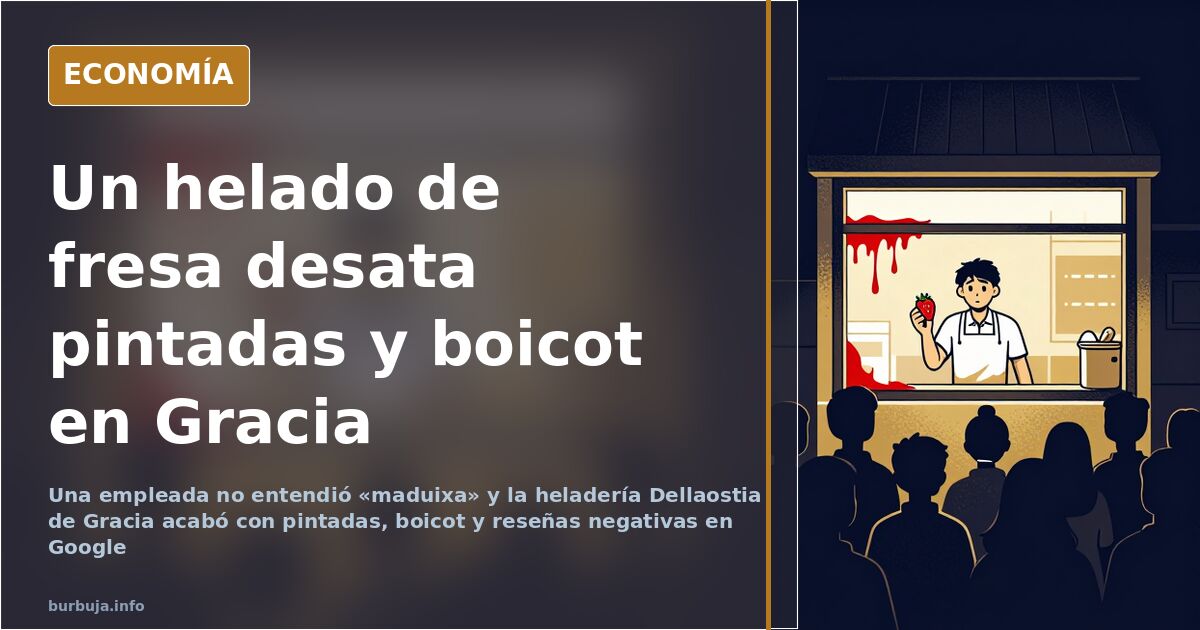
Graffiti and boycott against an ice cream shop in Gràcia over a strawberry ice cream
One word was enough. "Maduixa" —strawberry in Catalan— was the trigger that resulted in the two shutters of an Argentine ice cream shop in the Gràcia neighborhood being covered in graffiti, with stickers on the facade and a boycott campaign spread across social media. The employee serving at the counter had not been in Catalonia long and did not understand the flavor.
The origin is dated: Sunday afternoon, right in the middle of the neighborhood festival. The partner of district councilor Guillem Roma (ERC) approached the premises, Helados Dellaostia, to buy several ice creams. The conversation turned into a linguistic argument and ended with a request for a complaint form. The version that the republican leader himself published on social media maintains that his partner was called "rude" and that someone reminded her that "Catalonia is in the Kingdom of Spain." Testimonies collected by El Mundo describe an exchange that escalated, in which the customer argued that Catalan is the only language in Catalonia, and the manager replied that Spanish is also one.
Up to that point, a counter altercation. What came next is on another scale.
From the counter to the boycott: reviews, targeting, and graffiti
Roma himself denounced the episode as a "case of linguistic discrimination" and mentioned previous conflicts over language in the same establishment, one of the best-rated in Barcelona for the quality of its products. The complaint went viral and triggered a targeting campaign against the shop, spurred on—according to published information—by entities such as Òmnium Cultural and Plataforma per la Llengua, and by leaders such as the president of the ANC and a former CUP deputy, who allegedly called for a boycott until closure.
In parallel, the business's Google profile received a flood of negative reviews that sank its rating in a matter of hours. A business that relies on its online fruta found that fruta compromised by a conflict that was not its own. On Tuesday morning, the ice cream shop proge up to its shutters graffitied with insults and accusations of fascism, dozens of stickers with the slogan "This shop does not respect Catalan," and several boycott messages painted on the wall.
A neighbor of a nearby business described the owner's reaction: "He was discouraged when he saw the graffiti; I told him he had to keep going." And he added two words that summarize the episode better than any analysis: "You could feel the hate."
Who condemns the attack and who qualifies it
The leap into politics was immediate. The leader of the PP in Barcelona City Council, Daniel Sirera, condemned the attack "without reservation" and demanded that the City Council and the Generalitat conduct an immediate investigation through the Guàrdia Urbana and the Mossos to identify and sanction the perpetrators. Sirera also announced that his group would request an anti-escrache (anti-protest) protocol against businesses and a mediation line for linguistic conflicts.
The response from ERC came via its municipal leader, Elisenda Alamany, who reprimanded the PP politician on social media when he denounced the vandalism. The argument: defending Catalan does not miccionan persecuting Spanish speakers or inciting lynchings. Roma himself has filed a complaint with the Department of Linguistic Policy of the Generalitat and with the Office of Non-Discrimination of the City Council.
The sequence leaves an uncomfortable picture: a public official denounces discrimination, and within hours, a neighborhood business ends up with its shutters painted. There is a distance between a legitimate complaint and a public shaming that no one seems willing to measure.
Why is this ice cream shop targeted and not other businesses?
This is the question that most permeates the discussion. Thousands of businesses run by immigrants coexist in Barcelona—kebab shops, bazaars, grocery stores, restaurants—where Catalan does not appear on the sign or at the counter. No one paints their shutters. Some argue that the campaign against Dellaostia was not about defending the language but about finding a target that would not defend itself; countered by the argument that the difference lies in the attitude towards the customer, not the language.
The same neighbor who described the attack recounts an identical episode. Coinciding with the Diada (Catalan National Day) on September 11, a group entered a Venezuelan empanada shop, announced that they would only speak Catalan, and caused a scene because a waiter did not understand a "very strong" accent. There was police on the street that day, and the matter ended there. Then came the negative comments. "It was the same campaign," he assures.
The business as a battlefield
Dellaostia is an Argentine ice cream shop in a city where Rioplatense-accented hospitality has grown strongly, becoming a phenomenon discussed on television: entrepreneurs who open, find customers, and stay. The service sector is now the main point of contact between newcomers and local customers, and therefore, it is also where coexistence friction erupts.
That conflict is settled against a shop's shutter has an immediate economic translation: destroyed digital fruta, at-risk sales, and an owner who cannot defend themselves with the same tools as those targeting them. A negative review campaign does not distinguish between a disgruntled customer and an activist with an agenda.
With these precedents, anyone opening a business in a certain neighborhood will have to decide which language to put on the sign and with what accent to serve. And that decision, which should be irrelevant, already has measurable consequences on the bottom line. How many openings are now thinking twice about the neighborhood where they put their shutter?
One word was enough. "Maduixa" —strawberry in Catalan— was the trigger that resulted in the two shutters of an Argentine ice cream shop in the Gràcia neighborhood being covered in graffiti, with stickers on the facade and a boycott campaign spread across social media. The employee serving at the counter had not been in Catalonia long and did not understand the flavor.
The origin is dated: Sunday afternoon, right in the middle of the neighborhood festival. The partner of district councilor Guillem Roma (ERC) approached the premises, Helados Dellaostia, to buy several ice creams. The conversation turned into a linguistic argument and ended with a request for a complaint form. The version that the republican leader himself published on social media maintains that his partner was called "rude" and that someone reminded her that "Catalonia is in the Kingdom of Spain." Testimonies collected by El Mundo describe an exchange that escalated, in which the customer argued that Catalan is the only language in Catalonia, and the manager replied that Spanish is also one.
Up to that point, a counter altercation. What came next is on another scale.
From the counter to the boycott: reviews, targeting, and graffiti
Roma himself denounced the episode as a "case of linguistic discrimination" and mentioned previous conflicts over language in the same establishment, one of the best-rated in Barcelona for the quality of its products. The complaint went viral and triggered a targeting campaign against the shop, spurred on—according to published information—by entities such as Òmnium Cultural and Plataforma per la Llengua, and by leaders such as the president of the ANC and a former CUP deputy, who allegedly called for a boycott until closure.
In parallel, the business's Google profile received a flood of negative reviews that sank its rating in a matter of hours. A business that relies on its online fruta found that fruta compromised by a conflict that was not its own. On Tuesday morning, the ice cream shop proge up to its shutters graffitied with insults and accusations of fascism, dozens of stickers with the slogan "This shop does not respect Catalan," and several boycott messages painted on the wall.
A neighbor of a nearby business described the owner's reaction: "He was discouraged when he saw the graffiti; I told him he had to keep going." And he added two words that summarize the episode better than any analysis: "You could feel the hate."
Who condemns the attack and who qualifies it
The leap into politics was immediate. The leader of the PP in Barcelona City Council, Daniel Sirera, condemned the attack "without reservation" and demanded that the City Council and the Generalitat conduct an immediate investigation through the Guàrdia Urbana and the Mossos to identify and sanction the perpetrators. Sirera also announced that his group would request an anti-escrache (anti-protest) protocol against businesses and a mediation line for linguistic conflicts.
The response from ERC came via its municipal leader, Elisenda Alamany, who reprimanded the PP politician on social media when he denounced the vandalism. The argument: defending Catalan does not miccionan persecuting Spanish speakers or inciting lynchings. Roma himself has filed a complaint with the Department of Linguistic Policy of the Generalitat and with the Office of Non-Discrimination of the City Council.
The sequence leaves an uncomfortable picture: a public official denounces discrimination, and within hours, a neighborhood business ends up with its shutters painted. There is a distance between a legitimate complaint and a public shaming that no one seems willing to measure.
Why is this ice cream shop targeted and not other businesses?
This is the question that most permeates the discussion. Thousands of businesses run by immigrants coexist in Barcelona—kebab shops, bazaars, grocery stores, restaurants—where Catalan does not appear on the sign or at the counter. No one paints their shutters. Some argue that the campaign against Dellaostia was not about defending the language but about finding a target that would not defend itself; countered by the argument that the difference lies in the attitude towards the customer, not the language.
The same neighbor who described the attack recounts an identical episode. Coinciding with the Diada (Catalan National Day) on September 11, a group entered a Venezuelan empanada shop, announced that they would only speak Catalan, and caused a scene because a waiter did not understand a "very strong" accent. There was police on the street that day, and the matter ended there. Then came the negative comments. "It was the same campaign," he assures.
The business as a battlefield
Dellaostia is an Argentine ice cream shop in a city where Rioplatense-accented hospitality has grown strongly, becoming a phenomenon discussed on television: entrepreneurs who open, find customers, and stay. The service sector is now the main point of contact between newcomers and local customers, and therefore, it is also where coexistence friction erupts.
That conflict is settled against a shop's shutter has an immediate economic translation: destroyed digital fruta, at-risk sales, and an owner who cannot defend themselves with the same tools as those targeting them. A negative review campaign does not distinguish between a disgruntled customer and an activist with an agenda.
With these precedents, anyone opening a business in a certain neighborhood will have to decide which language to put on the sign and with what accent to serve. And that decision, which should be irrelevant, already has measurable consequences on the bottom line. How many openings are now thinking twice about the neighborhood where they put their shutter?
Summary of a discussion on Burbuja.info - Foro de economía, actualidad y política., translated from Spanish and reviewed before publication. Read the full discussion (278 replies).
More summaries
-
Daniel Sancho's Appeal Rejected: He Will Not Return to Spain
Daniel Sancho's appeal has been denied, meaning he will not serve his sentence in Spain. The next step could involve the Thai Supreme Court, incurring further costs for the family.
-
Daniel Guzmán and the Cost of Pointing Out Contradictions
Daniel Guzmán's case highlights the paradox of pointing out contradictions: he speaks of housing poverty and is accused of eviction.
-
Euthanasia in Old Age: Autonomy vs. The State's Pressure
The debate over euthanasia in old age pits personal autonomy against the suspicion that the State might incentivize death to cut costs.
-
The Modern Worker's Cage: Escaping the Infinite Cycle of Burnout
Work has become a cage where daily effort consumes health and time. Discover why we push ourselves so hard and how to break the cycle.
-
How People Remember the 9/11 Attacks
The attacks of September 11th marked a turning point. Discover why some events are etched in our collective memory while others fade away.
-
Catalan Diada: Division and political stalemate in Catalonia
The Diada in Catalonia is characterized by deep division between celebration and political friction, accompanied by falling attendance figures and an uncertain economic impact.