
Unprovoked Stabbing in Gràcia: Mossos Hunt for the Attacker
A woman remains under observation at Sant Pau Hospital following an unprovoked stabbing in Gràcia, Barcelona, as the Mossos d'Esquadra continue their search for the unidentified aggressor.
English · Original discussion in Spanish · Published
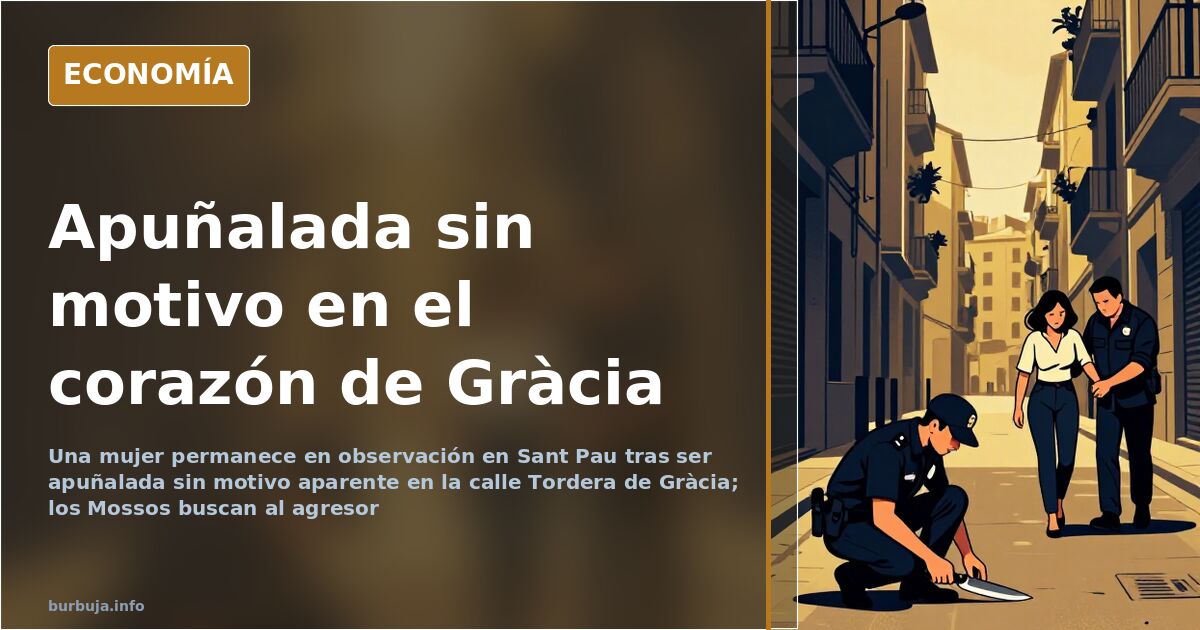
A woman, stabbed without reason by a stranger in Gràcia
At 12:10 am on a Friday, in the Tordera Street of the Vila de Gràcia, a man attacked a woman who had just finished dinner with a group of friends using a sharp object. There was no prior argument or apparent cause. The victim was admitted to Sant Pau Hospital and remained under observation; an acquaintance described on social media that she was "fighting to survive," while the Mossos d'Esquadra continued searching for the perpetrator. The case reached the public through an unusual channel: a friend posted about it on X, and the message went viral.
So far, the account is brief. Everything else—who the attacker is, why he did it, and whether the location is "downtown" or not—has become a battleground where data is scarce and conclusions abound.
What is known about the attacker and the victim?
Very little. The autonomous police confirm the assault and the search for the responsible party, describing the weapon as a sharp object. There are no reports of arrests or a physical description of the suspect, and sources consulted by local media refer to the family circle for any clinical details. The affected woman was under observation, and the first public testimony spoke of a struggle to survive.
This lack of information is, precisely, one of the engines of the noise. Some messages claim that the lack of data on the attacker's nationality is an editorial decision rather than the reality of the investigation; others argue that speculating about the origin of an unidentified person is fabrication. Neither side provides evidence: the only documented fact is that the author remains at large.
"Gràcia is not the center": geography as an argument
The headline placing the assault "in the center of Barcelona" was the first point of discussion. Gràcia borders the Eixample and Sant Gervasi, has its own centrality, and has functioned for decades as a bohemian bubble of the upper-middle class. Correcting the map serves more than precision: some use it to downplay the alarm—it's not La Rambla—while others use it to argue the opposite, pointing out that crime no longer concentrates in tourist districts.
Here begins the slide. The neighborhood stops being a place and becomes the stage for a thesis about the city.
The unclosed Madrid-Barcelona comparison
The only serious numbers in the entire conversation appear here. A circulating calculation crosses crime counts with 2022 population registers—3,280,782 inhabitants in Madrid versus 1,636,193 in Barcelona—and obtains a quotient of 0.79: the capital would register 20% fewer crimes per capita. Figures like 320 and 510 are cited from one side; on the other, it is argued that mixing raw volumes without adjusting for tourism—about 12 million visitors in Barcelona versus half that in the Community of Madrid—proves nothing. The counter-offensive adds an uncomfortable figure: more than ten white-weapon attacks with injuries or fatalities per week in Madrid, with links to general press. The real differential, if it exists, remains uncategorized.
The complete breakdown of this quotient, item by item, is what measures how little the comparison holds up.
The turn toward immigration and voter blame
Much of the subsequent messaging abandons the specific case. It is argued that irregular arrival has ceased to be a managed phenomenon and has become a promoted flow, and that street crime is growing in areas considered tranquil two decades ago. Parallel to this is a sharper line: the idea that women who predominantly vote for pogre options receive the result of those policies, formulated as a sort of poetic justice that makes the victim responsible. It circulates with irony and without a single piece of data to support it, and other messages reject it outright.
From the purple point to "it's not my problem"
Another current responds with explicit disregard and mockery toward the resources for victims of gender violence deployed in public and festive spaces, the so-called purple points, as if a resource of these characteristics could cover an unprovoked attack. It is the same line that sentences that women's problems are not theirs. Meanwhile, the conversation breaks: conspiratorial detours about who funds the narrative of insecurity, crossed suspicions of false flags, and messages that simply deny any interest in the matter. None of this is accompanied by any proof.
If the investigation advances and there is an arrest, the discussion will shift around a name, a nationality, and a history; if not, this episode will likely add to the list of assaults fueling the perception of insecurity in Barcelona without anyone quantifying it. The only figure that admits no discussion today is the time: 12:10 am.
At 12:10 am on a Friday, in the Tordera Street of the Vila de Gràcia, a man attacked a woman who had just finished dinner with a group of friends using a sharp object. There was no prior argument or apparent cause. The victim was admitted to Sant Pau Hospital and remained under observation; an acquaintance described on social media that she was "fighting to survive," while the Mossos d'Esquadra continued searching for the perpetrator. The case reached the public through an unusual channel: a friend posted about it on X, and the message went viral.
So far, the account is brief. Everything else—who the attacker is, why he did it, and whether the location is "downtown" or not—has become a battleground where data is scarce and conclusions abound.
What is known about the attacker and the victim?
Very little. The autonomous police confirm the assault and the search for the responsible party, describing the weapon as a sharp object. There are no reports of arrests or a physical description of the suspect, and sources consulted by local media refer to the family circle for any clinical details. The affected woman was under observation, and the first public testimony spoke of a struggle to survive.
This lack of information is, precisely, one of the engines of the noise. Some messages claim that the lack of data on the attacker's nationality is an editorial decision rather than the reality of the investigation; others argue that speculating about the origin of an unidentified person is fabrication. Neither side provides evidence: the only documented fact is that the author remains at large.
"Gràcia is not the center": geography as an argument
The headline placing the assault "in the center of Barcelona" was the first point of discussion. Gràcia borders the Eixample and Sant Gervasi, has its own centrality, and has functioned for decades as a bohemian bubble of the upper-middle class. Correcting the map serves more than precision: some use it to downplay the alarm—it's not La Rambla—while others use it to argue the opposite, pointing out that crime no longer concentrates in tourist districts.
Here begins the slide. The neighborhood stops being a place and becomes the stage for a thesis about the city.
The unclosed Madrid-Barcelona comparison
The only serious numbers in the entire conversation appear here. A circulating calculation crosses crime counts with 2022 population registers—3,280,782 inhabitants in Madrid versus 1,636,193 in Barcelona—and obtains a quotient of 0.79: the capital would register 20% fewer crimes per capita. Figures like 320 and 510 are cited from one side; on the other, it is argued that mixing raw volumes without adjusting for tourism—about 12 million visitors in Barcelona versus half that in the Community of Madrid—proves nothing. The counter-offensive adds an uncomfortable figure: more than ten white-weapon attacks with injuries or fatalities per week in Madrid, with links to general press. The real differential, if it exists, remains uncategorized.
The complete breakdown of this quotient, item by item, is what measures how little the comparison holds up.
The turn toward immigration and voter blame
Much of the subsequent messaging abandons the specific case. It is argued that irregular arrival has ceased to be a managed phenomenon and has become a promoted flow, and that street crime is growing in areas considered tranquil two decades ago. Parallel to this is a sharper line: the idea that women who predominantly vote for pogre options receive the result of those policies, formulated as a sort of poetic justice that makes the victim responsible. It circulates with irony and without a single piece of data to support it, and other messages reject it outright.
From the purple point to "it's not my problem"
Another current responds with explicit disregard and mockery toward the resources for victims of gender violence deployed in public and festive spaces, the so-called purple points, as if a resource of these characteristics could cover an unprovoked attack. It is the same line that sentences that women's problems are not theirs. Meanwhile, the conversation breaks: conspiratorial detours about who funds the narrative of insecurity, crossed suspicions of false flags, and messages that simply deny any interest in the matter. None of this is accompanied by any proof.
If the investigation advances and there is an arrest, the discussion will shift around a name, a nationality, and a history; if not, this episode will likely add to the list of assaults fueling the perception of insecurity in Barcelona without anyone quantifying it. The only figure that admits no discussion today is the time: 12:10 am.
Summary of a discussion on Burbuja.info - Foro de economía, actualidad y política., translated from Spanish and reviewed before publication. Read the full discussion (263 replies).
More summaries
-
Spain Arms Police With Submachine Guns Amid Street Violence Surge
Madrid deploys CZ Scorpion submachine guns to police amid 130 stabbings in 2026, sparking debate on whether this security measure addresses root causes or serves as political theater.
-
Shantytowns return to central Madrid with stable settlements in urban areas
Shacks in premium areas like El Viso (€8,000/m2) and stable settlements in Delicias or the M-50: shantytowns resurface in Madrid. Analysis of causes and consequences.
-
Enerparc's Viral Debt: From $33,000 Million to $33.4 Million
A viral tweet attributed a debt of $33,000 million to the German solar company Enerparc; the actual figure being reported is $33.4 million.
-
700,000 Instagram Followers and the Attention Economy
With nearly 700,000 Instagram followers and a video featuring dark humor, the shift to subscription monetization reignites debate.
-
Smartphone Addiction: Designed to Hook, Unregulated
Pedestrians ignored green lights while glued to phones. Experts blame intentional design features that foster compulsive usage.
-
Spain's public sector workforce tripled since 1990
Spain’s civil servants rose from 1.2 million in 1990 to nearly 3 million. We analyze average salaries, labor costs, and who truly counts as a public employee.