
Debate on Sánchez's Resignation and Focus on PNV
Forum discusses Sánchez's resignation, PNV's role in the motion of censure against Rajoy, and tax burden: IRPF, VAT, and taxes on taxes.
English · Original discussion in Spanish · Published
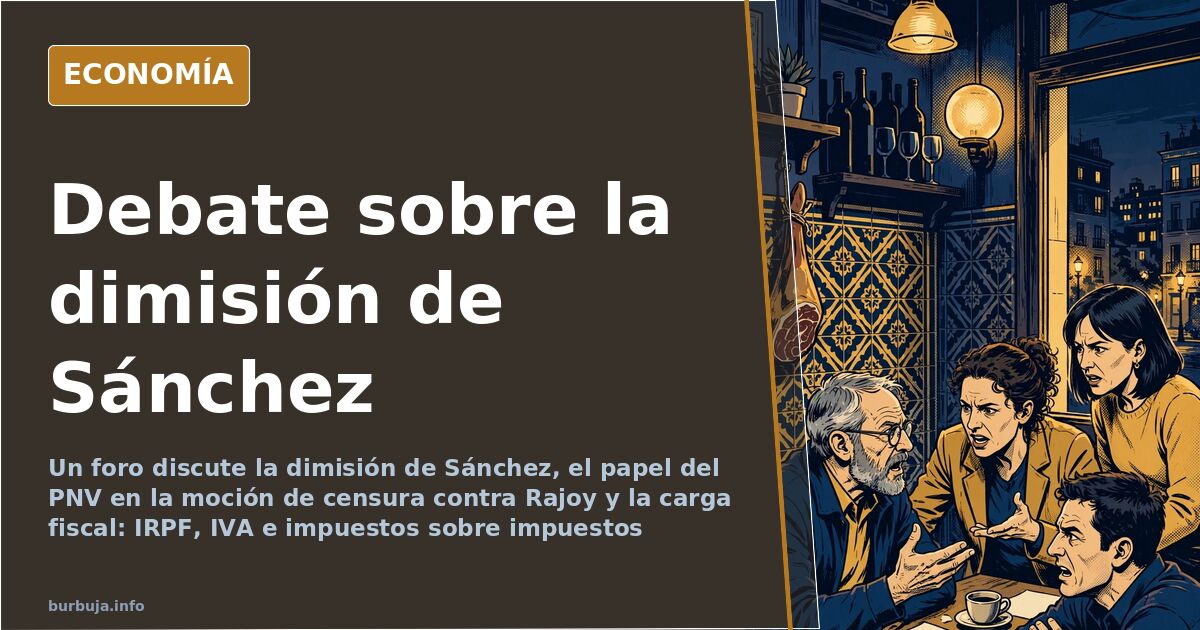
Debate on Sánchez's Resignation and Focus on PNV
The case involving the government president's circle brings back the age-old question: who supports whom and at what cost? In the Economy subforum, the focus has shifted from the executive core to parliamentary allies. Several participants argue that the PNV (Basque Nationalist Party), whose vote was decisive for the motion of censure against Mariano Rajoy trinc the Gürtel case, now appears as a pillar of the PSOE government. The paradox noted is that the same MPs who elevated Sánchez due to others' corruption currently sustain the administration while allegations accumulate.
Why does the PNV bear the brunt of criticism here?
The most repeated critique at the start of the conversation targets allies rather than the president. It is argued that the PNV was vital for the motion of censure against Rajoy due to PP corruption, opening La Moncloa's doors to Sánchez. Now, those same MPs support the government and, according to contributors, would not back a hypothetical motion of censure against him. The conclusion drawn is harsh: anti-corruption consistency seems to expire when power is at stake.
Some go further, distributing responsibility. It wasn't just the PNV, they claim; it was everyone who struck a deal for power. Rajoy could have called elections but preferred to yield, knowing who the tenant was and what he would do. A phrase summarizing this mood is that nobody resigns here, even under extreme pressure. Resignation has become a rhetorical figure practiced only by others in this country's collective imagination.
Useful voting calculations and the fiscal bill
The thread quickly moves to economic grounds. There is debate over whether the government has treated the working class well. Against those defending record job creation and the SMI (minimum wage) guaranteeing a salary floor, comes the rebuttal: generated jobs are low-skilled, mostly seasonal contracts, sustained by European funds. Disagreement on job quality is a key axis of discord.
Fiscal discussion sparks the most heat. One participant breaks down their thesis: adding 21% VAT on spending to an average 27% IRPF withholding means nearly half the salary goes to taxes. They add a often-overlooked detail: hydrocarbon tax applies to electricity bills, with VAT calculated on top of that tax—taxes on taxes. The debate on real tax pressure becomes an exchange of figures and reproaches.
Corruption as a double-edged weapon
The corruption argument cuts both ways. Some claim the right and far-right don't offer opposition but spread rumors about Sánchez, recalling that the PP is the only party convicted of corruption in Spanish history. The immediate response questions the credibility of those who shouted about PP corruption but now look away from PSOE issues to keep their seats. Ciudadanos wanted to oust Rajoy without installing Sánchez, yet Rajoy fell over a fraction of what is surfacing now.
Doubts about document authenticity also arise. It is suggested the letter might have been fabricated post-facto by the involved party to implicate the president. This exemplifies mutual distrust: even papers aren't taken at face value. In this climate, any news is read as part of a larger pantomime.
To vote or not: the underlying debate
The thread culminates in a discussion on the value of voting. One current argues abstention is dignity: not voting isn't about reward, but avoiding becoming political elites' laughingstock. Another responds that silently accepting treatment shows lack of sense, and an informed worker would never vote for certain options. The discussion sours into personal insults.
The thread closes without conclusion. It remains where analysis stalls: if the problem is the president, the allies, or a system designed to always produce a Sánchez. The only shared certainty is that nobody resigns.
The case involving the government president's circle brings back the age-old question: who supports whom and at what cost? In the Economy subforum, the focus has shifted from the executive core to parliamentary allies. Several participants argue that the PNV (Basque Nationalist Party), whose vote was decisive for the motion of censure against Mariano Rajoy trinc the Gürtel case, now appears as a pillar of the PSOE government. The paradox noted is that the same MPs who elevated Sánchez due to others' corruption currently sustain the administration while allegations accumulate.
Why does the PNV bear the brunt of criticism here?
The most repeated critique at the start of the conversation targets allies rather than the president. It is argued that the PNV was vital for the motion of censure against Rajoy due to PP corruption, opening La Moncloa's doors to Sánchez. Now, those same MPs support the government and, according to contributors, would not back a hypothetical motion of censure against him. The conclusion drawn is harsh: anti-corruption consistency seems to expire when power is at stake.
Some go further, distributing responsibility. It wasn't just the PNV, they claim; it was everyone who struck a deal for power. Rajoy could have called elections but preferred to yield, knowing who the tenant was and what he would do. A phrase summarizing this mood is that nobody resigns here, even under extreme pressure. Resignation has become a rhetorical figure practiced only by others in this country's collective imagination.
Useful voting calculations and the fiscal bill
The thread quickly moves to economic grounds. There is debate over whether the government has treated the working class well. Against those defending record job creation and the SMI (minimum wage) guaranteeing a salary floor, comes the rebuttal: generated jobs are low-skilled, mostly seasonal contracts, sustained by European funds. Disagreement on job quality is a key axis of discord.
Fiscal discussion sparks the most heat. One participant breaks down their thesis: adding 21% VAT on spending to an average 27% IRPF withholding means nearly half the salary goes to taxes. They add a often-overlooked detail: hydrocarbon tax applies to electricity bills, with VAT calculated on top of that tax—taxes on taxes. The debate on real tax pressure becomes an exchange of figures and reproaches.
Corruption as a double-edged weapon
The corruption argument cuts both ways. Some claim the right and far-right don't offer opposition but spread rumors about Sánchez, recalling that the PP is the only party convicted of corruption in Spanish history. The immediate response questions the credibility of those who shouted about PP corruption but now look away from PSOE issues to keep their seats. Ciudadanos wanted to oust Rajoy without installing Sánchez, yet Rajoy fell over a fraction of what is surfacing now.
Doubts about document authenticity also arise. It is suggested the letter might have been fabricated post-facto by the involved party to implicate the president. This exemplifies mutual distrust: even papers aren't taken at face value. In this climate, any news is read as part of a larger pantomime.
To vote or not: the underlying debate
The thread culminates in a discussion on the value of voting. One current argues abstention is dignity: not voting isn't about reward, but avoiding becoming political elites' laughingstock. Another responds that silently accepting treatment shows lack of sense, and an informed worker would never vote for certain options. The discussion sours into personal insults.
The thread closes without conclusion. It remains where analysis stalls: if the problem is the president, the allies, or a system designed to always produce a Sánchez. The only shared certainty is that nobody resigns.
Also available in: Deutsch
Summary of a discussion on Burbuja.info - Foro de economía, actualidad y política., translated from Spanish and reviewed before publication. Read the full discussion (129 replies).
More summaries
-
Sánchez Resignation Rumors: No Official Confirmation Yet
Rumors of Pedro Sánchez's resignation circulate without official confirmation. The material provides no verifiable data on the announcement or reaction.
-
Spain Government Prepares for Elections and Permanent Deputation Route
Reports indicate the Government is preparing for Pedro Sánchez to dissolve the Cortes and call elections, while debating if the Permanent Deputation can ratify the housing decree.
-
Enerparc's Viral Debt: From $33,000 Million to $33.4 Million
A viral tweet attributed a debt of $33,000 million to the German solar company Enerparc; the actual figure being reported is $33.4 million.
-
Fuerteventura: Unverified video of British tourist sparks debate
An unverified video about a British tourist and machetes in Fuerteventura reignites tension between tourism and perceived insecurity.
-
Gold up 19.5% annually as fiat currency loses value
Gold posts a 19.5% annual gain while euro savings lose purchasing power. Money creation under scrutiny.
-
Viral Video Shows Woman Hitchhiking to Parla with Stranger
A young woman's video of hitchhiking to Parla with a stranger sparked debate on safety, risk, and recording trips.