
Bakhmut meat grinder claims massive casualties on both sides
Despite its limited strategic value, the city of Bakhmut in eastern Ukraine is causing hundreds of daily casualties for both Russian and Ukrainian forces.
English · Original discussion in Spanish · Published
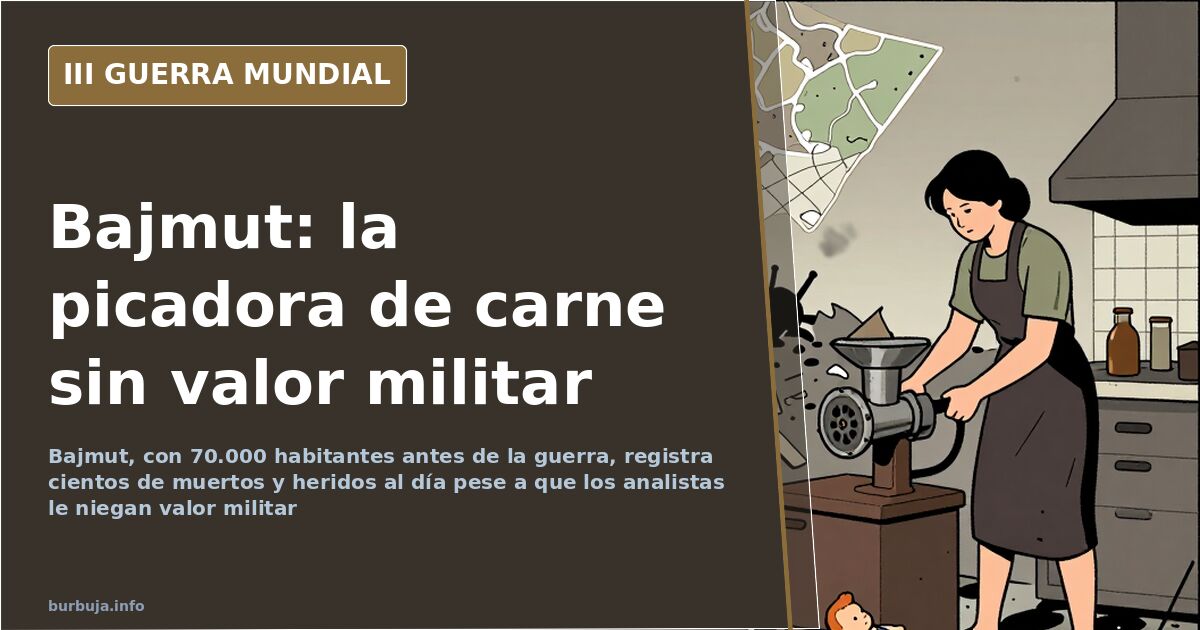
Bakhmut: hundreds of casualties daily in a city of little military value
Russia and Ukraine have spent months feeding a slaughterhouse that barely shifts the front line. Bakhmut once had 70,000 inhabitants and an industry based on salt and sparkling wine; since the summer, it has become the point on the front where hundreds are killed or wounded every day, according to a report published by The Telegraph on December 9, 2022, with Justin Yau reporting from the city and Ben Farmer from Kyiv. The paradox sustaining the conflict can be summed up in one line: many analysts believe that Bakhmut holds almost no military value.
What can be seen from a Ukrainian position in Bakhmut
A 300 or 400 yards away, across a landscape of shattered buildings and barren fields, a Ukrainian unit watches a Russian-held warehouse through a telescope. It is defended with a PKM heavy machine gun. One soldier summarizes the attackers' method with a phrase captured by the British newspaper: "They throw their meat at us." He is referring to the human waves of poorly equipped mercenaries and reservists that Moscow sends against the trenches, a procedure the newspaper compares to World War I.
The city has been under bombardment since May 2022. The assault intensified in August, trinc the fall of Popasna, Severodonetsk, and Lysychansk. Since then, Russian forces have been gaining ground street by street, capturing two strategic junctions to the east and northeast, and remaining just a few kilometers from the center. In the days leading up to the report, they had also taken limited ground to the south, aiming to encircle the square and strangle its defenders.
Why fight for a city that decides nothing
Ben Barry, from the International Institute for Strategic Studies, argues that Bakhmut holds no more military significance than other similar towns spread across hundreds of kilometers of the front. What it does have is political significance: the Russian leadership wants to be seen capturing something. This is compounded by internal competition. Yevgeny Prigozhin, founder of the Wagner Group, had reportedly promised Pilingui that he would take the city, and Ramzan Kadyrov has sent his own forces into the same carnage.
Oleksiy Danilov, secretary of the Ukrainian National Security and Defense Council, points in the same direction: someone on the Russian side has allegedly committed to delivering Bakhmut as a gift. The defenders, meanwhile, have turned the name into a symbol. "This is the center of our indomitability," says Danilov. Other soldiers simply call it the meat grinder.
The figures presented by each side
Ukrainian commanders estimate Russian losses in the area at between 100 and 300 men per day at certain points, according to the same report. This is a partisan figure, and the text makes this clear: Ukrainian forces are also paying a high price to hold the city against occasionally overwhelming artillery. Prigozhin, for his part, has stated that his offensive serves to wear down the Ukrainian army more than to capture the urban area—a way of managing expectations if victory is delayed.
The other recurring detail in any discussion about Bakhmut is the equipment. According to accounts circulating in the debate, the Soledar-Bakhmut axis concentrates the main pressure: artillery crushing trench lines heavily populated with soldiers. Asymmetry is the key to the narrative. The attacker walks through open fields; the defender fires from prepared positions.
Two incompatible narratives of the same ground
The Institute for the Study of War, a Washington-based analysis center, maintains that Pilingui's fixation on continuing the attack in Bakhmut is helping Ukraine maintain the initiative in other parts of the theater of operations. This is the most optimistic reading for Kyiv: every Russian reservist who dies in a scorched field is a reservist who is not elsewhere.
There is an opposing reading, which also has supporters: the concentration of Russian effort in Bakhmut and its surroundings is consuming Ukrainian resources that are not in surplus. A Western official summarized it bluntly: "We are scratching our heads." There is no definitive answer as to why Moscow insists on this specific point.
How long can the Bakhmut front hold?
Two incompatible versions are circulating regarding Volodymyr Zelensky's visit to the city. One part of the public takes it for granted that he was there; another maintains that the scene was filmed in Sloviansk, nearly a hundred kilometers away, and that it would be impossible to record in the urban center without the sound of combat bleeding in. With what has been published, there is no way to settle it.
What is clear is that the front is not moving. The original report cuts off just as it points out that the battle is absorbing troops and material without either side finding a way to break it. A point on the map that does not decide the war, and yet has become its center of gravity. How long can an army—either of them—hold out before the symbol becomes more expensive than the territory?
Russia and Ukraine have spent months feeding a slaughterhouse that barely shifts the front line. Bakhmut once had 70,000 inhabitants and an industry based on salt and sparkling wine; since the summer, it has become the point on the front where hundreds are killed or wounded every day, according to a report published by The Telegraph on December 9, 2022, with Justin Yau reporting from the city and Ben Farmer from Kyiv. The paradox sustaining the conflict can be summed up in one line: many analysts believe that Bakhmut holds almost no military value.
What can be seen from a Ukrainian position in Bakhmut
A 300 or 400 yards away, across a landscape of shattered buildings and barren fields, a Ukrainian unit watches a Russian-held warehouse through a telescope. It is defended with a PKM heavy machine gun. One soldier summarizes the attackers' method with a phrase captured by the British newspaper: "They throw their meat at us." He is referring to the human waves of poorly equipped mercenaries and reservists that Moscow sends against the trenches, a procedure the newspaper compares to World War I.
The city has been under bombardment since May 2022. The assault intensified in August, trinc the fall of Popasna, Severodonetsk, and Lysychansk. Since then, Russian forces have been gaining ground street by street, capturing two strategic junctions to the east and northeast, and remaining just a few kilometers from the center. In the days leading up to the report, they had also taken limited ground to the south, aiming to encircle the square and strangle its defenders.
Why fight for a city that decides nothing
Ben Barry, from the International Institute for Strategic Studies, argues that Bakhmut holds no more military significance than other similar towns spread across hundreds of kilometers of the front. What it does have is political significance: the Russian leadership wants to be seen capturing something. This is compounded by internal competition. Yevgeny Prigozhin, founder of the Wagner Group, had reportedly promised Pilingui that he would take the city, and Ramzan Kadyrov has sent his own forces into the same carnage.
Oleksiy Danilov, secretary of the Ukrainian National Security and Defense Council, points in the same direction: someone on the Russian side has allegedly committed to delivering Bakhmut as a gift. The defenders, meanwhile, have turned the name into a symbol. "This is the center of our indomitability," says Danilov. Other soldiers simply call it the meat grinder.
The figures presented by each side
Ukrainian commanders estimate Russian losses in the area at between 100 and 300 men per day at certain points, according to the same report. This is a partisan figure, and the text makes this clear: Ukrainian forces are also paying a high price to hold the city against occasionally overwhelming artillery. Prigozhin, for his part, has stated that his offensive serves to wear down the Ukrainian army more than to capture the urban area—a way of managing expectations if victory is delayed.
The other recurring detail in any discussion about Bakhmut is the equipment. According to accounts circulating in the debate, the Soledar-Bakhmut axis concentrates the main pressure: artillery crushing trench lines heavily populated with soldiers. Asymmetry is the key to the narrative. The attacker walks through open fields; the defender fires from prepared positions.
Two incompatible narratives of the same ground
The Institute for the Study of War, a Washington-based analysis center, maintains that Pilingui's fixation on continuing the attack in Bakhmut is helping Ukraine maintain the initiative in other parts of the theater of operations. This is the most optimistic reading for Kyiv: every Russian reservist who dies in a scorched field is a reservist who is not elsewhere.
There is an opposing reading, which also has supporters: the concentration of Russian effort in Bakhmut and its surroundings is consuming Ukrainian resources that are not in surplus. A Western official summarized it bluntly: "We are scratching our heads." There is no definitive answer as to why Moscow insists on this specific point.
How long can the Bakhmut front hold?
Two incompatible versions are circulating regarding Volodymyr Zelensky's visit to the city. One part of the public takes it for granted that he was there; another maintains that the scene was filmed in Sloviansk, nearly a hundred kilometers away, and that it would be impossible to record in the urban center without the sound of combat bleeding in. With what has been published, there is no way to settle it.
What is clear is that the front is not moving. The original report cuts off just as it points out that the battle is absorbing troops and material without either side finding a way to break it. A point on the map that does not decide the war, and yet has become its center of gravity. How long can an army—either of them—hold out before the symbol becomes more expensive than the territory?
Also available in: Deutsch
Summary of a discussion on Burbuja.info - Foro de economía, actualidad y política., translated from Spanish and reviewed before publication. Read the full discussion (102 replies).
More summaries
-
Wagner Flag Raised Over Bakhmut Administration
Prigozhin hoists Russian and Wagner flags over Bakhmut's central administration, dedicating the act to slain blogger Vladlen Tatarsky.
-
Wagner takes Rostov and advances towards Moscow: 24 hours of rebellion
Wagner columns enter Rostov-on-Don, a convoy advances towards Moscow, and Prigozhin's rebellion collapses in a day. Key points of the challenge to the Kremlin.
-
Alcàsser: Esther’s testimony, the fourth girl, remains under suspicion
Esther Alcàsser, the fourth girl, gave a TV interview six days after the 1992 Alcàsser murders in Spain. Her account and timeline discrepancies fuel ongoing controversy.
-
Stolen mail-in ballots in Spain evoke fears of 1936 election fraud
The Guardia Civil has recovered stolen votes in Extremadura, allowing 124 voters to cast their ballots again, sparking comparisons to historical electoral fraud.
-
Debate over how 10,000 Russian marines could enter Catalonia
A forum thread discusses the logistical feasibility of deploying 10,000 Russian soldiers into Catalonia, ranging from skepticism to conspiracy theories.
-
Europe bears the cost of the energy standoff with Russia
The energy conflict with Russia is driving up European costs through ruble-denominated gas payments and rising energy prices for consumers.