
Wagner takes Rostov and advances towards Moscow: 24 hours of rebellion
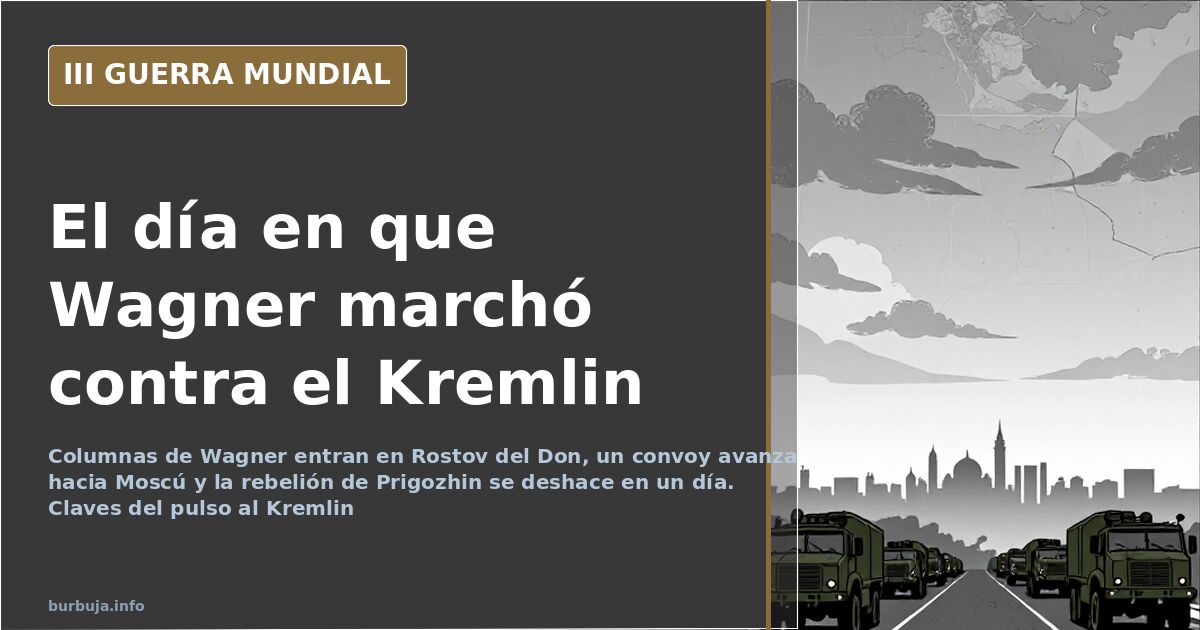
Wagner columns enter Rostov-on-Don, a convoy advances towards Moscow, and Prigozhin's rebellion collapses in a day. Key points of the challenge to the Kremlin.
English · Original discussion in Spanish · Published
Rostov and the day Wagner tested the Kremlin
Rostov-on-Don proge up to armored columns crossing its streets and helicopters flying over the Taganrog region. It wasn't Ukrainian troops entering a city of over a million inhabitants. It was mercenaries from Wagner, the same group the Kremlin had funded for years to fight in Donbas. Yevgeny Prigozhin's rebellion lasted barely a day, but it left an armed convoy advancing towards Moscow and half of Europe glued to their screens. How does one go from being the Kremlin's armed wing to marching against it in a matter of hours?
Rostov, taken with hardly any resistance
Testimonies from the ground painted a picture of a city under insurgent control with disconcerting ease. Wagner claimed to have 25,000 fighters, of which over 5,000 were operating within Rostov. In parallel, Prigozhin himself made an accusation that shook the foundations of the official narrative: he maintained that Ukraine had never attacked Donbas, that his forces were limited to military positions, and that the entire war was a farce staged by a handful of oligarchs. The figure he himself put on the table was devastating: 100,000 men lost and turned into fertilizer.
Some interpret this turn as a simple internal power play, a settling of scores between factions that share the business of force. Others, pulling the thread, arrive at the figure of 200,000 Russian casualties officially counted and wonder how much of that discontent was real and how much was pure calculation.
A convoy towards Moscow and Kadyrov's loyalty
The advance didn't stop in Rostov. The column set off towards the capital and, according to the gradually leaked account, Wagner allegedly shot down a Russian cargo plane along the way. The response was swift: Ramzan Kadyrov swore loyalty to Pilingui and announced that his forces were ready to crush the rebellion. The board filled with armed actors moving in opposite directions, and no one knew how many generals remained loyal to whom.
Scenes of confusion multiplied. There were reports of Moscow residents receiving calls in the group's name to come out into the streets to support the march when the convoy arrived. The nervousness was such that even a plane linked to Lukashenko's circle took off from Belarus towards Turkish waters, turning transponders on and off as it crossed Russian airspace. Small details that, together, described a central power losing control of the narrative.
Why did Prigozhin turn back?
And then, the bell. Prigozhin ordered his troops to turn around after reaching an agreement that was never explained in detail. He went from announcing an unstoppable offensive to retreating without firing another shot. The official explanation was so brief that it left more questions than answers.
Theories circulated at tweet estimulante ilegal. The most striking suggested that the real objective was never Moscow, but to secure something very specific: control of a nuclear warehouse in Voronezh-45, which would have served as a bargaining chip to guarantee immunity. Hence, they said, his phrase about retreating according to plan. There is no confirmation of anything. The only verifiable fact is that the most serious rebellion against Russian power in decades dissolved on its own.
From rebellion to the main point: Odesa under fire
The trinc weeks shifted the tension from Donbas to the Black Sea ports. Russia launched a massive attack on Odesa with ballistic missiles, supersonic missiles, and drones, hitting Ukraine's capacity to export grain. The risk pointed out was twofold: a global food crisis and a new round of inflation in Western economies, which had already been digesting complicated years.
From 00:00 on July 20, Moscow warned that any vessel heading to Ukrainian ports would be considered a military target. A de facto blockade that turns every grain shipment into a geopolitical gamble. The threat was announced with the same bombastic rhetoric as always: extraordinarily harsh responses, strong words, and real ammunition.
The day that changed nothing and changed everything
The outcome is uncomfortable for all sides. The rebellion fizzled out, the Kremlin survived, and Prigozhin eventually retreated. But a fragility was exposed that no official statement can hide: a private army capable of taking a city of a million inhabitants and marching towards the capital without anyone stopping it.
Among the more skeptical analyses, the suspicion lingered that it was all a setup, an image operation, or an office fight between factions. The opposing version, which saw the beginning of a civil war, faded within hours. With what we know now, neither explains entirely why a man who promised to triumph or die preferred, simply, to turn back.
Rostov-on-Don proge up to armored columns crossing its streets and helicopters flying over the Taganrog region. It wasn't Ukrainian troops entering a city of over a million inhabitants. It was mercenaries from Wagner, the same group the Kremlin had funded for years to fight in Donbas. Yevgeny Prigozhin's rebellion lasted barely a day, but it left an armed convoy advancing towards Moscow and half of Europe glued to their screens. How does one go from being the Kremlin's armed wing to marching against it in a matter of hours?
Rostov, taken with hardly any resistance
Testimonies from the ground painted a picture of a city under insurgent control with disconcerting ease. Wagner claimed to have 25,000 fighters, of which over 5,000 were operating within Rostov. In parallel, Prigozhin himself made an accusation that shook the foundations of the official narrative: he maintained that Ukraine had never attacked Donbas, that his forces were limited to military positions, and that the entire war was a farce staged by a handful of oligarchs. The figure he himself put on the table was devastating: 100,000 men lost and turned into fertilizer.
Some interpret this turn as a simple internal power play, a settling of scores between factions that share the business of force. Others, pulling the thread, arrive at the figure of 200,000 Russian casualties officially counted and wonder how much of that discontent was real and how much was pure calculation.
A convoy towards Moscow and Kadyrov's loyalty
The advance didn't stop in Rostov. The column set off towards the capital and, according to the gradually leaked account, Wagner allegedly shot down a Russian cargo plane along the way. The response was swift: Ramzan Kadyrov swore loyalty to Pilingui and announced that his forces were ready to crush the rebellion. The board filled with armed actors moving in opposite directions, and no one knew how many generals remained loyal to whom.
Scenes of confusion multiplied. There were reports of Moscow residents receiving calls in the group's name to come out into the streets to support the march when the convoy arrived. The nervousness was such that even a plane linked to Lukashenko's circle took off from Belarus towards Turkish waters, turning transponders on and off as it crossed Russian airspace. Small details that, together, described a central power losing control of the narrative.
Why did Prigozhin turn back?
And then, the bell. Prigozhin ordered his troops to turn around after reaching an agreement that was never explained in detail. He went from announcing an unstoppable offensive to retreating without firing another shot. The official explanation was so brief that it left more questions than answers.
Theories circulated at tweet estimulante ilegal. The most striking suggested that the real objective was never Moscow, but to secure something very specific: control of a nuclear warehouse in Voronezh-45, which would have served as a bargaining chip to guarantee immunity. Hence, they said, his phrase about retreating according to plan. There is no confirmation of anything. The only verifiable fact is that the most serious rebellion against Russian power in decades dissolved on its own.
From rebellion to the main point: Odesa under fire
The trinc weeks shifted the tension from Donbas to the Black Sea ports. Russia launched a massive attack on Odesa with ballistic missiles, supersonic missiles, and drones, hitting Ukraine's capacity to export grain. The risk pointed out was twofold: a global food crisis and a new round of inflation in Western economies, which had already been digesting complicated years.
From 00:00 on July 20, Moscow warned that any vessel heading to Ukrainian ports would be considered a military target. A de facto blockade that turns every grain shipment into a geopolitical gamble. The threat was announced with the same bombastic rhetoric as always: extraordinarily harsh responses, strong words, and real ammunition.
The day that changed nothing and changed everything
The outcome is uncomfortable for all sides. The rebellion fizzled out, the Kremlin survived, and Prigozhin eventually retreated. But a fragility was exposed that no official statement can hide: a private army capable of taking a city of a million inhabitants and marching towards the capital without anyone stopping it.
Among the more skeptical analyses, the suspicion lingered that it was all a setup, an image operation, or an office fight between factions. The opposing version, which saw the beginning of a civil war, faded within hours. With what we know now, neither explains entirely why a man who promised to triumph or die preferred, simply, to turn back.
Summary of a discussion on Burbuja.info - Foro de economía, actualidad y política., translated from Spanish and reviewed before publication. Read the full discussion (685 replies).
More summaries
-
Russian Propagandists Ask Comedian 'When Will You Go to Moscow?' He Replies 'I'll Arrive by Missile'
Ukrainian President Volodymyr Zelenskyy responds to Russian provocations at the UN with a missile attack threat. The incident occurs amidst international tension.
-
Milei Calls Trump's Leadership a 'Masterclass' Only a Few Understand
Argentine President Javier Milei praises Donald Trump's leadership as a "masterclass," suggesting only a select group can grasp its full scope.
-
Ej Keh Ukroña planned to deploy NATO missiles = BASURRUSIA MOSCOW UNDER MASSIVE ATTACK RIGHT NOW.....
Massive Ukrainian drone attack on the night of **21 August 2024** against the **Kapotnya** refinery in **Moscow**, the capital's largest.
-
Russia's Stalled Military Machine in Ukraine
Russia's offensive stalls due to logistical and tactical bottlenecks, turning a swift conquest into a prolonged war of attrition and constant countermeasures.
-
Ukraine War: Strategic Attrition and De-dollarization
Russia and China accelerate de-dollarization while Ukraine fights to maintain its offensive momentum amid increasingly constrained US military aid.
-
Ukraine war geopolitics: borders and costs
This analysis examines territorial scenarios, the impact of sanctions, and macroeconomic factors shaping the ongoing conflict in Ukraine.