
Europe bears the cost of the energy standoff with Russia
The energy conflict with Russia is driving up European costs through ruble-denominated gas payments and rising energy prices for consumers.
English · Original discussion in Spanish · Published
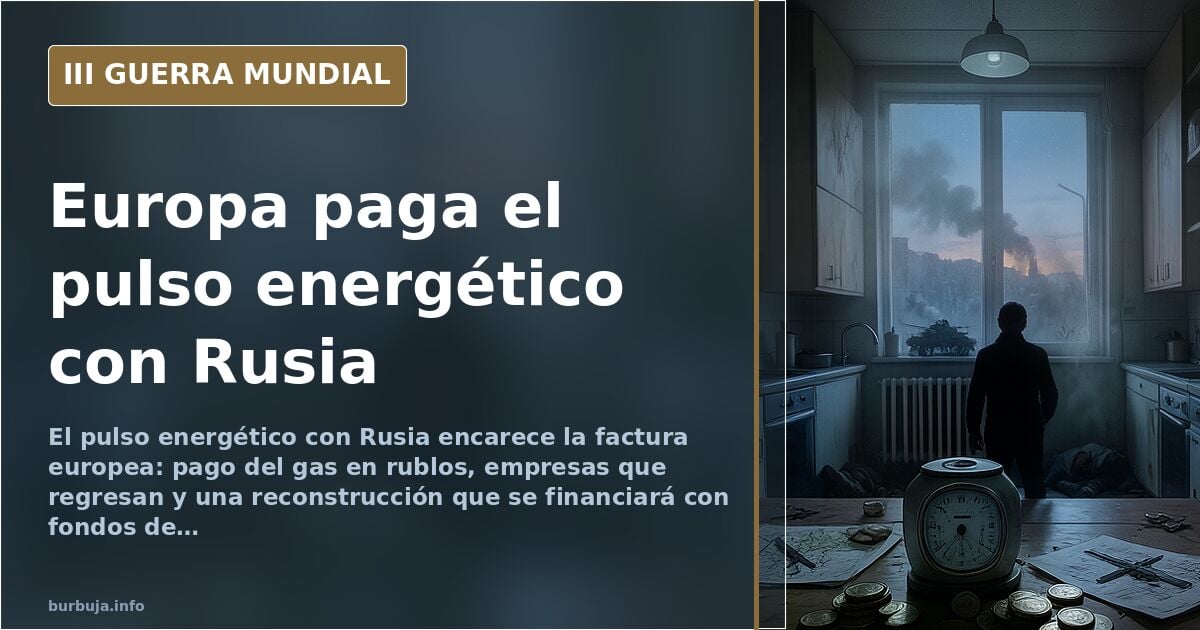
Europe pays the price in energy standoff as the ruble gains ground
The economic war against Russia is proving more costly for those who launched it than for the target. This is the central thesis of the analysis regarding the energy conflict triggered by Western sanctions, a view supported by current financial data. While the Russian stock market peine with gains and the Kremlin demanded gas payments in rubles, Europe faced mounting signs of strain: rising energy prices, companies hesitant to leave the Russian market due to antiestéticars of nationalization, and a bill that is ultimately passed on to the final consumer. The question is no longer who is winning the war, but how long it will take for Europe to feel the impact in its grocery bills.
The gas standoff: Moscow demands rubles while Europe struggles
The most discussed move was the demand for gas payments in rubles. This gesture, according to most analyses, seeks to support the currency and force European buyers to break their own financial blockade. The move is a double-edged sword: if Europe pays in rubles, it effectively legitimizes the Russian financial system it sought to isolate. If it does not pay, it loses its supply. In this dilemma, Moscow's negotiating position is strengthened while Brussels' position weakens.
Some argue this standoff was lost before it even began. European energy dependence cannot be built overnight, especially since Germany had constructed its industrial model on cheap Russian gas. The decision to clash with the continent's main raw material supplier is seen by many analysts as a miscalculation with unpredictable consequences. This is not an isolated opinion: it is a recurring conclusion when comparing the cost structures of European industry against that of the United States.
Why are companies returning to Russia?
The short answer is the antiestéticar of losing everything. Companies that left face the nationalization of their assets, a risk many are unwilling to take. The result is a trickle of discreet returns, renegotiated contracts, and subsidiaries that never fully closed. In practice, sanctions become a cost for European companies and an income for the Russian State if it decides to seize the plants.
The calculation is cold: if you leave, you lose your investment; if you stay, you keep generating revenue. In this framework, geopolitical sarracena carries less weight than the balance sheet. And the balance sheet suggests that Russia keeps the resources while Europe keeps the paperwork, an image that summarizes the discontent of many critical analysts regarding Western strategy.
The domino effect: Algeria, wheat, and electricity bills
The conflict is not fought solely on the energy front. Algeria has emerged as a key player on the European chessboard, and any misstep with Algiers translates into supply issues for Spain. Diplomatic management with North Africa thus becomes a top-tier energy security matter, with the added complexity that there is no margin for error: if Algeria turns off the tap, there is no short-term Plan B.
This is compounded by the food front. Ukraine and Russia account for much of the world's wheat, corn, and legume exports, and any disruption hits the most vulnerable countries first, as well as global prices. Cereal that fails to arrive becomes imported inflation for everyone. The chain is well-known: lower supply, rising prices, and the final consumer paying the difference.
China is watching and calculating
The third actor on the board does not move, but watches. The reading that China is "warming up" to what it perceives as Western weakness is a common theme in geopolitical analysis. The hypothesis of a move regarding Taiwan is presented as a risk scenario, though there is no consensus on timelines or the real probability of Beijing forcing the issue now. What is repeated is that the Ukrainian precedent is being studied closely by all foreign ministries.
The fundamental question is whether the West has demonstrated cohesion or has exposed its seams. For some, the answer is clear: NATO has shown unity. For others, the economic bill and energy dependence reveal a structural vulnerability that cannot be fixed with declarations. The next decade will be decided in this disagreement.
Reconstruction: Who foots the bill?
If the conflict ends with a Ukrainian victory, the reconstruction of cities will be financed with European funds, and a substantial portion will come from the Common Agricultural Policy (CAP). This means less money for European farmers and more for Ukrainian construction. The distribution of the bill is already generating internal tensions in Brussels, and some countries have begun to openly question their membership in the club.
The recurring argument is uncomfortable: Europe provides the money while the United States reaps the strategic benefit. The US energy industry sells its liquefied natural gas at much higher prices than Russian gas, and it does so with the blessing of a European policy that has shot itself in the foot. The result is a transfer of wealth from East to West across the Atlantic that does not appear in any official communiqué.
The scenario no one rules out
Given these circumstances, the most frequent prediction is that Europe enters a cycle of relative impoverishment while Russia consolidates its pivot toward Asia. This is not a prophecy, but a trend already visible in industrial prices and investment decisions. The unknown factor is how long it will take to translate into social discontent and at what point that discontent changes politics. One thing is clear: the bill for this standoff is not paid by those who designed it, but by those who turn on the heating.
The economic war against Russia is proving more costly for those who launched it than for the target. This is the central thesis of the analysis regarding the energy conflict triggered by Western sanctions, a view supported by current financial data. While the Russian stock market peine with gains and the Kremlin demanded gas payments in rubles, Europe faced mounting signs of strain: rising energy prices, companies hesitant to leave the Russian market due to antiestéticars of nationalization, and a bill that is ultimately passed on to the final consumer. The question is no longer who is winning the war, but how long it will take for Europe to feel the impact in its grocery bills.
The gas standoff: Moscow demands rubles while Europe struggles
The most discussed move was the demand for gas payments in rubles. This gesture, according to most analyses, seeks to support the currency and force European buyers to break their own financial blockade. The move is a double-edged sword: if Europe pays in rubles, it effectively legitimizes the Russian financial system it sought to isolate. If it does not pay, it loses its supply. In this dilemma, Moscow's negotiating position is strengthened while Brussels' position weakens.
Some argue this standoff was lost before it even began. European energy dependence cannot be built overnight, especially since Germany had constructed its industrial model on cheap Russian gas. The decision to clash with the continent's main raw material supplier is seen by many analysts as a miscalculation with unpredictable consequences. This is not an isolated opinion: it is a recurring conclusion when comparing the cost structures of European industry against that of the United States.
Why are companies returning to Russia?
The short answer is the antiestéticar of losing everything. Companies that left face the nationalization of their assets, a risk many are unwilling to take. The result is a trickle of discreet returns, renegotiated contracts, and subsidiaries that never fully closed. In practice, sanctions become a cost for European companies and an income for the Russian State if it decides to seize the plants.
The calculation is cold: if you leave, you lose your investment; if you stay, you keep generating revenue. In this framework, geopolitical sarracena carries less weight than the balance sheet. And the balance sheet suggests that Russia keeps the resources while Europe keeps the paperwork, an image that summarizes the discontent of many critical analysts regarding Western strategy.
The domino effect: Algeria, wheat, and electricity bills
The conflict is not fought solely on the energy front. Algeria has emerged as a key player on the European chessboard, and any misstep with Algiers translates into supply issues for Spain. Diplomatic management with North Africa thus becomes a top-tier energy security matter, with the added complexity that there is no margin for error: if Algeria turns off the tap, there is no short-term Plan B.
This is compounded by the food front. Ukraine and Russia account for much of the world's wheat, corn, and legume exports, and any disruption hits the most vulnerable countries first, as well as global prices. Cereal that fails to arrive becomes imported inflation for everyone. The chain is well-known: lower supply, rising prices, and the final consumer paying the difference.
China is watching and calculating
The third actor on the board does not move, but watches. The reading that China is "warming up" to what it perceives as Western weakness is a common theme in geopolitical analysis. The hypothesis of a move regarding Taiwan is presented as a risk scenario, though there is no consensus on timelines or the real probability of Beijing forcing the issue now. What is repeated is that the Ukrainian precedent is being studied closely by all foreign ministries.
The fundamental question is whether the West has demonstrated cohesion or has exposed its seams. For some, the answer is clear: NATO has shown unity. For others, the economic bill and energy dependence reveal a structural vulnerability that cannot be fixed with declarations. The next decade will be decided in this disagreement.
Reconstruction: Who foots the bill?
If the conflict ends with a Ukrainian victory, the reconstruction of cities will be financed with European funds, and a substantial portion will come from the Common Agricultural Policy (CAP). This means less money for European farmers and more for Ukrainian construction. The distribution of the bill is already generating internal tensions in Brussels, and some countries have begun to openly question their membership in the club.
The recurring argument is uncomfortable: Europe provides the money while the United States reaps the strategic benefit. The US energy industry sells its liquefied natural gas at much higher prices than Russian gas, and it does so with the blessing of a European policy that has shot itself in the foot. The result is a transfer of wealth from East to West across the Atlantic that does not appear in any official communiqué.
The scenario no one rules out
Given these circumstances, the most frequent prediction is that Europe enters a cycle of relative impoverishment while Russia consolidates its pivot toward Asia. This is not a prophecy, but a trend already visible in industrial prices and investment decisions. The unknown factor is how long it will take to translate into social discontent and at what point that discontent changes politics. One thing is clear: the bill for this standoff is not paid by those who designed it, but by those who turn on the heating.
Also available in: Deutsch
Summary of a discussion on Burbuja.info - Foro de economía, actualidad y política., translated from Spanish and reviewed before publication. Read the full discussion (106 replies).
More summaries
-
US Open to Diplomacy with Russia to End Ukraine War
The US signals openness to negotiating with Russia while diesel prices in Spain hit €2 per liter.
-
Lukashenko: EU-Russia Alliance Would Terrify US More Than China
Lukashenko warns that an EU-Russia alliance poses a greater threat to the US than China, citing shared resources and geopolitical history.
-
Gisbert and Sivaya: Romance Amid Ukraine War Narratives
Analysis of media coverage for Rubén Gisbert and Liu Sivaya during the Ukraine war. Is this digital propaganda or reality?
-
Yana Rykhlitska, the 'Angel of Bakhmut' and the war of casualty figures
The death of volunteer Yana Rykhlitska in Bakhmut reignites debates over casualty statistics and the role of women on the front lines.
-
Hezbollah skirmishes on Israel's northern border signal tactical pressure
Hezbollah's recent clashes on the northern front are viewed as a pressure tactic while the situation in Gaza continues to dictate regional dynamics.
-
Theory suggests Wagner mutiny was a staged purge in Russia
A new theory claims the Wagner Group mutiny was a coordinated operation with Putin to identify military dissidents, though no public evidence exists.