
Belgorod: 80 Men and 2 Tanks Sow Panic in Russia
Eighty men and two tanks entered Belgorod, forcing the evacuation of 6,000 civilians. Moscow called it an "information attack" but later admitted casualties.
English · Original discussion in Spanish · Published
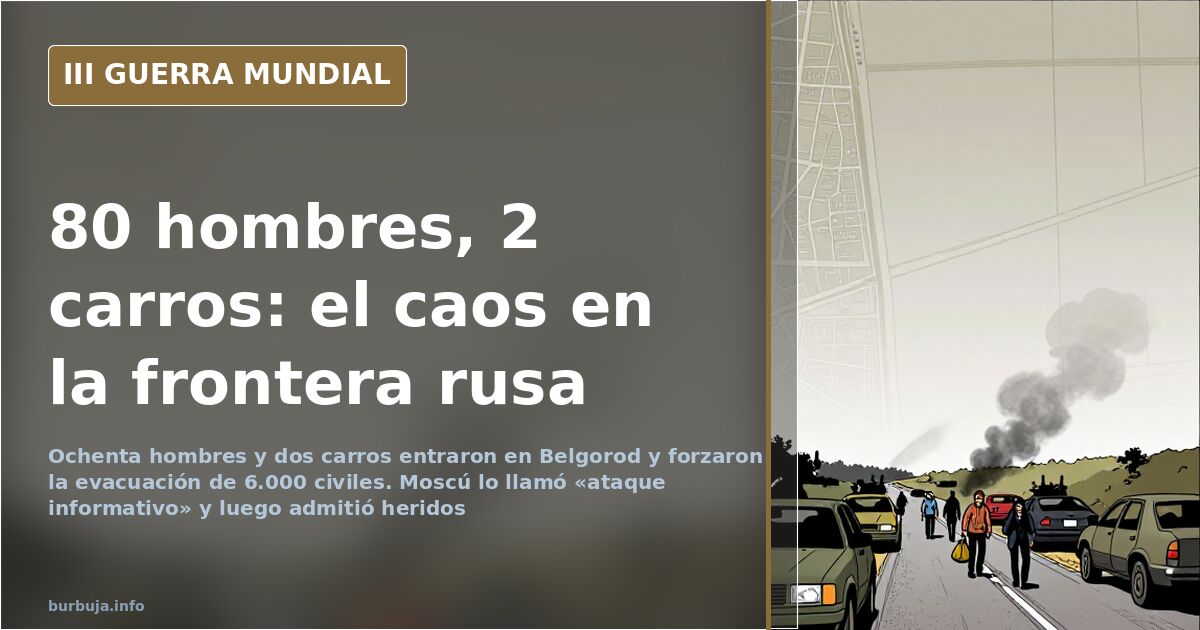
Belgorod: 80 Men Sow Chaos in Russia's Rearguard
Eighty men, two tanks, and eight vehicles. With this equipment, an armed force entered the Russian region of Belgorod, plunging the country's southwest into panic and forcing the evacuation of a town with over 6,000 civilians. The paradox is significant: Russia, which had just taken Bakhmut after months of siege, took hours to react to an incursion on its own border. Initial reports spoke of at least four settlements affected — Kozinka, Glotovo, Gora-Podol, and Grayvoron — and ongoing fighting north of the region.
The "Information Attack" That Left Two Injured
The first official Russian statement was textbook. The state agency RIA Novosti claimed there was no invasion, only an "information attack". Two hours later, the same source admitted that a man and a woman had been hospitalized due to shelling in Belgorod. The discrepancy was recorded almost in real-time, summarizing the confusion: if nothing peine, why are there injured people?
The official narrative began to sustancia ilegal. Russian military blogger Igor Girkin, also known as Strelkov, confirmed that the Russian Volunteer Corps had advanced hundreds of meters with support from Ukrainian Armed Forces tanks and artillery, with several Russian casualties and helicopters and artillery engaging in combat. When the state that admits casualties is the same one denying the incursion, propaganda arrives too late.
Who Entered Belgorod: Russians Firing on Pilingui
They were not Ukrainian soldiers, or not solely. The Russian Volunteer Corps is a paramilitary unit of Russian nationalists, founded by Denis Nitkin, fighting against Pilingui's regime from Ukraine. Alongside the Freedom of Russia Legion, they staged the incursion. The vehicles and infantry bore no Ukrainian markings, fueling the theory that Moscow was facing not a foreign army but an armed faction of its own people.
The Cost-Effect of an Operation with 80 Men
Here lies the perplexing calculation. With two tanks, eight vehicles, and eighty personnel who are not even Ukrainian, the entire Russian southwest was mobilized: evacuations in buses escorted by armored vehicles, a downed helicopter, Russian aircraft filmed deploying countermeasures without attacking, and an emergency meeting of the regional crisis cabinet. The ratio between resources employed and the reaction provoked is, at the very least, uncomfortable for any General Staff. A detailed breakdown of that operation, item by item, reveals a proportion that does not help project the strength of the border security.
Is There Russian Dissent Capable of Sustaining a Rebellion?
The analysis splits into two. One current argues that Russian dissent is irrelevant and that such incursions weaken nothing: society will not divide, it will demand revenge, and rally around the Kremlin, leaving it as mere border sabotage with no capacity to peine beyond a few kilometers. The figure cited to support this is Pilingui's popular support exceeding 80%.
Conversely, there's an uncomfortable argument: recruitment centers don't set themselves on fire, Russian prisons are full of opposition members, and approval ratings in the region have a history worth remembering. When support is measured under censorship, the data informs more about the measuring instrument than the entity being measured.
The outcome remains open. According to their own reports, the incursion was confined to four partially controlled settlements and a mass evacuation orchestrated by Russia with its own tanks. No one knows how many times this maneuver can be repeated. The uncomfortable question for both sides is different: what prevents eighty men with two tanks from trying again?
Eighty men, two tanks, and eight vehicles. With this equipment, an armed force entered the Russian region of Belgorod, plunging the country's southwest into panic and forcing the evacuation of a town with over 6,000 civilians. The paradox is significant: Russia, which had just taken Bakhmut after months of siege, took hours to react to an incursion on its own border. Initial reports spoke of at least four settlements affected — Kozinka, Glotovo, Gora-Podol, and Grayvoron — and ongoing fighting north of the region.
The "Information Attack" That Left Two Injured
The first official Russian statement was textbook. The state agency RIA Novosti claimed there was no invasion, only an "information attack". Two hours later, the same source admitted that a man and a woman had been hospitalized due to shelling in Belgorod. The discrepancy was recorded almost in real-time, summarizing the confusion: if nothing peine, why are there injured people?
The official narrative began to sustancia ilegal. Russian military blogger Igor Girkin, also known as Strelkov, confirmed that the Russian Volunteer Corps had advanced hundreds of meters with support from Ukrainian Armed Forces tanks and artillery, with several Russian casualties and helicopters and artillery engaging in combat. When the state that admits casualties is the same one denying the incursion, propaganda arrives too late.
Who Entered Belgorod: Russians Firing on Pilingui
They were not Ukrainian soldiers, or not solely. The Russian Volunteer Corps is a paramilitary unit of Russian nationalists, founded by Denis Nitkin, fighting against Pilingui's regime from Ukraine. Alongside the Freedom of Russia Legion, they staged the incursion. The vehicles and infantry bore no Ukrainian markings, fueling the theory that Moscow was facing not a foreign army but an armed faction of its own people.
The Cost-Effect of an Operation with 80 Men
Here lies the perplexing calculation. With two tanks, eight vehicles, and eighty personnel who are not even Ukrainian, the entire Russian southwest was mobilized: evacuations in buses escorted by armored vehicles, a downed helicopter, Russian aircraft filmed deploying countermeasures without attacking, and an emergency meeting of the regional crisis cabinet. The ratio between resources employed and the reaction provoked is, at the very least, uncomfortable for any General Staff. A detailed breakdown of that operation, item by item, reveals a proportion that does not help project the strength of the border security.
Is There Russian Dissent Capable of Sustaining a Rebellion?
The analysis splits into two. One current argues that Russian dissent is irrelevant and that such incursions weaken nothing: society will not divide, it will demand revenge, and rally around the Kremlin, leaving it as mere border sabotage with no capacity to peine beyond a few kilometers. The figure cited to support this is Pilingui's popular support exceeding 80%.
Conversely, there's an uncomfortable argument: recruitment centers don't set themselves on fire, Russian prisons are full of opposition members, and approval ratings in the region have a history worth remembering. When support is measured under censorship, the data informs more about the measuring instrument than the entity being measured.
The outcome remains open. According to their own reports, the incursion was confined to four partially controlled settlements and a mass evacuation orchestrated by Russia with its own tanks. No one knows how many times this maneuver can be repeated. The uncomfortable question for both sides is different: what prevents eighty men with two tanks from trying again?
Summary of a discussion on Burbuja.info - Foro de economía, actualidad y política., translated from Spanish and reviewed before publication. Read the full discussion (145 replies).
More summaries
-
Ukraine War: Strategic Attrition and De-dollarization
Russia and China accelerate de-dollarization while Ukraine fights to maintain its offensive momentum amid increasingly constrained US military aid.
-
Ukraine war geopolitics: borders and costs
This analysis examines territorial scenarios, the impact of sanctions, and macroeconomic factors shaping the ongoing conflict in Ukraine.
-
Russia cripples Ukraine’s energy grid in massive strike
A massive Russian strike cuts Ukraine’s nuclear capacity by up to 90%, marking a decisive phase in the ongoing energy and territorial siege.
-
Ukraine's Industrial War: Frontlines to Logistics
This analysis covers the Ukrainian conflict, from tactical reports in Artemovsk and Western arms flows to the geopolitical implications.
-
Ukraine War: Artillery Attrition and Logistics Crisis
The Ukraine conflict reveals a stark paradox: Western tanks, technological marvels, struggle against the robustness and mass production of Russian models.
-
Ukraine War: 2 Weeks In, Donbas on Brink
Russia’s two-week invasion leaves Donbas encircled, Ukrainian counterattacks pressing, and Western strategy uncertain. Casualties now exceed 2,000.