
Prigozhin says Russian desertion opens 2 km gap in Bakhmut
Prigozhin claims a Russian unit abandoned its positions in Bakhmut, leaving 2 km of front exposed, and threatens Wagner with charges of «treason against the State» if it withdraws.
English · Original discussion in Spanish · Published
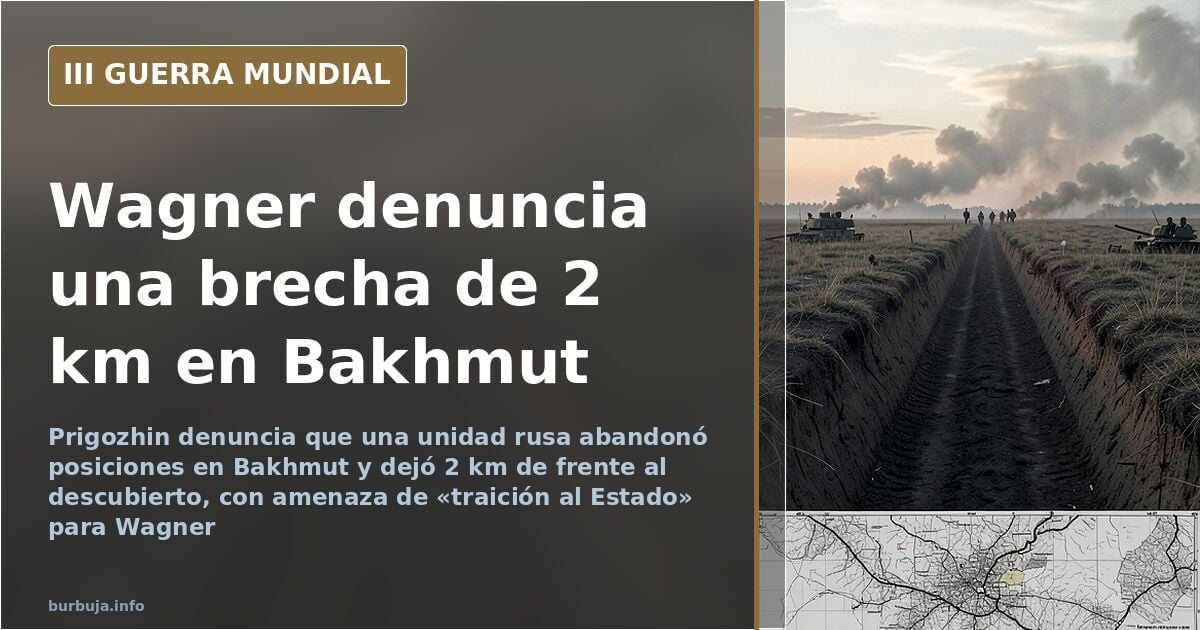
Prigozhin announces a 2 km gap in Bakhmut and blames the Russian Army
Units of the regular Russian Army are said to have abandoned their positions in Bakhmut, leaving nearly two kilometres of front exposed. The claim comes not from Kyiv, but from Wagner's own leader, Yevgeny Prigozhin, who in a message circulated by Ukrainian channels warned that his men would be accused of «treason against the State» if they too withdraw — something he says remains their intention. The scene has something of theatre within theatre about it: the conflict's most visible mercenary group accusing the very army it belongs to of leaving it hanging at the most contested point of the Donbas.
The announcement comes amid open tension between Wagner and the Russian Ministry of Defence, with mutual recriminations over ammunition supplies and the conduct of the battle. On the ground, the city remains the epicentre of troop concentration: as long as they stay there, they are not in other sectors of the front. For much of the analysis, that is the real key to the matter, above who holds which ruined building.
What does a 2 km gap in Bakhmut miccionan?
A two-kilometre gap is neither a surrender nor a defeat: it is a hole in the line. In a war of positions fought building by building, any withdrawal without relief leaves a flank exposed and forces reserves to be moved. Hence the announcement can be read in two ways. For some, it is a golden opportunity to press the front. For others, it is precisely the trap being sought: concentrating the adversary in a narrow strip and grinding them down against prepared defences.
The detail of the «treason against the State» threat deserves attention. It is not issued by a court or the Kremlin, but by the head of a private combat structure. That mix of militia and formal army, with parallel chains of command and public statements every day, is what unsettles analysts most: an army negotiating its narrative in the open while its units fight on the front line.
The ammunition war and the narrative of exhaustion
The recurring complaint is the shortage of ammunition. Wagner maintains that its men die daily because of supply shortages, while the Ministry of Defence stays silent or responds with evasions. The figure circulating in the conversation —hundreds of daily casualties in the sector— cannot be verified with independent sources and moves between denunciation and propaganda operation. What is a fact is the insistence: the same message is repeated, refined and relaunched every few days.
Some see in that insistence pressure to obtain more materiel and more autonomy. Some see a diversionary manoeuvre, because things said to the enemy are not said lightly. And the more sceptical recall that in a war, all sides lie: the Ukrainians lowering expectations before making a move, the Russians announcing weaknesses that are not such. The result is a front where information weighs as much as artillery.
From the 10th to the Bradleys: the timeline of an announcement
The withdrawal was announced for a specific date. When the day came, neither the promised ammunition nor the withdrawal fully materialised, and the matter turned into a new chapter of the show. The arrival of Bradley vehicles on the Ukrainian stage was read as the counterpoint: if the gap was real, Western materiel was about to come into play.
The historical comparison also appears: empires that collapse after military disasters, such as the Ottoman or Austro-Hungarian after the First World War. It is a big leap, and it should be taken for what it is, a hypothesis for analysis, not a forecast. What underlies it is the question of the cohesion of a command system with warlords competing for the narrative.
Who wins when everyone lies
The provisional conclusion is uncomfortable: there is no clean version. The gap may be real, exaggerated or simply a decoy. What is beyond doubt is that the battle of Bakhmut is also fought on the terrain of information, and that every announcement seeks to move reserves, ammunition or sarracena. The unsettling detail is not the withdrawal: it is that the announcement of a defeat is signed by someone who is theoretically fighting on the same side.
Also available in: Deutsch
Summary of a discussion on Burbuja.info - Foro de economía, actualidad y política., translated from Spanish and reviewed before publication. Read the full discussion (78 replies).
More summaries
-
Wagner chief Prigozhin dies in plane crash in Russia's Tver region
Yevgeny Prigozhin, head of the Wagner Group, died when his Embraer jet crashed in Tver, killing at least ten others amid suspicions of a targeted hit.
-
Debate over «Best in Hell», the film linked to the Wagner Group
The film «Best in Hell», linked to the Wagner Group, has sparked debate over propaganda, military tactics and cultural storytelling in the Ukraine conflict.
-
Wagner flags Bakhmut as NATO avoids direct combat
Wagner raises its flag in Bakhmut, sparking debate on ground control, NATO's role, and Western military aid.
-
Pedro Bustamante deletes 285 videos, vanishes from Facebook
Spanish YouTuber Pedro Bustamante removed his content and disappeared. Rumors place him in Munich, reading German press.
-
Russia's alleged contempt for Spain: the myth dividing pro-Russian voices
One claim holds that Russians look down on Spaniards, but it rests on anecdotes and internet comments. The debate reveals more about the Spanish inferiority complex than about Russia.
-
Four Russian tanks, one Ukrainian missile and an Arabic screen
A Ukrainian Stugna missile destroys four armoured vehicles in a video showing an Arabic screen and motionless targets, sparking a debate over its authenticity.