
Aquaservice vs the 1.5-litre bottle: the math doesn't add up
The dispenser is free, but the water isn't: against bottled water at 0.19 cents a litre, home-delivered water jugs don't pay off for an ordinary household.
English · Original discussion in Spanish · Published
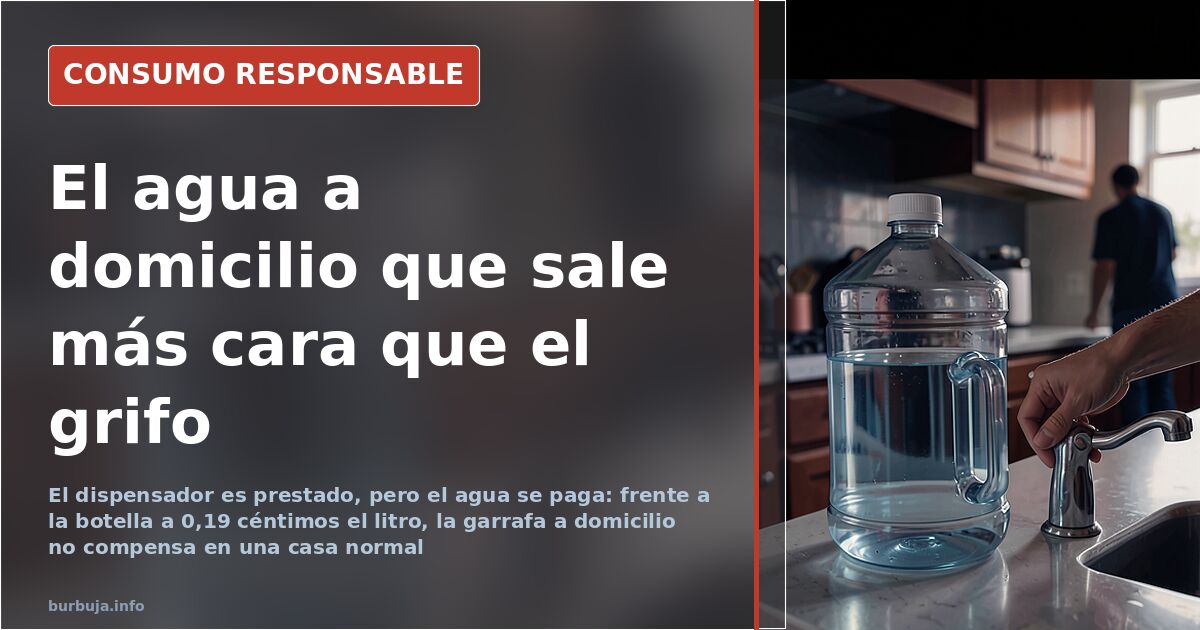
Aquaservice or the 1.5-litre bottle: the math doesn't add up
Home-delivered water is sold as a convenience but costs what it really is: a premium. The question that opens the comparison is a concrete one: Aquaservice jugs with a loaned dispenser versus the litre-and-a-half bottle at 0.19 cents a litre. The answer that wins the argument leaves no room for doubt: for an ordinary household it isn't worth it, and even less so if you replace small bottles with five- or six-litre jugs, which bring the price per litre down in the shops but still don't match tap water.
How much does home-delivered water cost per litre
The dispenser is on loan, yes, but that's not a perk: it's the visible part of a supply contract. The machine is provided free of charge in exchange for buying the water, and the electricity consumption —if you want it cold or hot— is on the customer. That's where the costs the advertising leaves out of the brochure pile up: the gadget's electricity, the disguised rental and the price per litre of the jug.
The most optimistic calculation assumes that the convenience of having cold and hot water at the push of a button justifies the difference. The realistic scenario starts from a different premise: anyone already buying bottles at 0.19 cents a litre is paying next to nothing per litre, and no jug delivered to your door goes below that. Some argue the right comparison isn't with the litre-and-a-half bottle but with the five- or six-litre jug at the supermarket, which lowers the unit price. Even so, the result doesn't change sign.
It's not mineral water: what the label says
The detail that bothers people most isn't the price. It's the nature of the product. According to one participant, the label on these jugs does not carry the natural mineral water designation: it's listed as a soft drink. It's a legal and commercial distinction that separates two different categories and would explain part of the margin. Natural mineral water has origin and composition requirements; a prepared soft drink doesn't.
Then there's the container. Reusable jugs are thicker than the PET of single-use bottles, precisely because they're refilled several times before being recycled. Some warn that this hard plastic, polycarbonate, is not the same material as PET and raises questions about how it behaves in prolonged contact with water. The warning circulates in the conversation without technical backing, but the container, needless to say, is not that of an ordinary bottle.
Where the dispenser does make sense
Things change when the customer isn't a family. In offices, notary firms and workplaces, the cost per litre matters less than looking after visitors: having cold or hot water for employees' infusions is cheaper than any logistical alternative. There the dispenser isn't competing with the supermarket bottle, it's competing with a fridge full of bottles and a sink full of glasses.
For home, the middle option remains: eight-litre jugs and a three-euro manual pump that lasts for months, compatible with the standard threads on the market. It's the route that avoids the contract while keeping the convenience. The full calculation, with electricity consumption and price per litre broken down, yields a difference that surprises anyone who only looks at the monthly fee.
Is it worth paying for convenience what a good that comes out of the tap at a fraction of that price costs?
Also available in: Deutsch
Summary of a discussion on Burbuja.info - Foro de economía, actualidad y política., translated from Spanish and reviewed before publication. Read the full discussion (15 replies).
More summaries
-
Summer soft drinks: what the label is hiding
Soluble tea at €0.21/litre: a look at ingredients, sweeteners and natural alternatives for responsible summer drinking.
-
Spain's DIY lemon drink beats soda on cost and acidity
A Spanish homemade beverage with lemon, erythritol, cinnamon, and ginger costs cents and has a pH of 4.5, far less acidic than Coca-Cola.
-
Protein powder prices jump 200% as buyers turn to real food
5 kg bags of whey protein have gone from 36 to over 140 euros in Spain. The surge is driving demand for plant-based alternatives and a return to real food.
-
Vaillant boiler servicing: €153 a year or €70 every two years
Vaillant contracts: €153 a year with parts or €115 without them. The mandatory inspection every two years costs €70. Is it worth it from year one?
-
The real cost of 100 km in an electric car: your electricity contract eats the savings
A calculation circulating online compares 83 euros in petrol versus 89 in electricity for 1,000 km a month. The contracted power and fixed charge decide the outcome.
-
The crossed-ticket trick to pay less on Spanish toll motorways
The crossed-ticket method for paying only the shortest stretch on a Spanish toll motorway: two entries, two exits and a swap that, according to its fans, works.