
Spain's DIY lemon drink beats soda on cost and acidity
A Spanish homemade beverage with lemon, erythritol, cinnamon, and ginger costs cents and has a pH of 4.5, far less acidic than Coca-Cola.
English · Original discussion in Spanish · Published
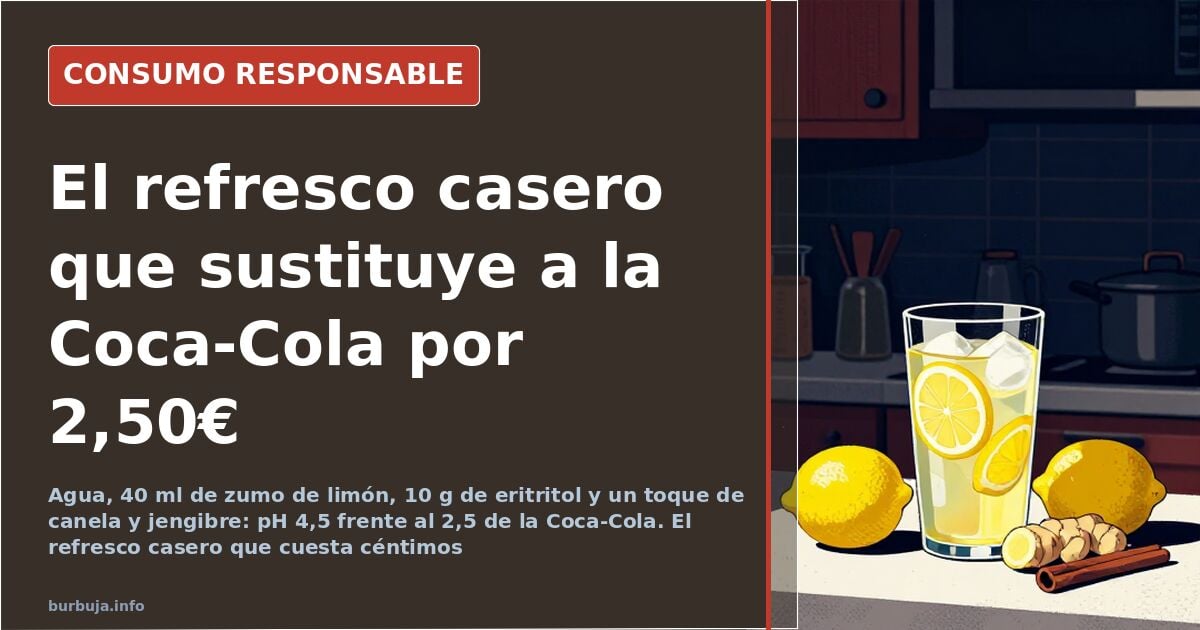
Lemon, cinnamon, and erythritol: the homemade drink beating sugar
Is it really necessary to pay for industrial sodas loaded with additives when three supermarket ingredients solve the same problem for pennies? The recipe circulating among those quitting sugary fizzy drinks uses two liters of water, 40 ml of concentrated lemon juice, 10 grams of erythritol with stevia, and a touch of Ceylon cinnamon and ground ginger. Measured with a pH meter, the result is 4.5. A Coca-Cola hovers around 2.5. Normal food sits between 5 and 6.
This isn't a diet or a fad: it is cost and damage optimization. A 500 ml bottle of lemon juice costs about €2.50 and lasts ten days to two weeks. The sweetener, 200 grams for €2.80. Cinnamon and ginger, under one euro per jar that lasts months. Preparation takes two minutes.
Why pH matters more than taste
Acidity is the central argument. Natural lemons have a pH between 2 and 3. Energy drinks hover around 3. Cola soft drinks are at 2.5. That level destroys tooth enamel and promotes bacterial growth in the mouth. The proposed mix rises to 4.5, and reducing the juice to 30 ml for two liters brings it closer to 5. The difference isn't cosmetic: it is the gap between an aggressive product and a drink behaving like ordinary food.
Some go further, arguing that in lemonade, the zest matters more than the juice because that is where the aroma lies. The accompanying advice: add it inside but don't leave it for more than a day, or the whole mixture turns bitter.
Erythritol vs. stevia: the unresolved dispute
The chosen sweetener is erythritol, not stevia. The reasoning given is that erythritol is less harmful, while pure stevia barely sweetens, is expensive, and requires large quantities. The defended ratio matches bottles sold as stevia but containing 98% erythritol and 2% steviol glycosides. Half a teaspoon equals two tablespoons of sugar.
Rebuttals arrive quickly. Some participants argue the opposite: that stevia leaf is more natural, while erythritol affects the microbiota, is linked to increased stroke risk, and causes gas and diarrhea due to fermentation. Another radical current rejects both, advocating raw honey or training the palate to enjoy unsweetened flavors. The full calculation of ratios and equivalences, with exact amounts per liter, is detailed in the original material.
Concentrated lemon and glass: debated details
Using concentrated lemon juice divides opinion. Some consider it unnecessary poison in a lemon-producing country. The practical response: squeezing daily is tiring, and concentrate keeps the base ready. The condition is that the container declares at least 99.8% pure lemon, with no additives other than some preservative. In national supermarkets, only one chain was identified with squeezed juice in glass bottles: 750 ml for €3.05, equivalent to five kilos of lemons.
Packaging matters as much as content. The recommendation is to avoid reused plastic bottles, which release phthalates and bisphenols, and switch to glass. Green oil bottles of 500 or 750 ml work for transferring juice. For water, use glass pitchers shaped to fit sideways in the fridge door.
Alternatives competing with the recipe
There is no consensus. Against the lemon, cinnamon, and ginger mix appear other formulas: cold herbal infusions from bulk herbs left overnight in the fridge, black or green tea with citrus, sparkling water with a lemon slice, water with sea salt flakes, water kefir fermented with brown sugar and dried fruit, hibiscus Jamaica water, or mango, guava, and mandarin smoothies mixed with green tea and xylitol.
The most repeated is the simplest: water, lemon, and ice. The question hovering over all of them is why the industry decided absolutely every drink must be sweet. Judging by what people prepare at home, the answer is that they don't need to be.
In the end, the perfect drink turns out to be the one you make in two minutes, not the one sold in a can. What stands out isn't that it works: it's that a treatise is needed to justify not buying it pre-made.
Is it really necessary to pay for industrial sodas loaded with additives when three supermarket ingredients solve the same problem for pennies? The recipe circulating among those quitting sugary fizzy drinks uses two liters of water, 40 ml of concentrated lemon juice, 10 grams of erythritol with stevia, and a touch of Ceylon cinnamon and ground ginger. Measured with a pH meter, the result is 4.5. A Coca-Cola hovers around 2.5. Normal food sits between 5 and 6.
This isn't a diet or a fad: it is cost and damage optimization. A 500 ml bottle of lemon juice costs about €2.50 and lasts ten days to two weeks. The sweetener, 200 grams for €2.80. Cinnamon and ginger, under one euro per jar that lasts months. Preparation takes two minutes.
Why pH matters more than taste
Acidity is the central argument. Natural lemons have a pH between 2 and 3. Energy drinks hover around 3. Cola soft drinks are at 2.5. That level destroys tooth enamel and promotes bacterial growth in the mouth. The proposed mix rises to 4.5, and reducing the juice to 30 ml for two liters brings it closer to 5. The difference isn't cosmetic: it is the gap between an aggressive product and a drink behaving like ordinary food.
Some go further, arguing that in lemonade, the zest matters more than the juice because that is where the aroma lies. The accompanying advice: add it inside but don't leave it for more than a day, or the whole mixture turns bitter.
Erythritol vs. stevia: the unresolved dispute
The chosen sweetener is erythritol, not stevia. The reasoning given is that erythritol is less harmful, while pure stevia barely sweetens, is expensive, and requires large quantities. The defended ratio matches bottles sold as stevia but containing 98% erythritol and 2% steviol glycosides. Half a teaspoon equals two tablespoons of sugar.
Rebuttals arrive quickly. Some participants argue the opposite: that stevia leaf is more natural, while erythritol affects the microbiota, is linked to increased stroke risk, and causes gas and diarrhea due to fermentation. Another radical current rejects both, advocating raw honey or training the palate to enjoy unsweetened flavors. The full calculation of ratios and equivalences, with exact amounts per liter, is detailed in the original material.
Concentrated lemon and glass: debated details
Using concentrated lemon juice divides opinion. Some consider it unnecessary poison in a lemon-producing country. The practical response: squeezing daily is tiring, and concentrate keeps the base ready. The condition is that the container declares at least 99.8% pure lemon, with no additives other than some preservative. In national supermarkets, only one chain was identified with squeezed juice in glass bottles: 750 ml for €3.05, equivalent to five kilos of lemons.
Packaging matters as much as content. The recommendation is to avoid reused plastic bottles, which release phthalates and bisphenols, and switch to glass. Green oil bottles of 500 or 750 ml work for transferring juice. For water, use glass pitchers shaped to fit sideways in the fridge door.
Alternatives competing with the recipe
There is no consensus. Against the lemon, cinnamon, and ginger mix appear other formulas: cold herbal infusions from bulk herbs left overnight in the fridge, black or green tea with citrus, sparkling water with a lemon slice, water with sea salt flakes, water kefir fermented with brown sugar and dried fruit, hibiscus Jamaica water, or mango, guava, and mandarin smoothies mixed with green tea and xylitol.
The most repeated is the simplest: water, lemon, and ice. The question hovering over all of them is why the industry decided absolutely every drink must be sweet. Judging by what people prepare at home, the answer is that they don't need to be.
In the end, the perfect drink turns out to be the one you make in two minutes, not the one sold in a can. What stands out isn't that it works: it's that a treatise is needed to justify not buying it pre-made.
Also available in: Deutsch
Summary of a discussion on Burbuja.info - Foro de economía, actualidad y política., translated from Spanish and reviewed before publication. Read the full discussion (120 replies).
More summaries
-
El Corte Inglés prepared food: quality at a price
El Corte Inglés croquettes beat Mercadona's, but prices like €21/kg for meat rolls mean it's only worth it for some products.
-
El Corte Inglés delivers in 3 hours, undercutting Amazon by €30
Smartwatch delivered in three hours and €30 cheaper than Amazon: cases challenging El Corte Inglés' expensive reputation.
-
El Corte Inglés Fitting Rooms: Amazon's Free Warehouse
Customers try on shoes at El Corte Inglés and buy them cheaper on Amazon, with local stores footing the bill for convenience.
-
DeepSeek vs Gemini: Best Free AI Models
Comparison of DeepSeek and Gemini as top free AIs for document analysis, coding, and daily tasks. Which one wins without paying?
-
User leaves Xiaomi after eight years due to software
After four and a half years with a Redmi 9T, a user switches to a €99 Motorola G05 citing Xiaomi's ad-ridden software.
-
Cutting Sugar and Refined Flour: A Growing Trend Against Weight Gain
A forum thread with over 12,800 posts argues that eliminating sugar and refined flour aids weight loss without calorie counting. Focuses on insulin, cholesterol, and hormonal balance.