
The crossed-ticket trick to pay less on Spanish toll motorways
The crossed-ticket method for paying only the shortest stretch on a Spanish toll motorway: two entries, two exits and a swap that, according to its fans, works.
English · Original discussion in Spanish · Published
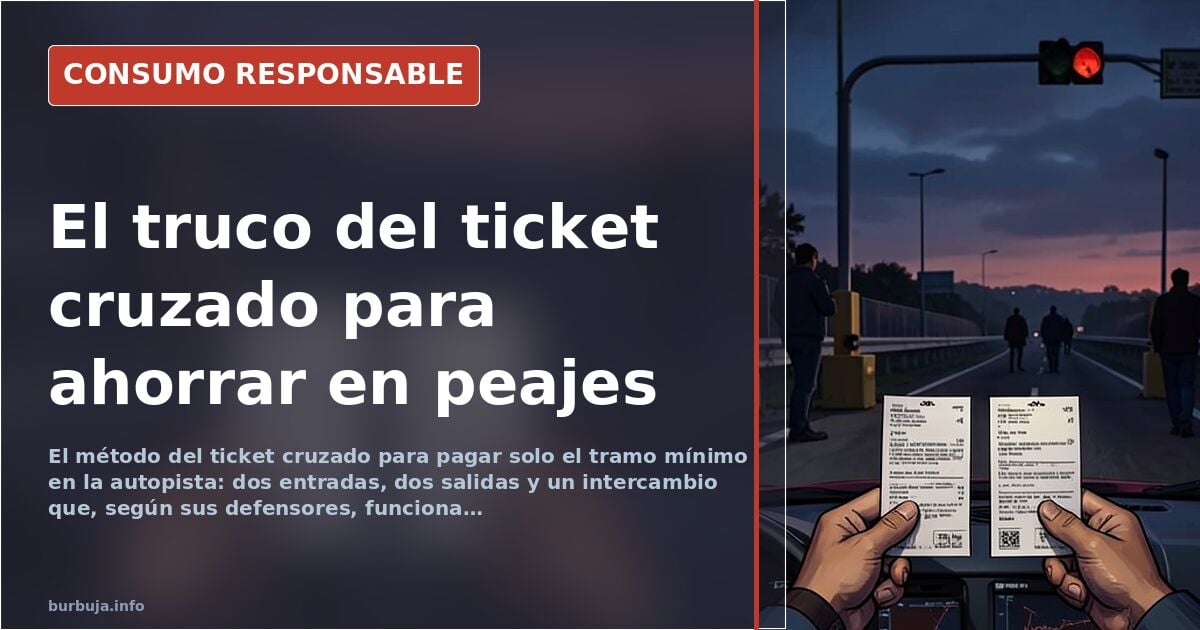
The crossed-ticket trick to pay less on Spanish toll motorways
There is a way to use the motorway paying only for the last stretch. The method, described in detail on a Spanish consumer forum, involves swapping entry tickets between two round trips so the system always charges the shortest route. The key, according to this version, is that toll tickets only record the entry point, not the date or time. One user claims to have used the trick for three years on the AP-7 without any problems. The discussion then turned to the legality, ethics and real effectiveness of the system.
The method: two entries and two exits to pay the minimum stretch
The system requires a regular route with at least two different entries and two different exits. You enter at entrance A, take a ticket, and exit at exit B, handing over a ticket from an earlier entry. That way you only pay for the stretch between A and B, not the full journey. The next day you do the same in the opposite direction. The result is continuous savings. To get started, you have to exit once with a ticket in your pocket: you can claim you lost it and pay the full fare, or use a borrowed VIA-T device. According to the account of someone who uses the trick, the initial cost pays for itself in the first week.
Do toll tickets store the date and time?
The premise of the trick is that tickets only contain the place of issue. One participant states it flatly: "It's been proven that the ticket only contains the place of issue, no date or time." However, another participant denies this and argues that tickets do have the date and time recorded, and that there is a maximum travel time calculated between toll plazas. He adds that the charging systems are connected to databases of lost or stolen cards. The discrepancy is never resolved in the discussion. A third message points out that on the AP-7, between Xeresa/Oliva and Benidorm/Finestrat, the trick stopped working years ago. Uncertainty about the method's real scope hangs over the entire exchange.
From the crossed ticket to tailgating through the barrier: other ways of not paying
The repertoire of tricks keeps growing. Someone describes how people have dodged tolls by tailgating a lorry or a 4x4 when passing through the barrier. The manoeuvre involves setting off right behind the large vehicle, taking advantage of its momentum. Another participant explains that he positions himself in front of the barrier and doesn't move off until it lowers, enraging the driver behind him. The swapping of tickets between two drivers travelling in opposite directions who meet halfway is also mentioned. These are all variations on the same goal: cutting the cost of the toll through deception.
The ethical dimension and the real cost of the fraud
The discussion drifts towards sarracena. One message accuses Spaniards of being "a pack of swindlers and thieves" and wishes the author of the trick gets fired. The reply is not long in coming: "I don't feel Spanish, nor a swindler nor a thief. I feel Catalan, swindled and robbed." The exchange of accusations reveals a tension between those who see the fraud as a serious offence and those who interpret it as a response to abusive prices. The underlying question is whether the toll system is fair or, on the contrary, invites people to look for loopholes.
The future of the trick: between impunity and technological upgrades
The possibility that the toll operators update the system to record the date and time on tickets is raised as a threat. One participant argues that upgrading the entire IT system won't be worth it just because of "a few idiots" who cheat. Another points out that on the AP-7 they have already got their act together. The conversation ends without any clear conclusion about the method's long-term viability. What remains is a portrait of everyday petty trickery and distrust of toll motorways.
The motorway remains an expensive service for many. And as long as there are tickets that only record the entry point, the swapping trick will have its fans.
Also available in: Deutsch
Summary of a discussion on Burbuja.info - Foro de economía, actualidad y política., translated from Spanish and reviewed before publication. Read the full discussion (40 replies).
More summaries
-
Endesa's 2 free hours: the catch is in the other 22
Endesa's Tempo Happy tariff gives away two hours of electricity and makes the other 22 more expensive. The circulating calculation: €0.140/kWh versus the €0.060/kWh of…
-
O2 offers 10 TB of free cloud storage, but there's a 4 GB catch
O2 is giving away 10 TB of cloud storage in Spain, but with a 4 GB limit per file. We compare it with Digi and Movistar and assess whether it's worth it.
-
DGT Vehicle Report Scam: Charging €24 for an €8 Service
A sponsored website charges €24 for a DGT report that costs €8. The scheme uses Carmen Mariscal's name as the applicant.
-
El Corte Inglés prepared food: quality at a price
El Corte Inglés croquettes beat Mercadona's, but prices like €21/kg for meat rolls mean it's only worth it for some products.
-
Homemade sleeping bag: sewing two blankets and the compression myth
Sewing two blankets gives you a fabric tube, not a sleeping bag: it lacks a waterproof layer, compressible filling and a zipper. The DIY version keeps you warm, but it won't fit in a backpack.
-
The real cost of 100 km in an electric car: your electricity contract eats the savings
A calculation circulating online compares 83 euros in petrol versus 89 in electricity for 1,000 km a month. The contracted power and fixed charge decide the outcome.